

Thursday 13 March 2025
Scientists have made a significant breakthrough in developing a new type of quantum sensor that can detect even the tiniest changes in magnetic fields under extreme conditions. The sensor, which uses defects in a material called hexagonal boron nitride (hBN), is capable of measuring the strength and direction of magnetic fields with unprecedented precision.
The development of this sensor has important implications for scientists studying complex phenomena such as superconductivity and magnetism. These phenomena are crucial to understanding many fundamental processes in physics, from the behavior of atoms and molecules to the workings of the universe itself.
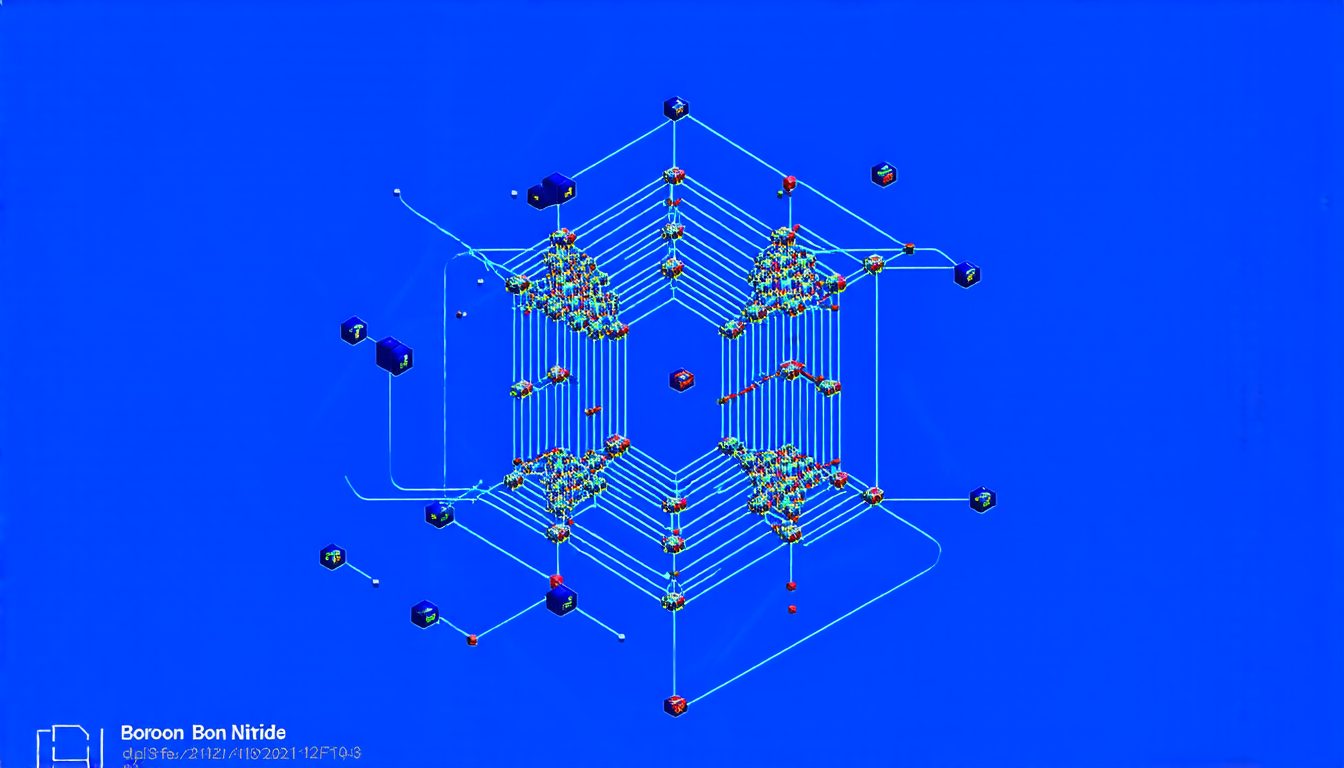
The new sensor uses a type of defect called a boron vacancy (V-B) that is created when a boron atom is removed from the hBN lattice. This defect has unique spin properties that make it extremely sensitive to external magnetic fields. By shining light on the V-B defects, scientists can detect even slight changes in the magnetic field and measure its strength with unprecedented precision.
One of the key challenges in developing this sensor was finding a material that could withstand the extreme conditions under which it would be used. The team discovered that hBN is ideal for this purpose because it is incredibly robust and can maintain its structure even at very high pressures.
To test the sensor, scientists subjected it to a range of magnetic fields, from weak to strong, and measured its response. They found that the sensor was able to detect changes in the magnetic field with incredible precision, down to levels as small as 0.24 millitesla per square root of hertz.
The implications of this breakthrough are significant. For example, scientists studying superconductors could use the new sensor to measure the tiny changes in magnetic fields that occur when these materials transition from a normal state to a superconducting state. This would allow them to better understand the fundamental physics underlying these phenomena and potentially develop more efficient and powerful superconductors.
Similarly, the sensor could be used to study the behavior of magnetic materials under extreme conditions, such as high pressure or temperature. This would provide valuable insights into the properties of these materials and could lead to the development of new technologies with a wide range of applications.
The development of this sensor is also an important step towards the creation of more advanced quantum sensors that can be used in a wide range of fields. By pushing the boundaries of what is possible with quantum sensing, scientists are opening up new avenues for research and discovery that were previously inaccessible.
Cite this article: “Breakthrough Quantum Sensor Enables Precise Detection of Magnetic Fields Under Extreme Conditions”, The Science Archive, 2025.
Quantum Sensor, Hexagonal Boron Nitride, Magnetic Fields, Superconductivity, Magnetism, Defects, Spin Properties, Precision Measurement, High Pressure, Extreme Conditions





