

Friday 14 March 2025
Scientists have long been searching for a way to detect dark photons, hypothetical particles that could make up part of dark matter. Dark matter is an invisible substance that makes up about 27% of the universe, but its exact nature remains unknown.
Recently, researchers from the Hong Kong University of Science and Technology proposed a new method for detecting these elusive particles using polarimetry, which involves measuring the orientation of light waves. This approach could potentially reveal the presence of dark photons by analyzing the polarization patterns in light emitted by supermassive black holes at the centers of galaxies.
The team’s idea is based on the concept that dark photons would interact with regular photons, causing a subtle change in their polarization patterns. By studying these patterns, scientists might be able to distinguish between light modified by dark photons and unmodified light.
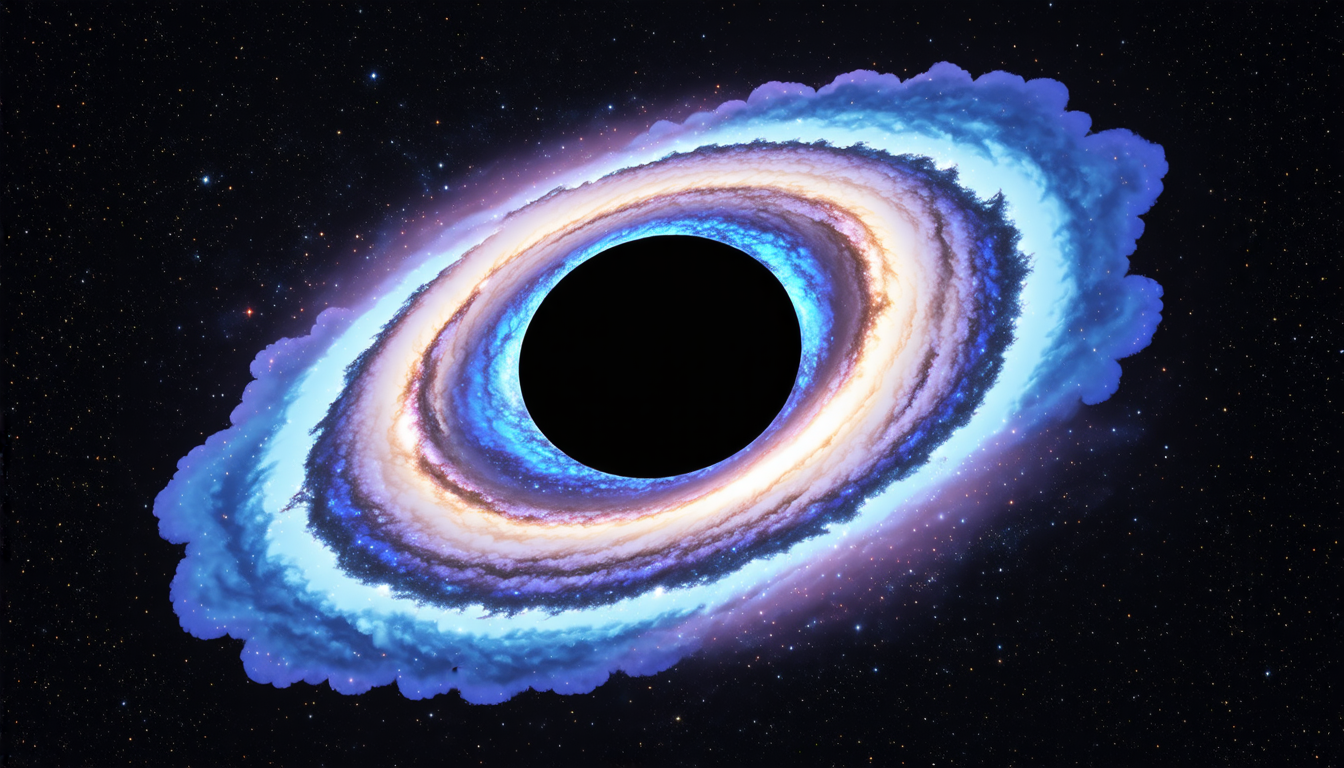
To test this theory, the researchers used data from the Event Horizon Telescope (EHT), which captured high-resolution images of the supermassive black hole at the center of the galaxy M87. The EHT uses a network of telescopes around the world to form a virtual Earth-sized telescope, allowing it to capture incredibly detailed images of distant objects.
The team analyzed the polarization patterns in the light emitted by M87’s black hole and found that they could set limits on the presence of dark photons. These limits are significant because they suggest that if dark photons exist, their mass would need to be extremely low – much lower than previously thought.
This study is exciting not only because it provides new insights into dark matter but also because it demonstrates the potential power of polarimetry in detecting unknown particles. The technique could potentially be applied to other areas of astrophysics and cosmology, such as studying the properties of black holes or searching for signs of extraterrestrial life.
While this research is still in its early stages, it has already sparked a lot of interest in the scientific community. As researchers continue to explore the possibilities of dark photons, they may uncover new secrets about the universe and our place within it.
Cite this article: “Detecting Dark Photons: A New Approach using Polarimetry”, The Science Archive, 2025.
Dark Matter, Dark Photons, Polarimetry, Black Holes, Galaxies, Event Horizon Telescope, Eht, Hong Kong University Of Science And Technology, Astrophysics, Cosmology





