

Friday 14 March 2025
Scientists have long been fascinated by the relationship between chaos and quantum mechanics. In a new study, researchers have made a significant breakthrough in understanding how chaotic behavior can emerge in simple quantum systems.
The study focuses on a type of quantum walk, a phenomenon where a particle moves through space in a random and unpredictable manner. Quantum walks are often used to model complex systems, such as the behavior of particles in magnetic fields or the spread of information through networks.
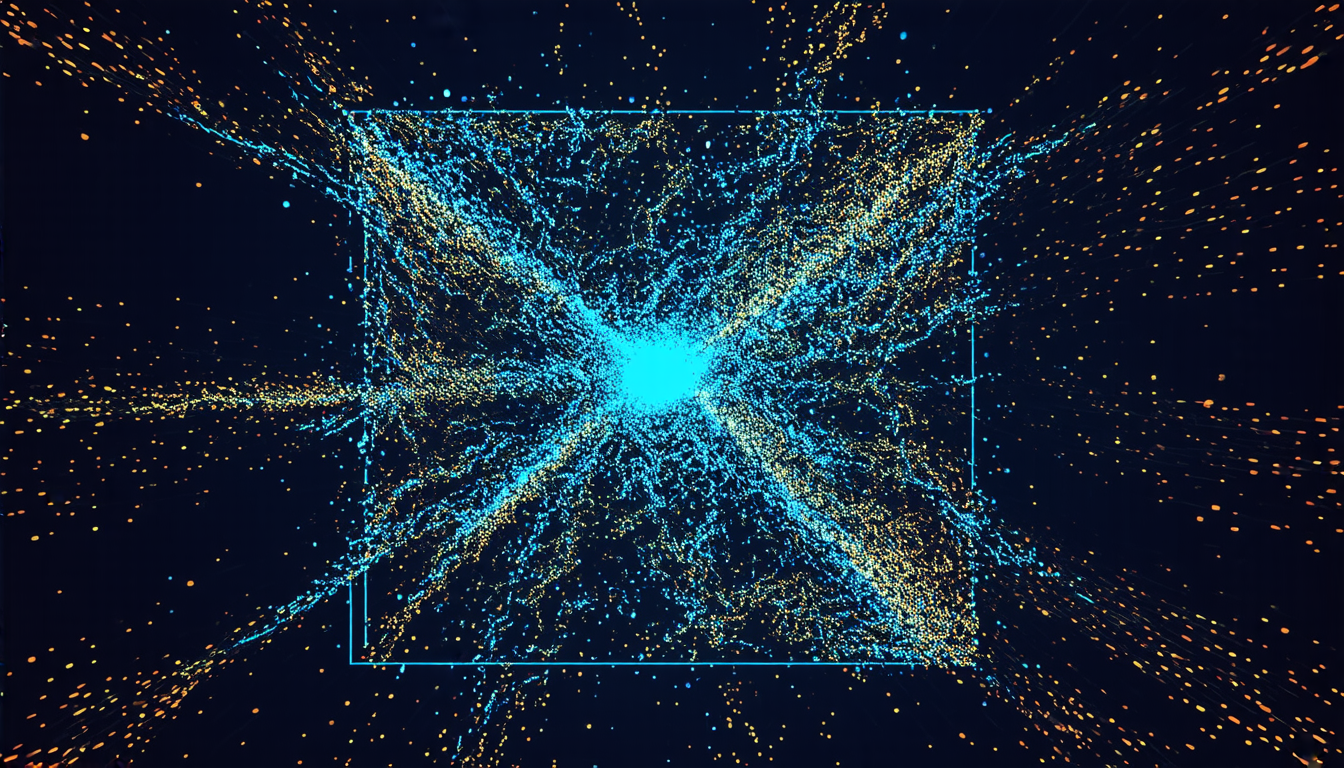
In this research, scientists created a two-dimensional quantum walk, where the particle moved through a square-shaped domain with different boundaries. They found that when they introduced chaotic features into the system, such as irregularly shaped boundaries, it led to emergent chaos in the behavior of the particle.
The researchers used a simple model to simulate the behavior of the particle, which consisted of alternate one-dimensional walks along the two spatial coordinates of the bidimensional domain. They then analyzed the properties of the eigenfunctions, or the patterns of probability density, of the system.
One key finding was that the chaotic features led to strong scarring phenomena, where the particle became localized on specific structures within the domain. This is in contrast to traditional quantum chaos models, which often involve more complex systems and are less easily observable.
The study’s authors suggest that their findings could have implications for a wide range of fields, from quantum computing to search algorithms. For example, they propose that simple quantum walks with chaotic features could be used to improve the efficiency of search algorithms or even create new types of quantum computers.
Another potential application is in the study of complex systems, where chaotic behavior can often make it difficult to predict outcomes. By understanding how chaos emerges in simple quantum systems, researchers may be able to develop new tools and techniques for analyzing more complex systems.
The authors also point out that their findings could have implications for our understanding of the relationship between classical and quantum mechanics. For example, they suggest that chaotic behavior in quantum systems may not always arise from the same underlying mechanisms as in classical systems.
Overall, this study provides a fascinating glimpse into the complex interplay between chaos and quantum mechanics. By exploring these phenomena in simple systems, researchers may be able to unlock new insights and applications in a wide range of fields.
Cite this article: “Unlocking Chaos: New Insights into Quantum Systems”, The Science Archive, 2025.
Quantum Mechanics, Chaos Theory, Quantum Walk, Particle Behavior, Magnetic Fields, Networks, Eigenfunctions, Scarring Phenomena, Search Algorithms, Quantum Computing





