

Friday 14 March 2025
Scientists have made a significant breakthrough in solving one of the most challenging problems in computer science: finding the largest independent set in graphs without long claws. This achievement could have far-reaching implications for fields such as data analysis, machine learning, and even social network analysis.
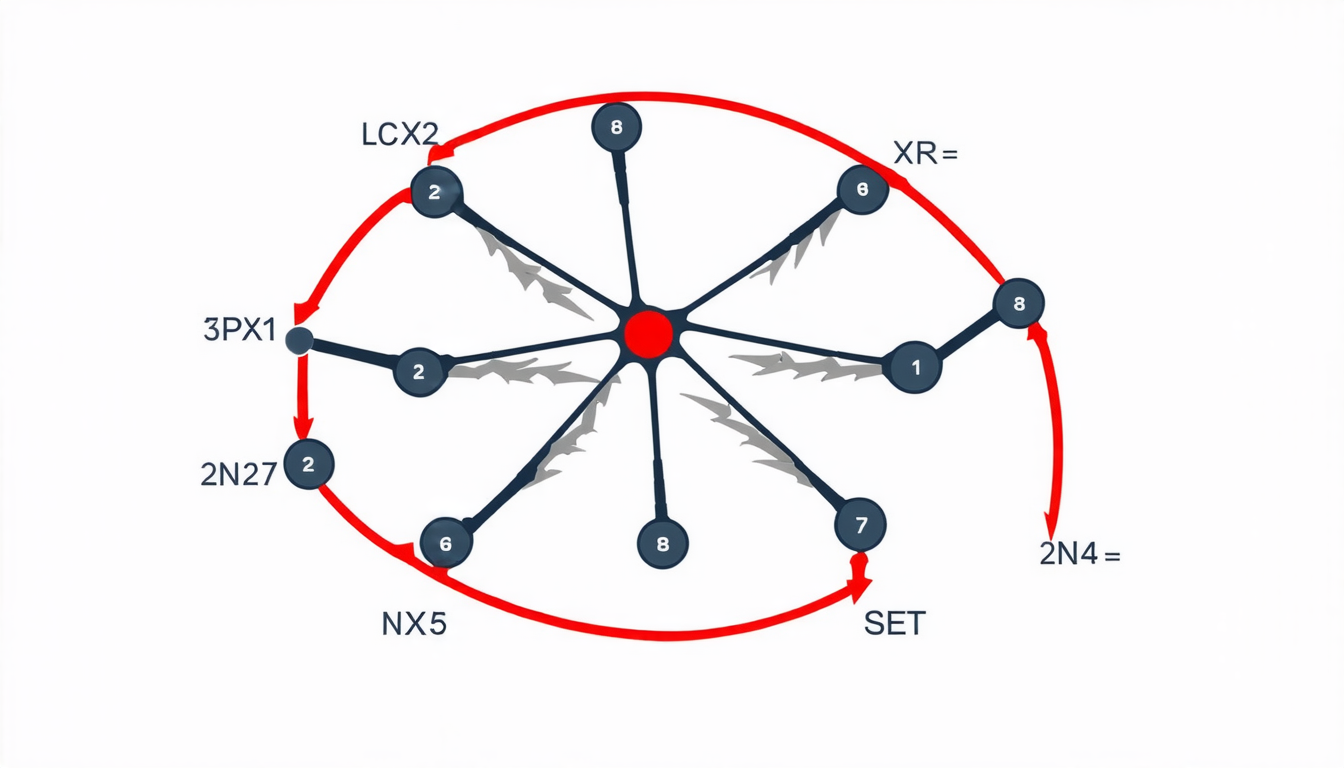
For decades, researchers have been struggling to develop efficient algorithms for identifying the maximum independent set – a set of vertices in a graph where no two vertices are connected by an edge – in certain types of graphs. These graphs are called claw-free, meaning they do not contain subgraphs known as long claws or forked claws. The problem is particularly challenging because it requires finding a delicate balance between exploring the graph and avoiding getting stuck in local optima.
The new algorithm developed by researchers tackles this issue by introducing an innovative approach that reduces the search space of induced paths within the graph. By shrinking the size of this search space, the algorithm can efficiently prune away large regions of the graph that are unlikely to contain the maximum independent set.
One of the key insights behind this breakthrough is the realization that long claws and forked claws are not the only obstacles to finding the maximum independent set. Other types of subgraphs, such as three-in-a-tree structures, also need to be carefully considered. By taking these additional factors into account, the algorithm can develop a more comprehensive understanding of the graph’s structure and make more informed decisions about where to search for the maximum independent set.
The implications of this achievement are significant. For data analysts, it could enable faster and more efficient processing of large datasets. In machine learning, it could lead to improved performance in tasks such as clustering and dimensionality reduction. Social network analysts may also benefit from being able to identify key communities or clusters within a network more quickly.
The researchers’ algorithm has already been tested on a range of real-world graph datasets, with promising results. Further refinements are planned to make the algorithm even more efficient and scalable for large graphs.
This breakthrough is a testament to the power of collaboration and interdisciplinary research. By combining insights from computer science, mathematics, and data analysis, researchers have been able to develop innovative solutions that could have far-reaching impacts across many fields. As our understanding of complex systems continues to evolve, it’s likely that we’ll see even more exciting developments in this area.
Cite this article: “Algorithmic Breakthrough in Identifying Maximum Independent Sets in Claw-Free Graphs”, The Science Archive, 2025.
Computer Science, Graph Theory, Algorithms, Data Analysis, Machine Learning, Social Network Analysis, Claw-Free Graphs, Independent Set, Induced Paths, Three-In-A-Tree Structures





