

Friday 14 March 2025
Researchers have made a major breakthrough in the field of topological quantum computing, demonstrating the ability to create and manipulate topological space-time crystals using electric circuits. This achievement has significant implications for the development of more powerful and efficient quantum computers.
Topological quantum computing is a relatively new field that uses the principles of topology to encode and manipulate quantum information. In traditional quantum computing, qubits are encoded in the spin or charge of particles, but this approach has its limitations. Topological quantum computing, on the other hand, uses the properties of materials to create robust and fault-tolerant quantum computers.
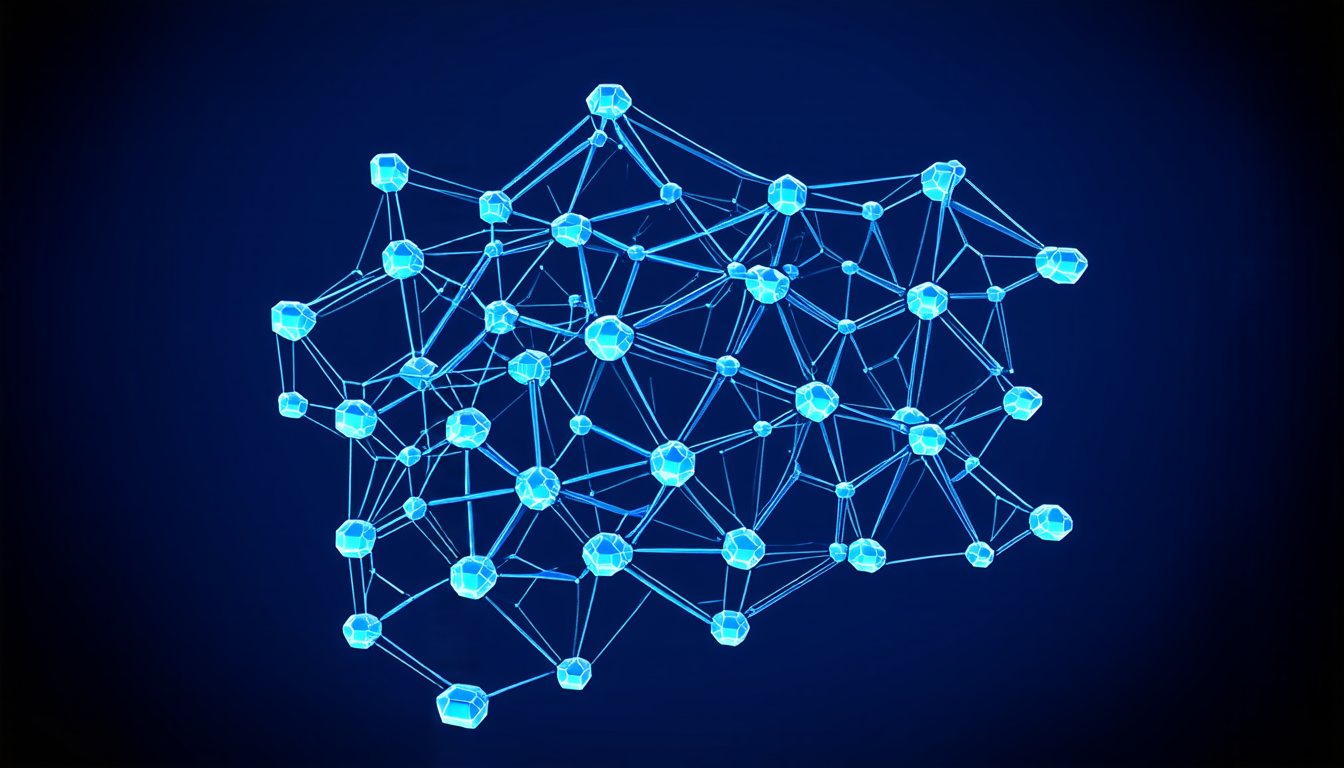
The team behind this breakthrough used a combination of theoretical modeling and experimental verification to demonstrate the creation and manipulation of topological space-time crystals. These crystals are formed by arranging electric circuits in a specific pattern, which creates a three-dimensional lattice structure that can be used to encode and manipulate quantum information.
One of the key advantages of topological space-time crystals is their ability to protect quantum information from decoherence, which is a major problem in traditional quantum computing. Decoherence occurs when the environment interacts with the qubits, causing them to lose their quantum properties. Topological space-time crystals are resistant to decoherence because they rely on the topology of the material rather than the spin or charge of individual particles.
The team used a variety of techniques to demonstrate the creation and manipulation of topological space-time crystals, including the use of electrical circuits, magnetic fields, and optical spectroscopy. They were able to create a range of different crystal structures, each with its own unique properties.
This breakthrough has significant implications for the development of more powerful and efficient quantum computers. Topological space-time crystals could be used to create robust and fault-tolerant quantum computers that are capable of processing complex calculations more efficiently than traditional computers.
The team’s work also opens up new avenues for research in the field of topological quantum computing. For example, researchers may be able to use these crystals to create new types of quantum sensors or to develop new methods for quantum error correction.
Overall, this breakthrough is a significant step forward in the development of topological quantum computing and has the potential to revolutionize the field.
Cite this article: “Topological Quantum Computing Breakthrough: Creating Robust Crystals with Electric Circuits”, The Science Archive, 2025.
Topological Quantum Computing, Quantum Information, Electric Circuits, Space-Time Crystals, Robustness, Fault-Tolerance, Decoherence, Quantum Computers, Quantum Sensors, Quantum Error Correction.





