

Friday 14 March 2025
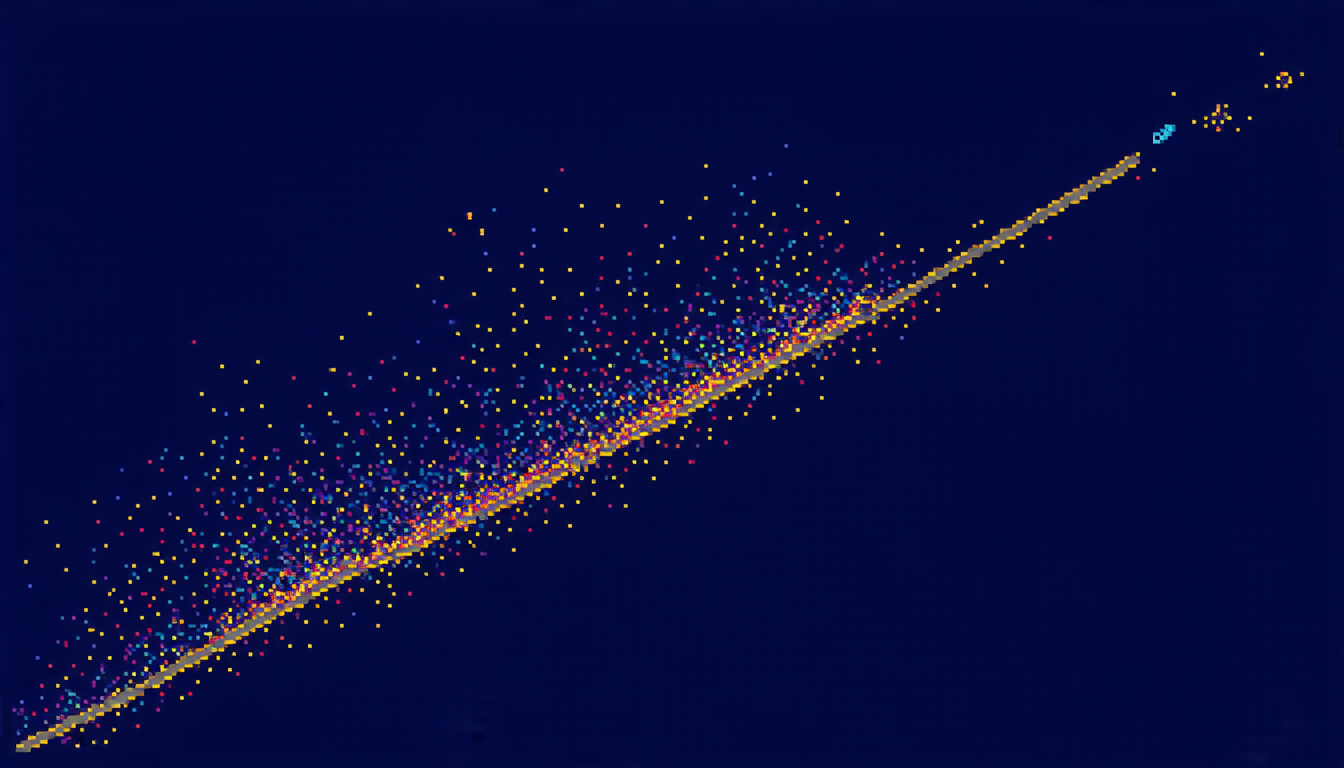
The Bullet Process has long been a fascinating phenomenon in physics, where particles move along a one-dimensional track and collide with each other, leading to annihilation. Researchers have been trying to understand the behavior of these particles for decades, but a crucial piece of information remained elusive: the critical velocity, or the slowest speed at which a particle can survive.
Recently, mathematicians made significant progress in understanding this phenomenon. By analyzing the patterns of collisions and annihilations, they were able to determine that the critical velocity is not a fixed value, but rather depends on the distribution of velocities among the particles.
One of the key findings was that when the velocity distribution has finite support – meaning there is a maximum speed beyond which particles cannot reach – then infinitely many particles can survive. This seems counterintuitive, as one would expect the faster particles to dominate and annihilate the slower ones. However, the mathematicians showed that this is not the case, and that the slowest particles can actually outlast their faster counterparts.
The researchers also demonstrated that when the velocity distribution has infinite support – meaning there is no maximum speed – then only finitely many particles can survive. This makes sense, as one would expect the fast-moving particles to eventually dominate and annihilate all others.
Another important finding was that the probability of a particle surviving decreases continuously as its velocity increases. This means that even if a particle is not the slowest in the system, it may still have a chance to survive if its velocity is close enough to the critical value.
The implications of these findings are far-reaching. They could help us better understand complex systems where particles interact with each other, such as in chemical reactions or biological processes. They could also inspire new approaches to modeling and simulating these systems.
In addition, the research highlights the importance of considering the distribution of velocities among particles. In many cases, this is overlooked in favor of focusing on individual particle properties. However, our understanding of complex systems is often incomplete without taking into account the interactions and distributions among particles.
The study of the Bullet Process may seem esoteric at first glance, but it has significant implications for our understanding of complex phenomena in physics and beyond. By unraveling the mysteries of this phenomenon, researchers are shedding light on the intricate dance of particles and helping us better grasp the workings of the universe around us.
Cite this article: “Unveiling the Secrets of the Bullet Process”, The Science Archive, 2025.
Physics, Bullet Process, Particle Collisions, Annihilation, Critical Velocity, Velocity Distribution, Finite Support, Infinite Support, Probability, Complex Systems
Reference: Josh Meisel, “The critical velocity of the bullet process appears pathwise” (2025).





