

Friday 14 March 2025
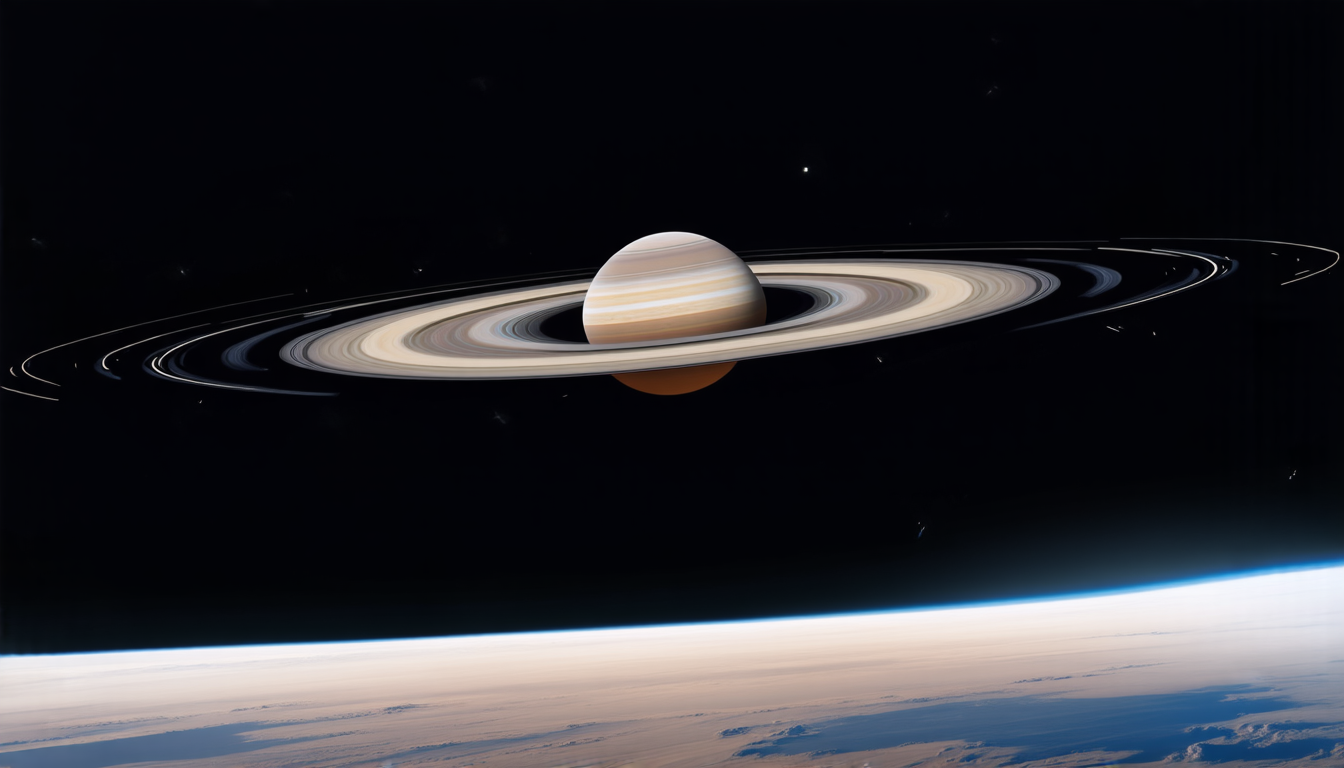
The intricate dance of Saturn’s small moons has long fascinated astronomers and planetary scientists alike. Among these, one moon in particular stands out for its unique orbital behavior: Atlas. This tiny satellite, measuring just 30 kilometers across, is trapped in a complex web of gravitational interactions with its larger neighbors.
Saturn’s inner ring system is home to numerous small moons, each orbiting the planet at different distances and speeds. As these moons interact with one another, they create a delicate balance of forces that govern their motions. For Atlas, this means being pulled into a 54:53 resonance with Prometheus, a larger moon that orbits Saturn every 14.5 Earth days.
The resonance between Atlas and Prometheus is what makes its orbit so fascinating. As the two moons interact, Atlas’s path is influenced by Prometheus’s gravitational tug, causing it to oscillate in a unique pattern. This behavior has been observed and studied by astronomers, who have used computer simulations to map out the intricate dance of gravitational forces at play.
Recently, scientists have taken a closer look at Atlas’s orbital dynamics, exploring how its interactions with other moons affect its motion. One of these moons is Pandora, another small satellite that orbits Saturn in a more distant path. While Pandora doesn’t have a significant impact on Atlas’s orbit, the combined effects of both moon’s gravitational influence create a complex pattern of resonance and chaos.
By studying these interactions, scientists can gain insights into the formation and evolution of our solar system. The moons of Saturn are like tiny time capsules, preserving clues about the planet’s early history and the processes that shaped its inner ring system. Atlas, in particular, offers a unique window into this past, as its orbital behavior is influenced by the gravitational forces that acted on it during its formation.
The study of Atlas’s orbit also has implications for our understanding of chaos theory. In complex systems like planetary orbits, small changes can have significant effects on the overall motion. The resonance between Atlas and Prometheus is a prime example of this principle in action, as even tiny variations in their orbital paths can lead to dramatic changes in Atlas’s behavior.
As scientists continue to study Saturn’s inner ring system, they are likely to uncover even more secrets about the intricate dance of gravitational forces at play. Atlas may be a small moon, but its unique orbit holds important clues about the formation and evolution of our solar system. By exploring these mysteries, astronomers can gain a deeper understanding of the complex interactions that shape the universe around us.
Cite this article: “The Intricate Dance of Saturns Small Moons”, The Science Archive, 2025.
Saturn, Moons, Atlas, Prometheus, Orbital Dynamics, Chaos Theory, Gravitational Forces, Resonance, Planetary Science, Astronomy





