

Friday 14 March 2025
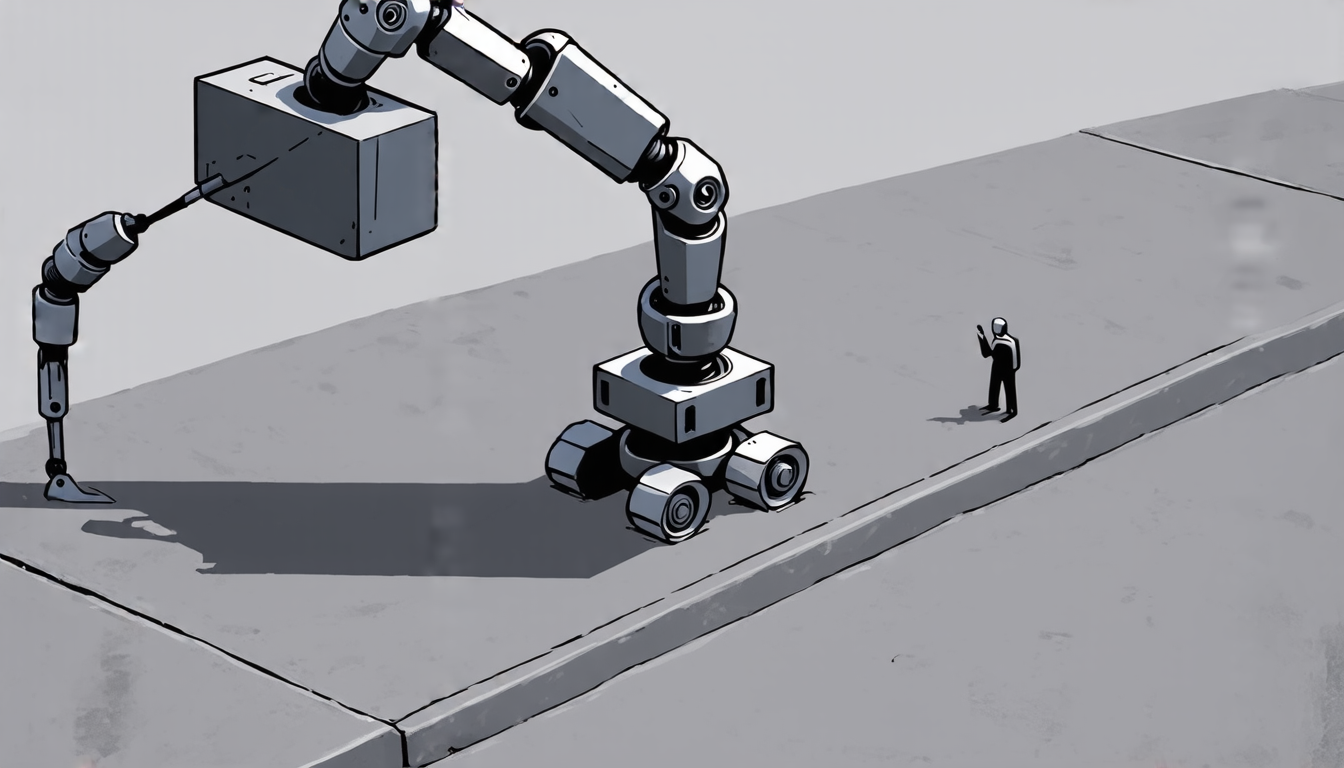
Robotics has long been a staple of manufacturing and industry, but its applications in construction have been limited by the need for precise positioning and navigation. To overcome this challenge, researchers have developed advanced sensors and algorithms to enable robots to accurately locate themselves on complex construction sites.
A recent study published in IEEE Robotics and Automation Letters presents a novel approach to robotic stationing that leverages high-accuracy accelerometers to compensate for deflections and backlash in robotic arms. The authors’ method integrates a physically informed deflection model with sensor data to achieve significant improvements in positioning accuracy.
The issue of deflection is particularly critical in construction, where robots must navigate complex structures and workspaces. Traditional methods rely on simplified models that assume constant joint stiffness, but real-world joints exhibit nonlinear behavior that can lead to inaccuracies. The authors’ approach addresses this limitation by modeling the robot’s joints as four-bar linkages, which better capture the complex dynamics of joint motion.
The accelerometers play a crucial role in the system, providing precise measurements of the robot’s movement and enabling the deflection model to adapt to changing conditions. This allows the robot to adjust its position in real-time, ensuring accurate placement of materials and tools.
The authors tested their approach on a variety of datasets, including simulations and real-world construction scenarios. The results show that the system can achieve positioning accuracy within 3mm, even in complex environments with multiple obstacles and dynamic conditions.
This breakthrough has significant implications for the construction industry, enabling robots to work more efficiently and accurately in challenging environments. As automation continues to transform construction, this research paves the way for more sophisticated and reliable robotic systems that can improve productivity, safety, and quality on-site.
In the future, it’s likely that we’ll see even more advanced sensors and algorithms integrated into robotic systems, further expanding their capabilities and reliability. For now, however, this innovative approach represents a major step forward in enabling robots to work effectively in complex construction environments.
Cite this article: “Advanced Sensors and Algorithms Enable Robotic Stationing in Complex Construction Environments”, The Science Archive, 2025.
Robotics, Construction, Positioning, Navigation, Accelerometers, Deflection, Backlash, Robotic Arms, Joint Motion, Sensors





