

Friday 14 March 2025
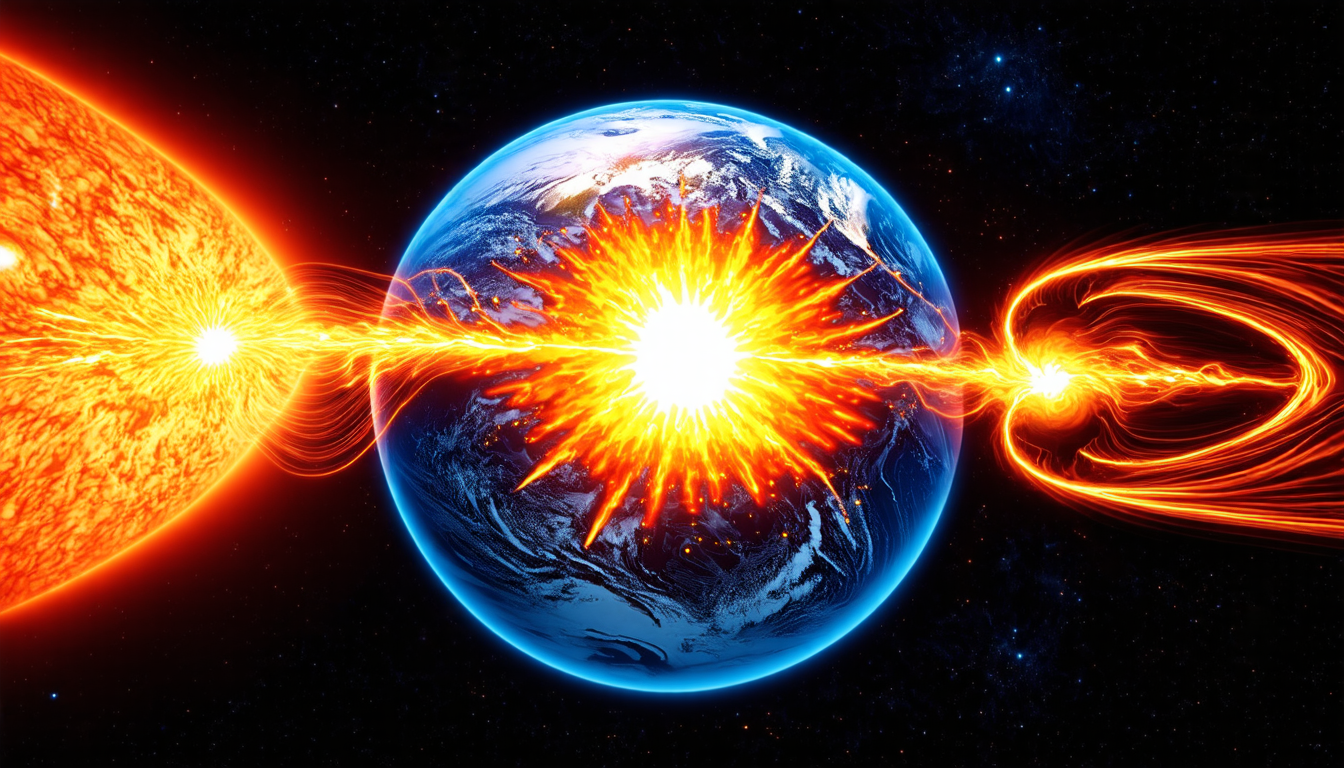
A pair of powerful solar explosions has been studied in unprecedented detail, revealing new insights into the complex dance between our star and its closest planetary neighbor.
The events in question are coronal mass ejections (CMEs), massive bursts of energy that erupt from the sun’s corona and can have far-reaching consequences for Earth. These particular CMEs occurred in November and December 2023, and scientists have been analyzing data collected by a range of spacecraft and ground-based observatories to better understand their behavior.
One key finding is that these CMEs were unusually powerful, with speeds reaching over 1,000 kilometers per second – significantly faster than average. This velocity is significant because it affects how the CME interacts with Earth’s magnetic field, leading to more intense geomagnetic storms.
The research team used a combination of computer simulations and observations from spacecraft like NASA’s Solar Dynamics Observatory and the European Space Agency’s Proba-2 mission to reconstruct the events in stunning detail. By analyzing the motion and behavior of the CMEs as they traveled through space, scientists were able to identify key features that influence their impact on Earth.
One important factor is the way the CME interacts with other magnetic structures in space, such as solar wind streams and coronal holes. These interactions can cause the CME to change direction or speed, affecting its ability to interact with Earth’s magnetic field.
The study also highlights the importance of timing in determining the severity of a geomagnetic storm. When a CME arrives at Earth’s magnetic field just right, it can create a powerful shockwave that triggers spectacular aurora displays and disrupts communication systems. However, if the CME arrives when the magnetic field is already disturbed, its impact may be reduced.
By studying these complex interactions in unprecedented detail, scientists hope to improve their ability to predict when and how CMEs will affect Earth. This knowledge can help us better prepare for geomagnetic storms, which can have significant impacts on our daily lives and technological systems.
The research also sheds light on the intricate relationships between the sun, its corona, and the solar wind – a topic that is still not fully understood. By continuing to study these powerful solar explosions, scientists may uncover new insights into the underlying mechanisms that drive the sun’s activity and shape our planet’s magnetic field.
Cite this article: “Unraveling the Complexity of Solar Explosions”, The Science Archive, 2025.
Solar, Explosions, Coronal Mass Ejections, Cmes, Nasa, Esa, Solar Dynamics, Geomagnetic Storms, Aurora, Magnetic Field.





