

Friday 14 March 2025
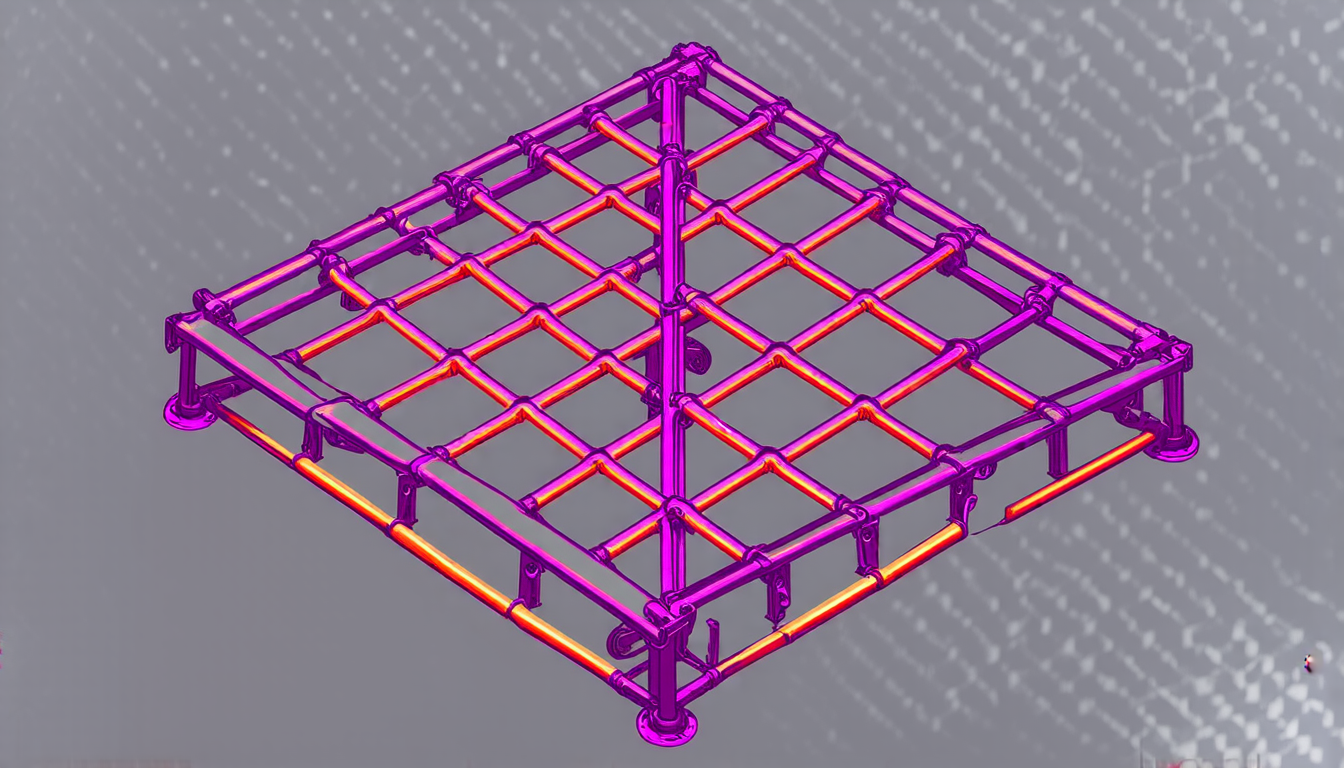
Scientists have made a significant breakthrough in the development of advanced materials, specifically lattice structures that can withstand extreme stress and pressure. Lattice structures are three-dimensional networks of struts that are used in various applications such as aerospace, energy storage, and biomedical devices.
Traditionally, lattice structures have been made from materials like aluminum or titanium, which have limitations in terms of their strength-to-weight ratio. However, researchers have now successfully created lattice structures using a defect-tolerant binary alloy called Ti-14Mo. This alloy has shown remarkable properties, including high strength, good ductility, and excellent energy absorption capacity.
The research team used an additive manufacturing technique called powder bed fusion (PBF) to create the lattice structures. PBF is a 3D printing process that allows for complex geometries and precise control over material properties.
The researchers created three different microstructures using the Ti-14Mo alloy: a two-phase alpha-beta microstructure, a beta-metastable microstructure, and a beta-metastable microstructure with nanoprecipitation of omega phase. Each microstructure has unique properties that affect the behavior of the lattice structure under compression.
The study found that the beta-metastable microstructure exhibited an excellent energy absorption capacity, with up to 80% efficiency in absorbing energy during compression. This is significant because it means that these lattice structures can be designed to withstand extreme stress and pressure without compromising their structural integrity.
In contrast, the two-phase alpha-beta microstructure showed a more unstable post-yielding behavior, with sudden drops in stress and strain localization. The beta-metastable microstructure with nanoprecipitation of omega phase exhibited an intermediate behavior, with a higher strength but reduced energy absorption capacity compared to the pure beta-metastable microstructure.
The researchers believe that these findings have important implications for the development of advanced materials and structures. By tuning the microstructure of lattice structures using defect-tolerant alloys like Ti-14Mo, it may be possible to create materials with unprecedented properties.
For example, lattice structures with high energy absorption capacity could be used in impact-resistant applications such as crash zones in vehicles or protective gear for athletes. Lattice structures with high strength-to-weight ratio could be used in aerospace and biomedical devices where weight reduction is critical.
The study highlights the potential of additive manufacturing techniques like PBF to create complex geometries and microstructures that are not possible with traditional manufacturing methods.
Cite this article: “Advances in Lattice Structure Materials Through Additive Manufacturing”, The Science Archive, 2025.
Lattice Structures, Advanced Materials, Ti-14Mo Alloy, Powder Bed Fusion, Pbf, 3D Printing, Microstructures, Energy Absorption Capacity, Strength-To-Weight Ratio, Additive Manufacturing.





