

Friday 14 March 2025
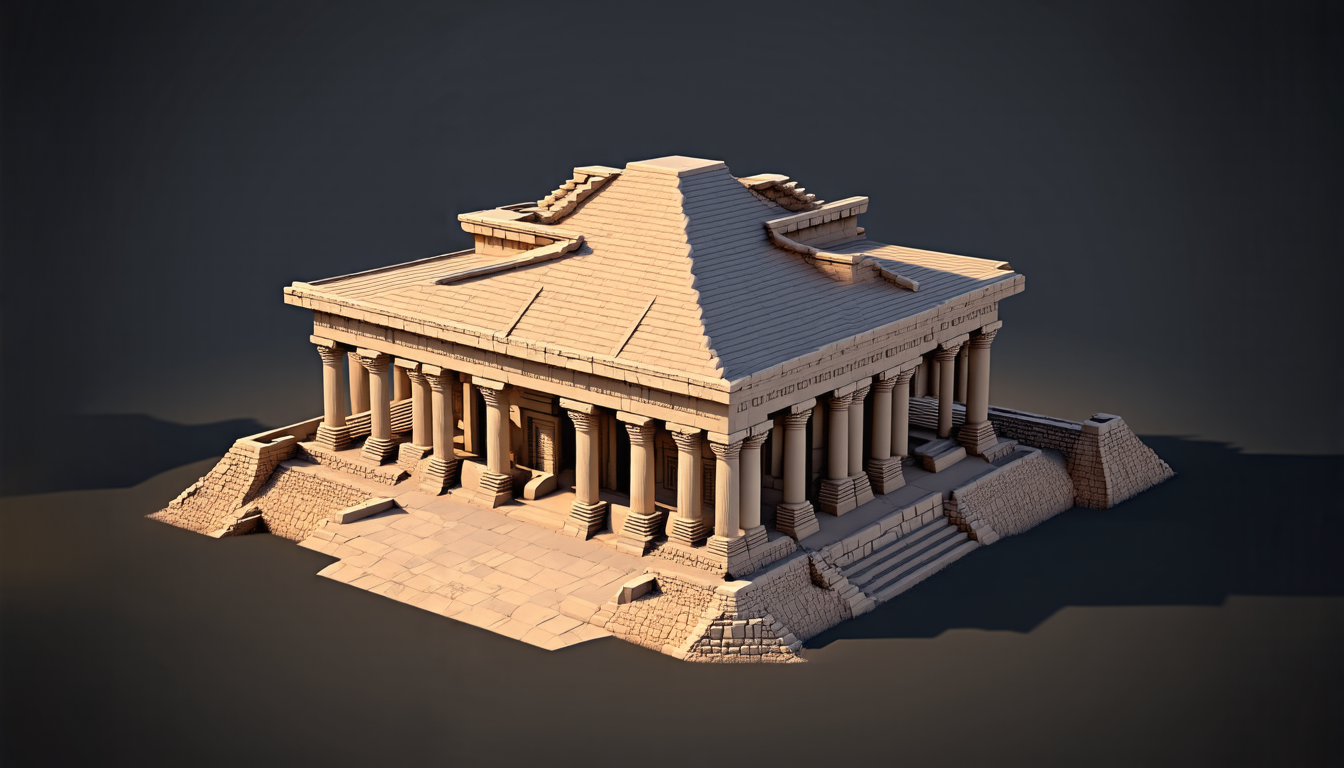
Scientists have made a significant breakthrough in developing an efficient architecture for cultural heritage information systems. This innovative approach allows for the creation of detailed and accurate 3D models of historical sites, monuments, and artifacts, making it easier to document, preserve, and share cultural heritage.
The new system structures information into thematic layers, which are then mapped onto the surface of the 3D model using 2D textures. This unique approach takes advantage of the parallel processing capabilities of Graphics Processing Units (GPUs) to handle large amounts of data quickly and efficiently.
One of the key advantages of this system is its ability to store information independently of the geometry of the 3D model, allowing for greater flexibility and accuracy when editing or updating the model. This is particularly useful in situations where the original data is incomplete, damaged, or difficult to access.
The system also features a texture padding algorithm that ensures smooth transitions between different layers of information, reducing visual artifacts and errors. This algorithm uses a kernel to modify the texture values around the edges of the layer, creating a seamless transition between adjacent areas.
Empirical tests have shown that this architecture outperforms traditional octree-based systems in terms of speed, efficiency, and accuracy. The system is able to handle large amounts of data quickly and efficiently, even on complex models with high levels of detail.
One of the most significant advantages of this system is its ability to reduce the amount of memory required to store 3D models, making it more feasible for use in applications where storage space is limited. This could be particularly useful in situations where large amounts of data need to be transported or stored remotely.
The implications of this breakthrough are far-reaching, with potential applications in a wide range of fields including archaeology, architecture, and cultural heritage conservation. By providing a more efficient and accurate way to document and preserve cultural heritage, this system could help to promote greater understanding, appreciation, and protection of our shared cultural heritage.
In addition to its practical applications, this breakthrough also highlights the importance of innovative thinking and collaboration in advancing science and technology. The development of this architecture required a deep understanding of computer graphics, data structures, and cultural heritage preservation, demonstrating the value of interdisciplinary research and cooperation.
Cite this article: “Revolutionizing Cultural Heritage Preservation through Innovative 3D Modeling Architecture”, The Science Archive, 2025.
Cultural Heritage, 3D Modeling, Data Structures, Computer Graphics, Gpu Processing, Parallel Computing, Texture Mapping, Information Systems, Archaeology, Architecture





