

Friday 14 March 2025
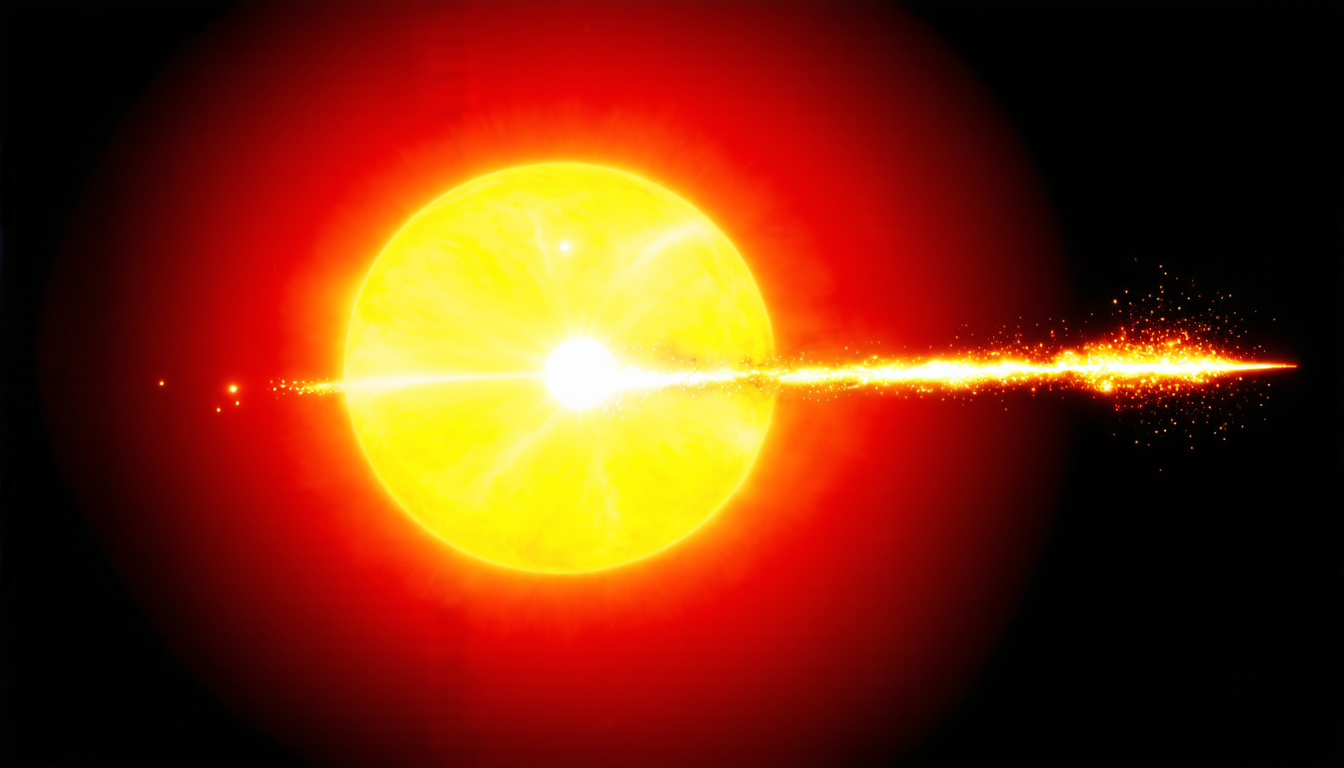
The quest for a better understanding of solar energetic particles (SEPs) has taken a significant step forward with the discovery of two new methods for calculating their intensities. SEPs are high-energy particles that originate from the sun and can pose a threat to spacecraft and even human explorers.
Until now, scientists have relied on two main methods to calculate SEP intensities: re-binned intensity and spectral binned intensity. Re-binned intensity involves integrating the particle intensity over a range of energies, while spectral binned intensity involves integrating the log-intensity in log-energy space. However, these methods have their limitations.
Re-binned intensity can be problematic because it assumes that the particle spectrum is constant over time, which isn’t always the case. On the other hand, spectral binned intensity can be difficult to interpret because it reports the intensity at a specific energy, rather than providing a more general picture of the particle distribution.
A team of researchers has now proposed two new methods for calculating SEP intensities: jlinlin and jloglog. Jlinlin is similar to re-binned intensity, but takes into account the time-varying spectral index of the particles. Jloglog, on the other hand, reports the intensity at a log-centered energy, which provides a more consistent picture of the particle distribution over time.
The researchers tested these new methods using data from the Parker Solar Probe (PSP), a spacecraft that has been exploring the sun’s corona since 2018. They found that jlinlin and jloglog provided more accurate and meaningful results than traditional methods, particularly in cases where the particle spectrum is changing over time.
One of the key advantages of these new methods is their ability to provide a more nuanced understanding of SEP behavior. By reporting the intensity at different energies, rather than just a single energy, scientists can gain insights into the dynamics of particle acceleration and transport in the solar wind.
The researchers also found that jlinlin and jloglog are useful for identifying specific events, such as solar flares and coronal mass ejections, which can have a significant impact on space weather. By analyzing the intensities of SEPs during these events, scientists can better understand how they affect the Earth’s magnetic field and upper atmosphere.
The implications of this research are far-reaching, with potential applications in fields such as space weather forecasting, radiation protection for spacecraft and astronauts, and even the search for extraterrestrial life.
Cite this article: “New Methods Unravel the Mystery of Solar Energetic Particles”, The Science Archive, 2025.
Solar Energetic Particles, Sep Intensities, Particle Spectra, Parker Solar Probe, Solar Flares, Coronal Mass Ejections, Space Weather, Radiation Protection, Spacecraft, Astronaut Safety





