

Friday 14 March 2025
A team of researchers has made a significant breakthrough in the field of robotics, developing a new system that enables robots to learn complex tasks by observing and imitating humans. The system, known as force-based imitation learning, uses sensors to capture the subtle forces and movements involved in human actions, allowing robots to replicate them with precision.
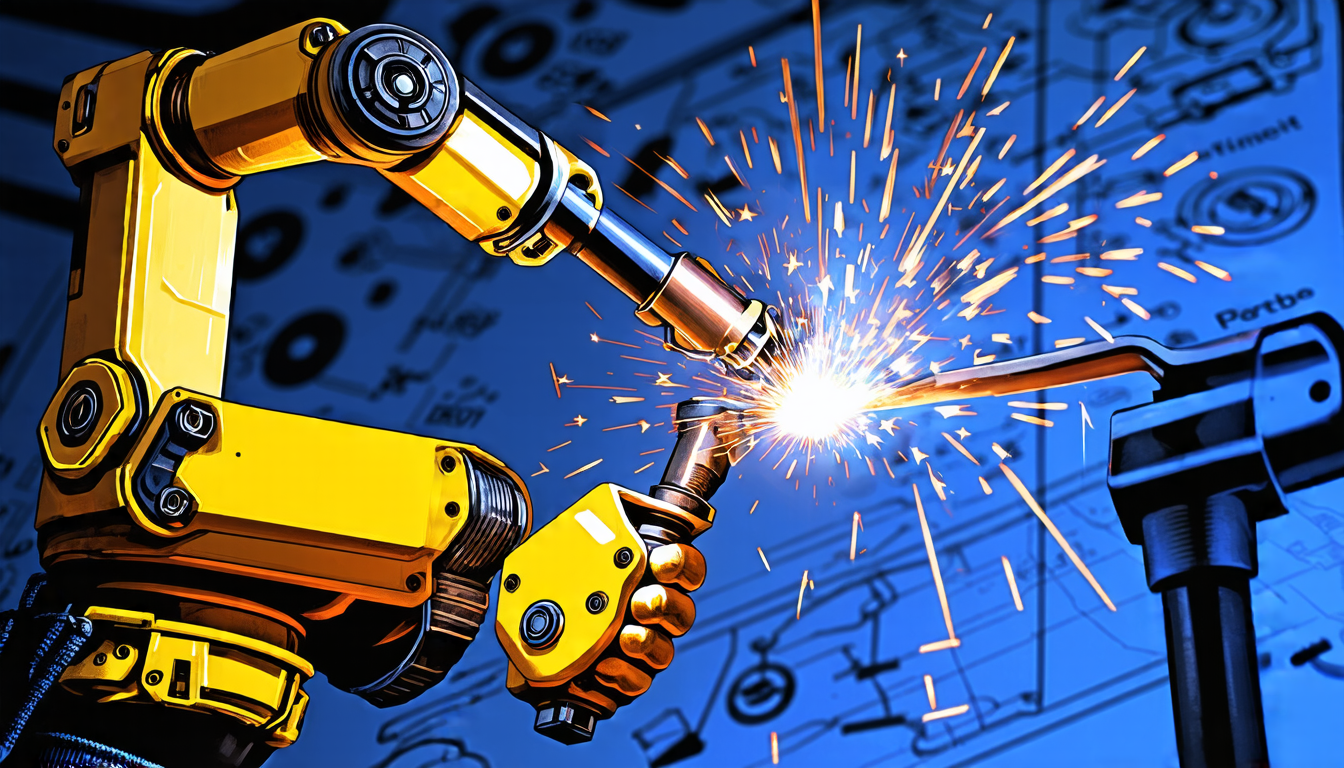
The research team, led by Dr. Hengxu You, has been working on developing a robotic arm that can perform tasks such as welding and pipe insertion, which require delicate handling and adaptive force controls. These tasks are currently difficult or impossible for robots to accomplish without human intervention, but the new system aims to change that.
The key innovation is the use of sensors to capture the subtle forces and movements involved in human actions. By recording these forces and movements, the robot can learn to replicate them with precision, allowing it to perform complex tasks such as welding and pipe insertion. The sensors are attached to the robotic arm and provide real-time feedback on the forces and movements being used, enabling the robot to adjust its actions accordingly.
The system has been tested in a series of experiments, where human operators performed tasks such as welding and pipe insertion while wearing special gloves that captured their movements and forces. The data collected from these experiments was then used to train the robotic arm to perform the same tasks.
The results are impressive, with the robotic arm able to perform complex tasks such as welding and pipe insertion with precision and accuracy. The system has also been shown to be adaptable, allowing the robot to learn new tasks quickly and easily.
This breakthrough has significant implications for a range of industries, including construction, manufacturing, and healthcare. Robots could potentially be used in these fields to perform tasks that are currently difficult or impossible for humans, freeing up human workers to focus on more complex and creative tasks.
The research team is now working on refining the system and exploring its potential applications. They hope that their work will pave the way for a new generation of robots that can learn and adapt quickly, allowing them to perform complex tasks with precision and accuracy.
Cite this article: “Robots Learn Complex Tasks by Observing Humans”, The Science Archive, 2025.
Robotics, Force-Based Imitation Learning, Sensors, Robotic Arm, Welding, Pipe Insertion, Human-Robot Interaction, Machine Learning, Artificial Intelligence, Automation





