

Friday 14 March 2025
The world of graph neural networks, where data is represented as nodes and edges in a complex web-like structure. It’s an area that has seen significant advancements in recent years, with researchers continually pushing the boundaries of what’s possible. The latest innovation in this field comes in the form of personalized layer selection for graph neural networks.
In traditional GNNs, each node’s representation is calculated by combining its own features with those of its neighbors. This approach works well when all nodes have similar relationships with their neighbors. However, real-world graphs often exhibit complex structures and relationships between nodes. Some nodes may have strong connections to a few key neighbors, while others may be part of a larger community.
This heterogeneity can lead to oversmoothing, where the model fails to capture the unique characteristics of individual nodes. To address this issue, researchers have proposed various techniques, such as using different layers for different nodes or incorporating attention mechanisms into the model. However, these methods often require significant modifications to the underlying architecture and may not be universally applicable.
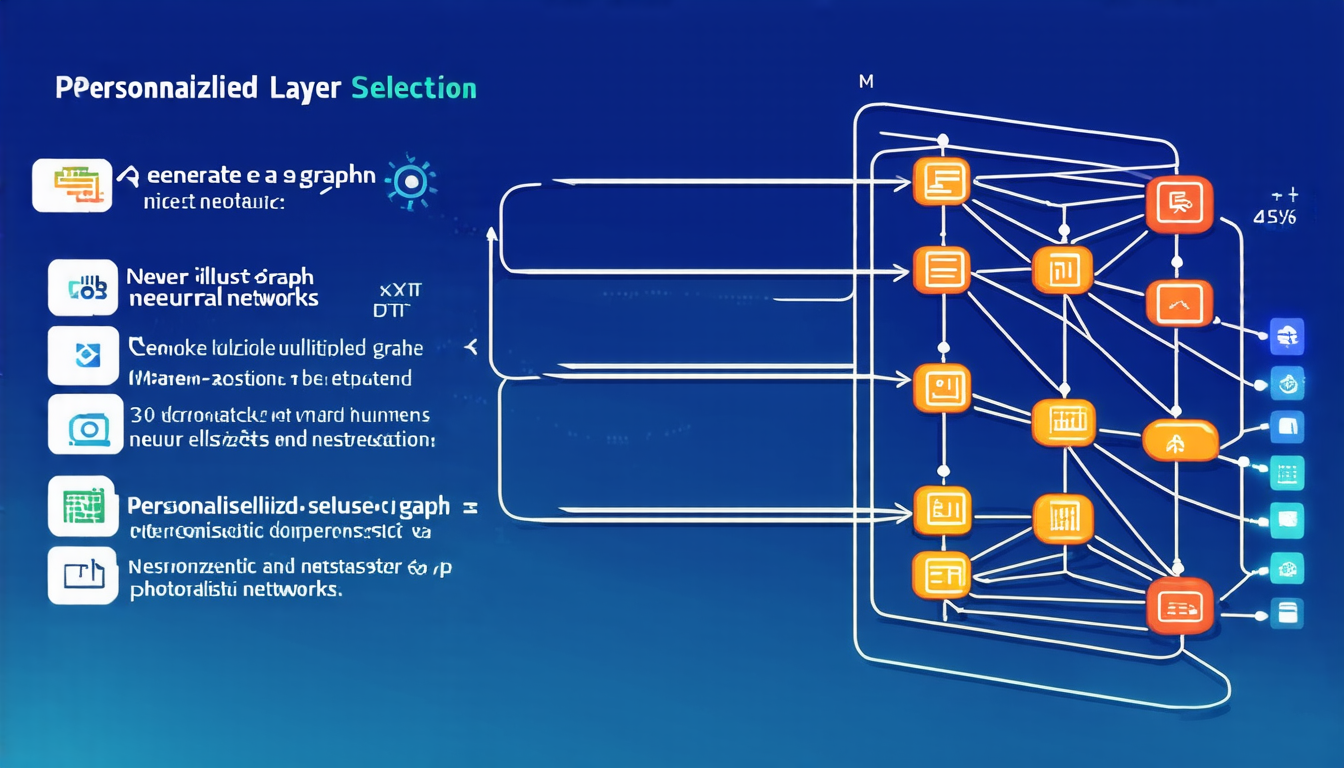
The new approach, dubbed MetSelect, takes a different tack. Instead of trying to adapt the entire model to each node’s needs, it focuses on identifying the optimal layer for each individual node. This is achieved through a novel algorithm that selects the layer with the smallest distance between the node’s representation and the class prototype.
In other words, MetSelect determines which layer can best capture the unique characteristics of each node and uses that layer to make predictions. This personalized approach has been shown to significantly improve the accuracy of GNNs on various tasks, including node classification and graph regression.
One of the key benefits of MetSelect is its simplicity. Unlike many other techniques, it doesn’t require significant modifications to the underlying architecture or the training process. Instead, it’s a straightforward addition that can be easily integrated into existing models.
The results are impressive. On a range of benchmark datasets, MetSelect outperforms traditional GNNs by a significant margin. It’s particularly effective on graphs with complex structures and relationships between nodes.
But what about scalability? One of the main concerns when dealing with large-scale graph data is that complex algorithms can quickly become computationally expensive. Fortunately, MetSelect has been designed with scalability in mind. The algorithm is efficient and can be easily parallelized, making it well-suited for large datasets.
In addition to its technical merits, MetSelect also offers a new perspective on the nature of GNNs.
Cite this article: “Personalizing Graph Neural Networks with MetSelect”, The Science Archive, 2025.
Graph Neural Networks, Personalized Layer Selection, Metselect, Node Classification, Graph Regression, Gnns, Oversmoothing, Attention Mechanisms, Scalability, Parallelization





