

Friday 14 March 2025
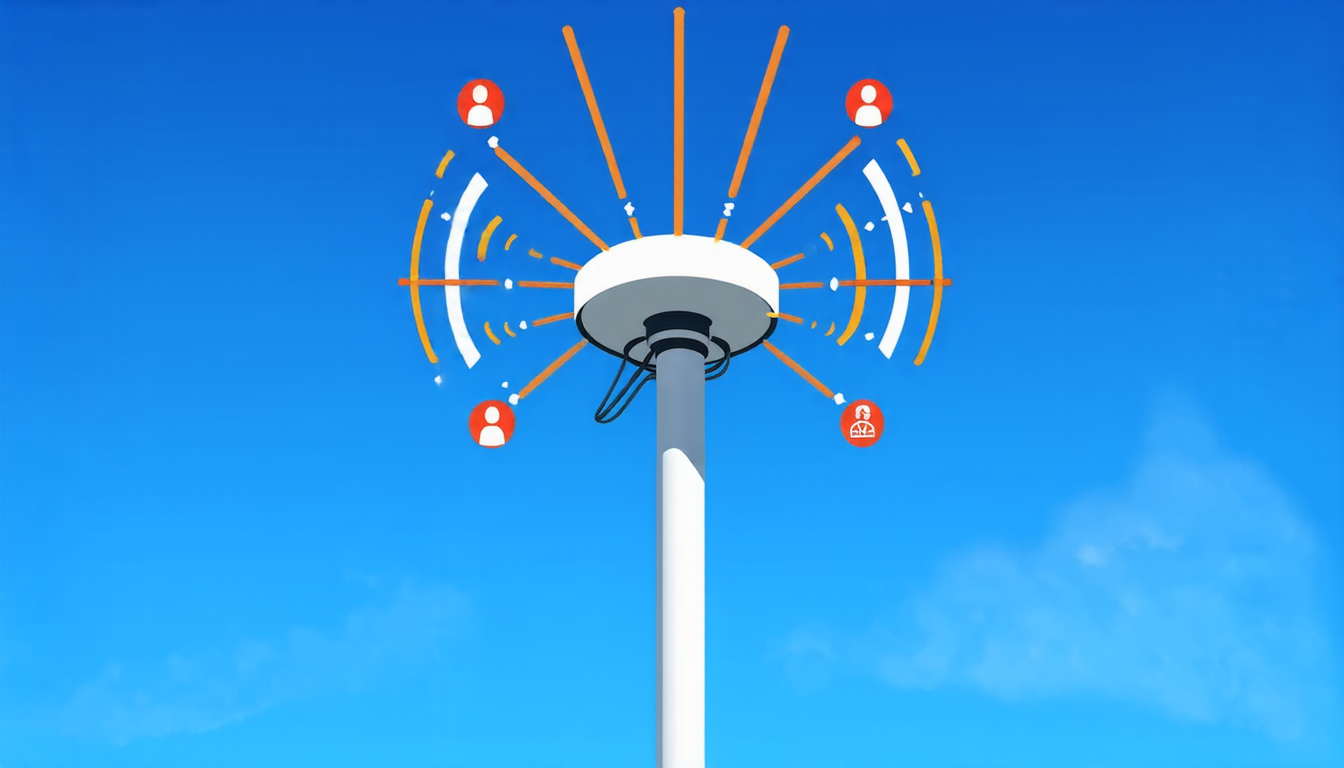
The quest for faster, more efficient wireless communication has led researchers to explore new frontiers in beamforming technology. In a recent paper, a team of scientists has proposed a novel approach that combines the benefits of analog and digital beamforming to create a hybrid system capable of serving multiple users simultaneously.
Traditional beamforming techniques rely on either analog or digital methods to focus radio waves towards specific areas. Analog beamforming uses phase shifters to adjust the direction of transmission, while digital beamforming employs complex algorithms to optimize signal processing. However, each approach has its limitations. Analog beamforming is prone to errors and degrades with increasing frequency, while digital beamforming requires significant computational resources.
The proposed hybrid system, known as Joint Phase-Time Arrays (JPTA), seeks to bridge this gap by integrating both analog and digital components. JPTA utilizes true-time delay units (TTDs) to create a phased array that can adjust the timing of signal transmission to optimize beam direction. This is combined with phase shifters, which fine-tune the beam’s direction through adjustments in phase.
The researchers have demonstrated that JPTA outperforms traditional analog and digital beamforming methods by achieving higher data rates and better user fairness. In a 5-user scenario, JPTA was able to boost user rates by up to 8.21% compared to conventional phased arrays. Furthermore, the system’s energy efficiency was found to be significantly improved, with a reduction in power consumption of up to 26.4%.
The key innovation behind JPTA lies in its ability to jointly optimize beamforming and subband allocation. By using a deep learning-based approach, the system can learn to map channel information to optimal resource allocation strategies, ensuring that each user receives an equitable share of bandwidth.
While JPTA shows great promise for future wireless communication systems, there are still several challenges to be addressed before it becomes widely adopted. For instance, the system’s complexity and power consumption may need to be further optimized to make it more practical for widespread deployment.
Despite these limitations, the potential benefits of JPTA are undeniable. As wireless networks continue to evolve to meet the demands of increasingly connected devices, innovative solutions like this hybrid beamforming approach will play a crucial role in shaping the future of communication technology.
Cite this article: “Hybrid Beamforming Technology Boosts Wireless Communication Efficiency”, The Science Archive, 2025.
Wireless Communication, Beamforming, Analog Beamforming, Digital Beamforming, Hybrid System, Joint Phase-Time Arrays, True-Time Delay Units, Phased Arrays, Deep Learning, Resource Allocation





