

Friday 14 March 2025
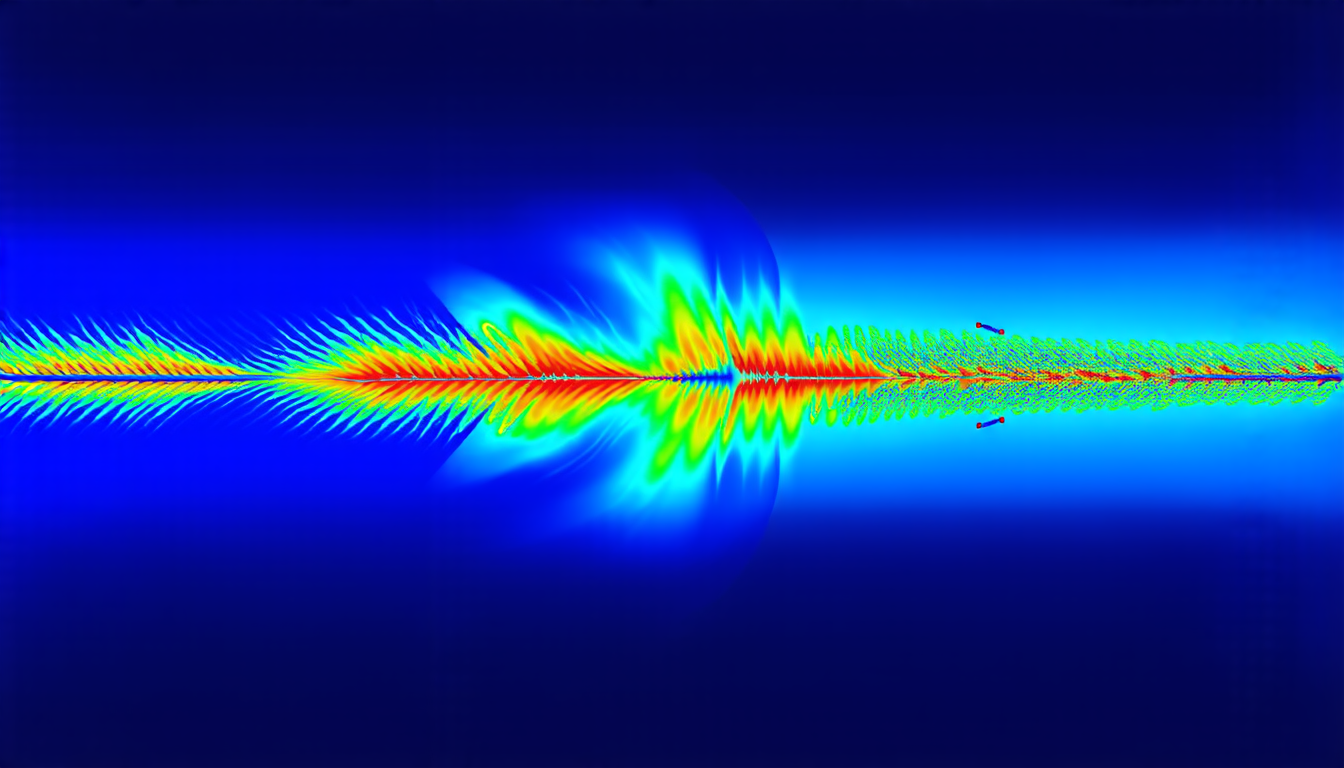
Scientists have made a significant breakthrough in understanding the behavior of shockwaves in compressible fluids, which could have far-reaching implications for fields such as aerospace engineering and medicine.
Shockwaves are sudden, intense pressure waves that can occur when a fluid flows rapidly through a narrow passage or is compressed suddenly. They are commonly seen in supersonic aircraft and can be used to treat certain medical conditions, but understanding how they behave is crucial for designing efficient and safe systems.
Researchers have been studying the behavior of shockwaves in compressible fluids using complex mathematical models and computer simulations. However, these models often rely on simplifying assumptions that don’t accurately reflect real-world phenomena.
A team of scientists has now developed a new approach to modeling shockwave behavior that takes into account the complexities of real-world systems. By using a combination of advanced numerical methods and experimental data, they have been able to create a more accurate model of shockwave propagation in compressible fluids.
One of the key challenges in understanding shockwave behavior is the need to balance competing factors such as pressure, velocity, and density. As a fluid flows through a narrow passage or is compressed, its pressure increases rapidly, causing the velocity to decrease. At the same time, the density of the fluid also changes, which can affect the way it responds to pressure waves.
The new model takes into account these complex interactions by using a novel numerical approach that combines finite element methods with an adaptive mesh refinement technique. This allows the researchers to capture the intricate details of shockwave behavior at high spatial and temporal resolutions.
The team has used their new model to simulate the behavior of shockwaves in a range of different systems, from simple compressible fluids to complex aerospace engineering applications. Their results show that the model is able to accurately predict the behavior of shockwaves in a wide range of situations, including those where traditional models would fail to capture important details.
The implications of this breakthrough are significant, with potential applications in fields such as aircraft design, medical treatment, and materials science. For example, the new model could be used to optimize the design of supersonic aircraft or to develop more effective treatments for conditions such as lung disease.
Overall, this research demonstrates the power of advanced numerical methods and experimental data in understanding complex physical phenomena. By developing a more accurate model of shockwave behavior, scientists can gain a deeper understanding of these fascinating pressure waves and unlock new possibilities for innovation and discovery.
Cite this article: “Unlocking the Secrets of Shockwaves: A Breakthrough in Understanding Compressible Fluid Behavior”, The Science Archive, 2025.
Shockwaves, Compressible Fluids, Aerospace Engineering, Medicine, Mathematical Models, Computer Simulations, Numerical Methods, Adaptive Mesh Refinement, Finite Element Methods, Shockwave Behavior.





