

Friday 14 March 2025
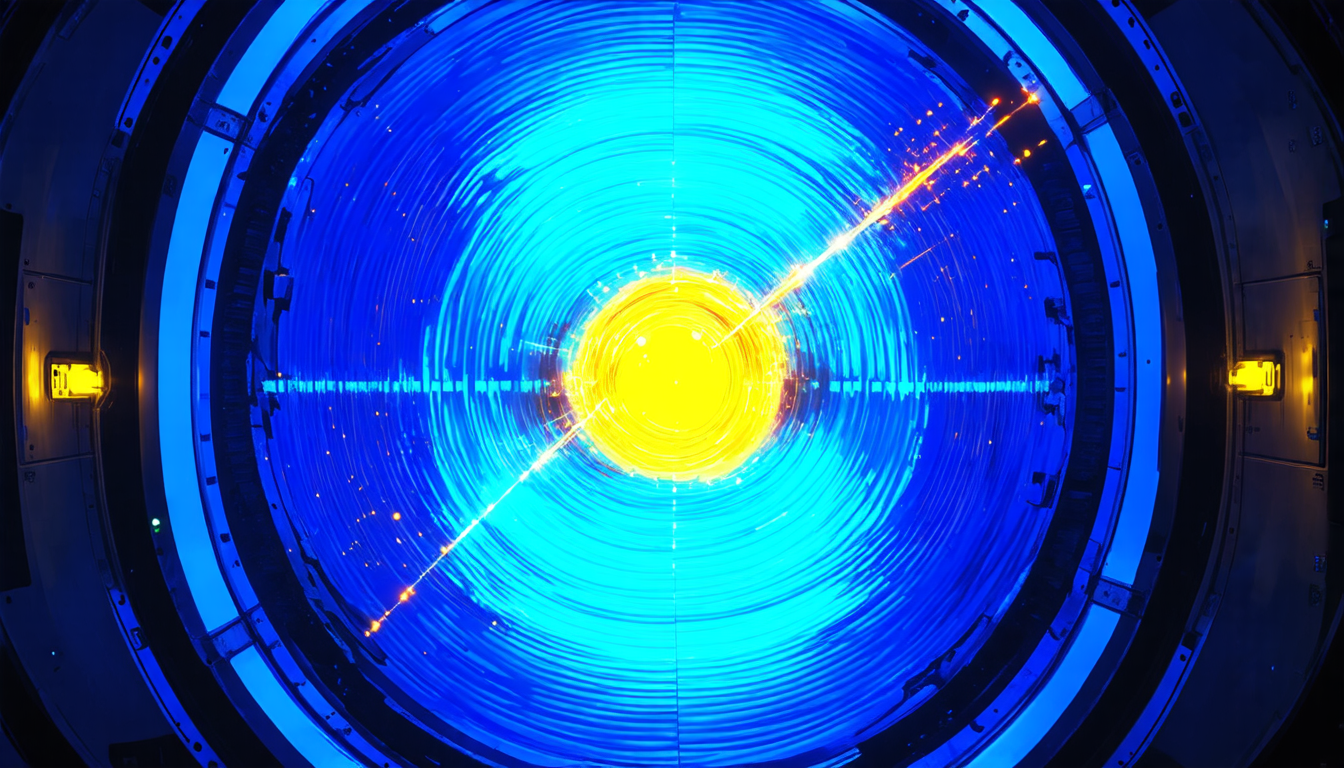
Scientists have made a breakthrough in understanding how to improve the accuracy of energy measurements in high-energy particle collisions. For decades, researchers have been working on developing more precise methods for measuring the energy released during these events, which is crucial for uncovering new insights into the fundamental nature of matter and the universe.
One approach that has shown promise is called dual-readout calorimetry, where two different types of sensors are used to measure the energy deposited by particles in a detector. By combining the information from both sensors, scientists can correct for errors and improve the overall accuracy of their measurements.
To better understand how this works, let’s take a step back and look at what happens during a high-energy particle collision. When two particles collide, they release a tremendous amount of energy, which is then deposited in a detector made up of sensitive materials like scintillators or Cherenkov radiators. The goal of the detector is to measure this energy with as much precision as possible, so that scientists can analyze the results and gain new insights into the underlying physics.
However, there are several challenges that make it difficult to achieve high accuracy in these measurements. For one thing, the detectors themselves can be affected by various types of noise or fluctuations, which can distort the signal and lead to errors. Additionally, the particles being detected may not always follow a straightforward path through the detector, which can also affect the accuracy of the measurement.
Dual-readout calorimetry is designed to address these challenges by using two different sensors that are sensitive to different aspects of the energy deposition process. The first sensor measures the energy deposited in the detector through scintillation, or the emission of light when particles interact with the material. This type of detection is very effective for measuring energies above a certain threshold, but it can be less accurate at lower energies.
The second sensor measures the energy deposited in the detector through Cherenkov radiation, which is a phenomenon where particles traveling faster than the speed of light in the detector material emit a characteristic radiation pattern. This type of detection is more sensitive to lower-energy particles and can provide a more detailed picture of the energy deposition process.
By combining the information from both sensors, scientists can create a more accurate measurement of the energy deposited by the particles. The dual-readout approach allows them to correct for errors and uncertainties that might arise from the limitations of each individual sensor. In this way, they can achieve higher accuracy and gain new insights into the fundamental physics underlying high-energy particle collisions.
Cite this article: “Improving Energy Measurements in High-Energy Particle Collisions”, The Science Archive, 2025.
Energy Measurements, High-Energy Particle Collisions, Dual-Readout Calorimetry, Sensor Technology, Particle Detectors, Scintillators, Cherenkov Radiators, Energy Deposition, Accuracy Improvement, Fundamental Physics.





