

Friday 14 March 2025
Scientists have long been working on creating a quantum internet, a network that would allow for secure and fast communication over long distances using the principles of quantum mechanics. One major hurdle in achieving this goal is the challenge of distributing entangled photons, which are crucial for quantum communication, across vast distances.
Traditional methods for entanglement distribution rely on fiber-optic cables, but these have limitations due to the exponential loss of signal strength with distance. To overcome this, researchers have turned to satellite-based solutions, where entangled photons can be transmitted between satellites and then down to Earth.
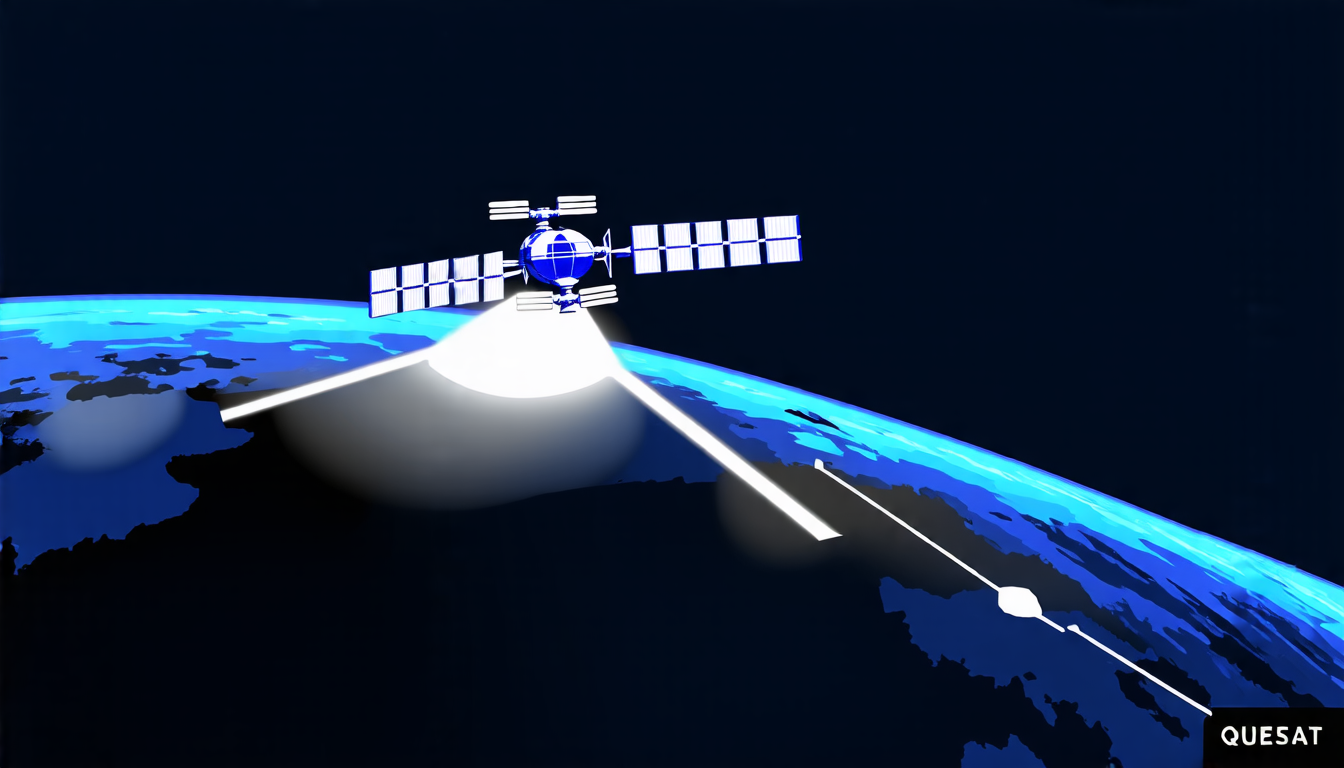
A recent study has proposed a new hybrid approach that combines both ground-based and satellite-based networks to create a more efficient and resilient quantum internet. The system, known as QuESat, uses low-Earth orbit (LEO) satellites to establish a global-scale passive optical network, which is then connected to an on-the-ground fiber network.
The key innovation of QuESat lies in its ability to dynamically configure the beam guides used to transmit entangled photons between satellites and ground stations. This allows for more efficient use of resources and enables the system to adapt to changing demands and satellite positions.
One of the major challenges in creating a quantum internet is ensuring that entangled photons are transmitted with high fidelity, meaning that they remain entangled over long distances without being affected by external factors such as noise or interference. QuESat’s dynamic configuration allows for more precise control over the beam guides, which reduces the impact of these external factors and increases the overall fidelity of the entangled photons.
The benefits of QuESat are twofold. Firstly, it enables the creation of a global-scale quantum internet that can connect users across the globe, regardless of their geographical location. Secondly, it provides a more resilient and adaptable system that can respond to changing demands and satellite positions, ensuring continuous operation even in the event of satellite failures or maintenance.
The QuESat system has been simulated using advanced algorithms and has shown promising results, with significant improvements in entanglement distribution rates and fidelity compared to traditional fiber-optic approaches. While there are still many challenges to overcome before a fully functional quantum internet can be established, the development of QuESat represents an important step forward in this direction.
The future of quantum communication is bright, with researchers working towards developing more advanced technologies that will enable secure and fast communication over even longer distances.
Cite this article: “Quantum Internet Breakthrough: QuESat System Enables Global-Scale Entanglement Distribution”, The Science Archive, 2025.
Quantum Internet, Entangled Photons, Satellite-Based Solutions, Fiber-Optic Cables, Quantum Communication, Quesat, Low-Earth Orbit Satellites, Beam Guides, Entanglement Distribution, Quantum Fidelity.





