
Saturday 15 March 2025
The quest for faster, more efficient wireless communication has led researchers to explore innovative techniques like Rate-Splitting Multiple Access (RSMA). This approach combines two existing methods – Orthogonal Frequency Division Multiple Access (OFDMA) and Sparse Code Multiple Access (SCMA) – to create a more robust system.
In traditional OFDMA systems, multiple users are assigned different frequencies to transmit data. However, this can lead to interference between users, reducing overall performance. SCMA addresses this issue by using sparse codes, which are essentially long sequences of zeros and ones that allow for efficient transmission and reception. But SCMA has its own limitations – it’s not well-suited for systems with a large number of users.
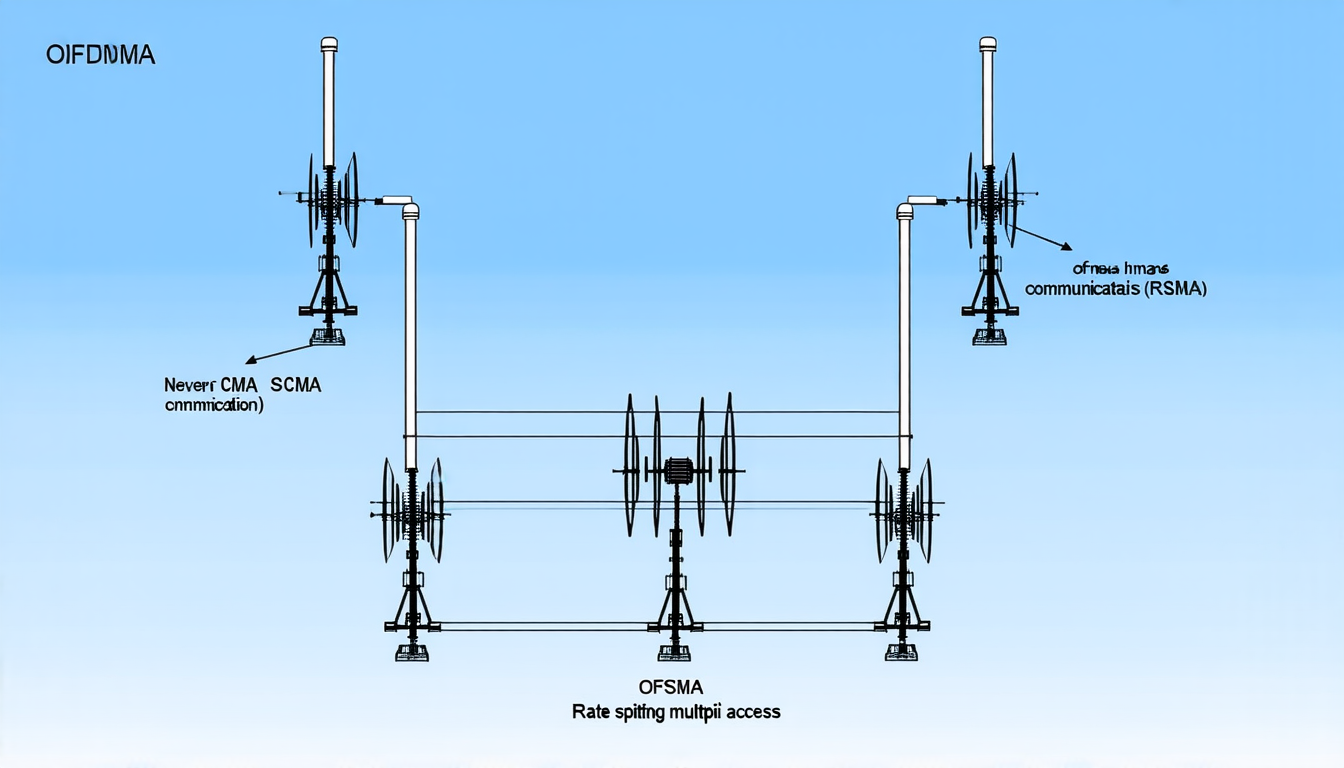
RSMA aims to bridge the gap between these two approaches by splitting each user’s data into common and private components. The common component is transmitted using OFDMA, while the private component is encoded using SCMA. This allows RSMA to take advantage of the strengths of both methods – the efficient use of spectrum in OFDMA and the low-complexity decoding of SCMA.
In a recent paper, researchers demonstrated the effectiveness of RSMA in a system with six users transmitting data over five antennas. The results showed that RSMA outperformed traditional OFDMA and SCMA systems in terms of error rate performance, even at high user densities. This is significant because it opens up new possibilities for wireless communication systems to support more users without sacrificing performance.
One key advantage of RSMA is its ability to adapt to changing channel conditions. In traditional systems, changes in the channel can cause interference and reduce performance. But RSMA’s use of SCMA codes allows it to adjust to these changes quickly and efficiently.
Another benefit of RSMA is its potential for low-complexity implementation. Because the system uses sparse codes, the decoding process is relatively simple and doesn’t require a lot of computational resources. This makes it well-suited for devices with limited processing power, such as those used in Internet of Things (IoT) applications.
The researchers also explored different scenarios to demonstrate the flexibility of RSMA. They found that the system performed well even when some users had very low transmission rates, while others had much higher rates. This is important because it allows RSMA to be used in a variety of real-world situations, from high-bandwidth applications like video streaming to low-bandwidth applications like sensor data transmission.
Cite this article: “Faster Wireless Communication: Rate-Splitting Multiple Access (RSMA) Technology”, The Science Archive, 2025.
Wireless Communication, Rate-Splitting Multiple Access, Orthogonal Frequency Division Multiple Access, Sparse Code Multiple Access, Ofdma, Scma, Error Rate Performance, Channel Conditions, Low-Complexity Implementation, Iot Applications.