

Saturday 15 March 2025
A team of physicists has made a breakthrough in understanding how to boost the temperature at which certain materials can conduct electricity without resistance, known as superconductors. The discovery could pave the way for the development of more efficient and powerful electronics.
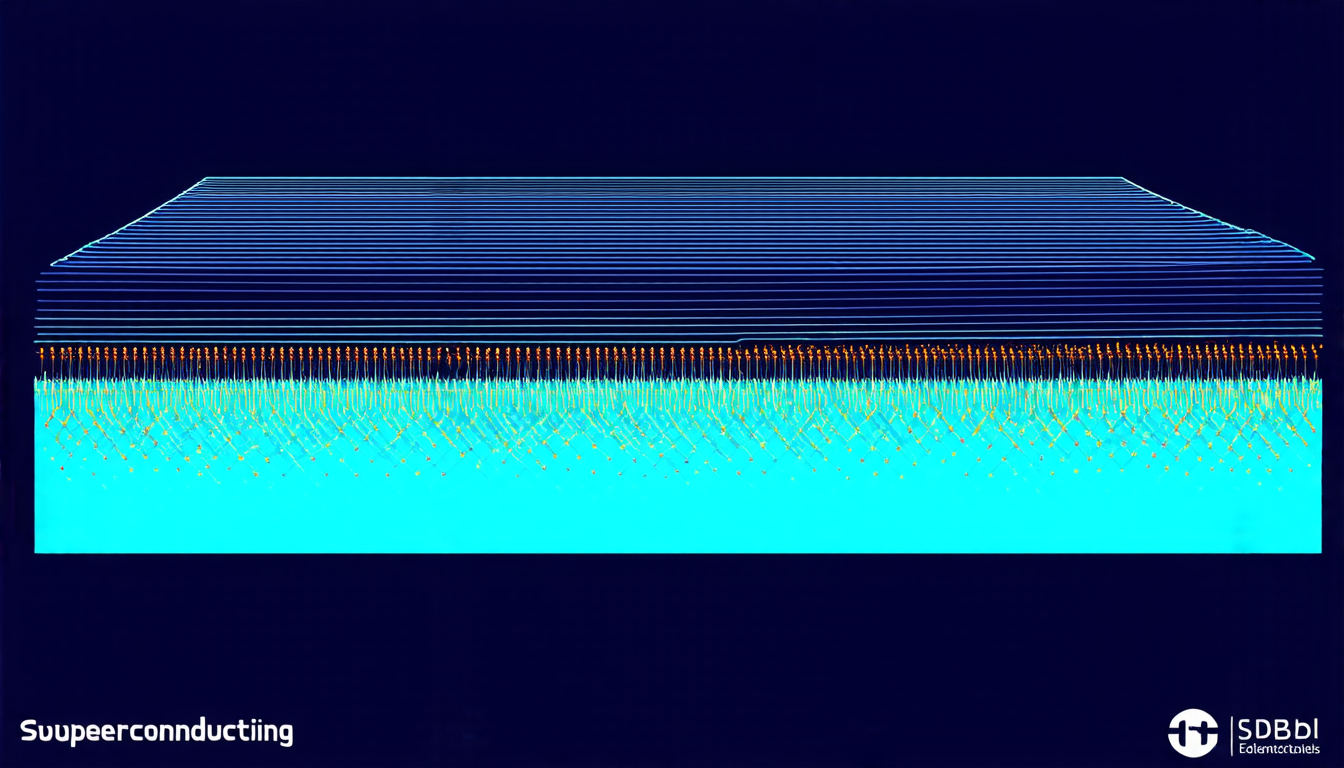
The researchers used computer simulations to study the properties of a type of material called a metal-superconductor bilayer, where two layers of different materials are stacked on top of each other. They found that by carefully controlling the interaction between the two layers, they could increase the temperature at which the material becomes superconducting.
The team used a technique called determinant quantum Monte Carlo to simulate the behavior of electrons in the material. This allowed them to study how the electrons interacted with each other and with the lattice structure of the material.
Their results showed that when the interaction between the two layers was just right, the material became superconducting at higher temperatures than it would otherwise. The researchers believe that this could be due to the way in which the electrons are able to move more freely through the material when the interaction is strong.
The discovery has important implications for the development of new electronic devices. Superconductors are used in a wide range of applications, including medical equipment, power transmission lines, and magnetic resonance imaging (MRI) machines. However, many superconducting materials only become superconducting at very low temperatures, which can be difficult to achieve.
The ability to boost the temperature at which a material becomes superconducting could make it easier to develop new devices that use these materials. For example, it could allow for the creation of more powerful and efficient MRI machines, or the development of new medical equipment that is smaller and more portable.
The researchers are now working to understand the underlying physics behind their discovery, and to see if they can apply their findings to other types of materials. They believe that their work could have important implications for a wide range of fields, from medicine to energy production.
Cite this article: “Boosting Superconductivity: Researchers Unlock New Possibilities for Efficient Electronics”, The Science Archive, 2025.
Superconductors, Temperature, Materials Science, Electronics, Physics, Computer Simulations, Metal-Superconductor Bilayer, Determinant Quantum Monte Carlo, Electrons, Lattice Structure





