

Saturday 15 March 2025
Researchers have made a significant breakthrough in understanding the behavior of spin currents, tiny electrical currents that flow without resistance. These currents are crucial for the development of low-energy electronics and spin-based devices.
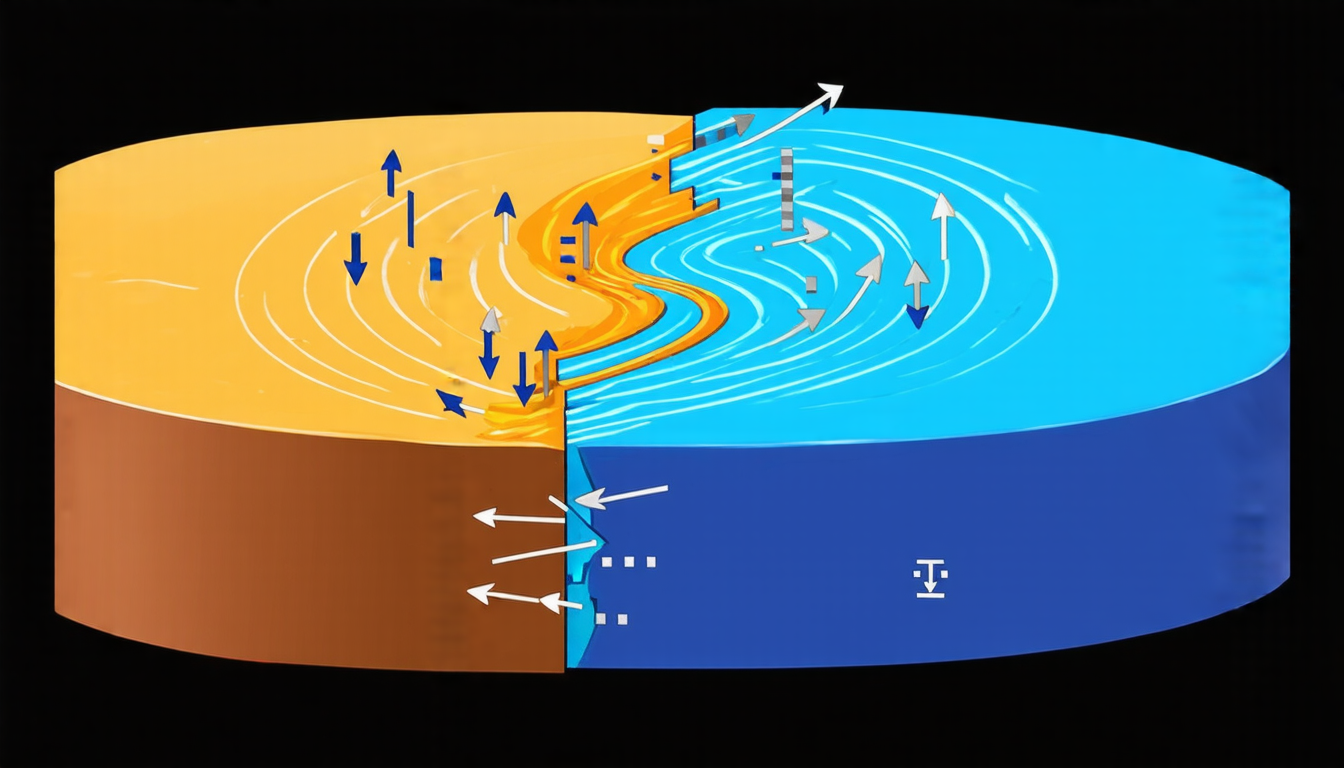
The study focused on a heterostructure, a layer of two different materials sandwiched together. The researchers used computer simulations to investigate how the spin currents behaved when they interacted with the interface between the two layers.
They found that the spin currents were able to flow across the interface without being scattered by defects or impurities in the material. This is because the spin currents are topologically protected, meaning that they are resistant to disruptions caused by the environment.
The researchers also discovered that the spin currents could be controlled by adjusting the strength of the interactions between the two layers. By tweaking these interactions, they were able to tune the magnitude and direction of the spin currents.
These findings have important implications for the development of spin-based devices. For example, spin Hall effects, which are the conversion of charge currents into spin currents, could be used to generate spin currents that flow in specific directions.
The study also highlights the potential of topological insulators, a class of materials that exhibit unusual electronic properties. These materials have been shown to support the formation of topologically protected edge states, which could be used to create robust and efficient spin-based devices.
Overall, this research has shed new light on the behavior of spin currents and their interactions with interfaces. The findings have significant implications for the development of low-energy electronics and spin-based devices, and could potentially lead to the creation of more efficient and reliable electronic components.
Cite this article: “Unlocking the Secrets of Spin Currents: A Breakthrough in Understanding Their Behavior”, The Science Archive, 2025.
Spin Currents, Low-Energy Electronics, Spin-Based Devices, Heterostructure, Interface, Topological Protection, Spin Hall Effects, Topological Insulators, Edge States, Electronic Components





