

Saturday 15 March 2025
Scientists have long been fascinated by the properties of materials that can exhibit both superconductivity and topological behavior, two phenomena that seem mutually exclusive. In a recent study, researchers have made significant progress in understanding these properties by investigating the electride MgLi, a material that contains lithium and magnesium atoms.
Electrides are unique compounds that contain localized electrons, known as interstitial quasi-atoms (ISQs), which behave like anions despite being embedded within the crystal lattice. These ISQs can induce exotic phenomena such as superconductivity, metal-insulator transitions, and colossal charge states of impurity atoms.
The research team used a combination of theoretical calculations and experimental techniques to explore the properties of MgLi under high pressure. They discovered that at pressures above 200 gigapascals, MgLi exhibits both superconducting and topological behavior. The material’s superconducting transition temperature, which is the temperature below which it becomes resistant to electrical current flow, was found to be around 22.8 Kelvin.
The researchers also investigated the role of phonons, or lattice vibrations, in the material’s superconductivity. They found that low-frequency phonons play a dominant role in the phenomenon, and that these phonons are responsible for the material’s ability to exhibit topological behavior.
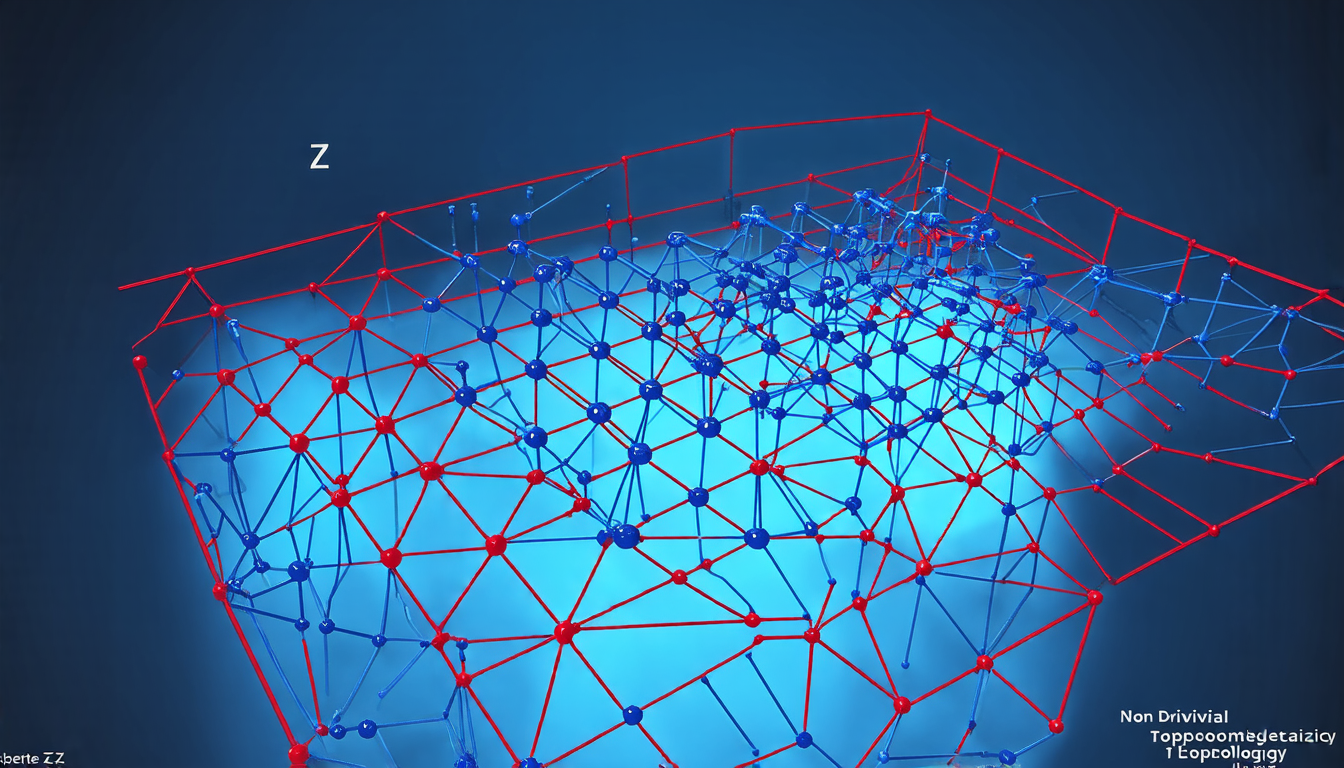
Topological behavior refers to the way the material’s electronic structure is arranged. In this case, the researchers discovered that the material has non-trivial Z2 topology, which means that its bulk band structure exhibits a specific symmetry that is not found in ordinary materials. This topology gives rise to topologically protected surface states, which are electronic states that are robust against defects and disorder.
The discovery of superconducting and topological behavior in MgLi has significant implications for the development of new materials with unique properties. The material’s ability to exhibit both phenomena at high pressure opens up possibilities for the creation of new compounds with even more exotic properties.
Furthermore, the research highlights the importance of understanding the interplay between electronic and lattice degrees of freedom in determining a material’s behavior. By exploring this complex relationship, scientists may be able to design new materials that can exhibit multiple phases or states, potentially leading to breakthroughs in fields such as energy storage, quantum computing, and advanced materials.
The study also underscores the importance of high-pressure research in understanding the properties of materials. The ability to create extreme conditions in a laboratory setting allows scientists to explore the behavior of materials under conditions that would be impossible to achieve naturally.
Cite this article: “Unveiling Exotic Properties in Electride MgLi Under High Pressure”, The Science Archive, 2025.
Superconductivity, Topological Behavior, Electride, Mgli, High Pressure, Phonons, Lattice Vibrations, Non-Trivial Z2 Topology, Surface States, Exotic Properties





