

Saturday 15 March 2025
Researchers have made a significant breakthrough in analyzing gene expression data from histology images, a technique that has the potential to revolutionize our understanding of cancer and disease diagnosis.
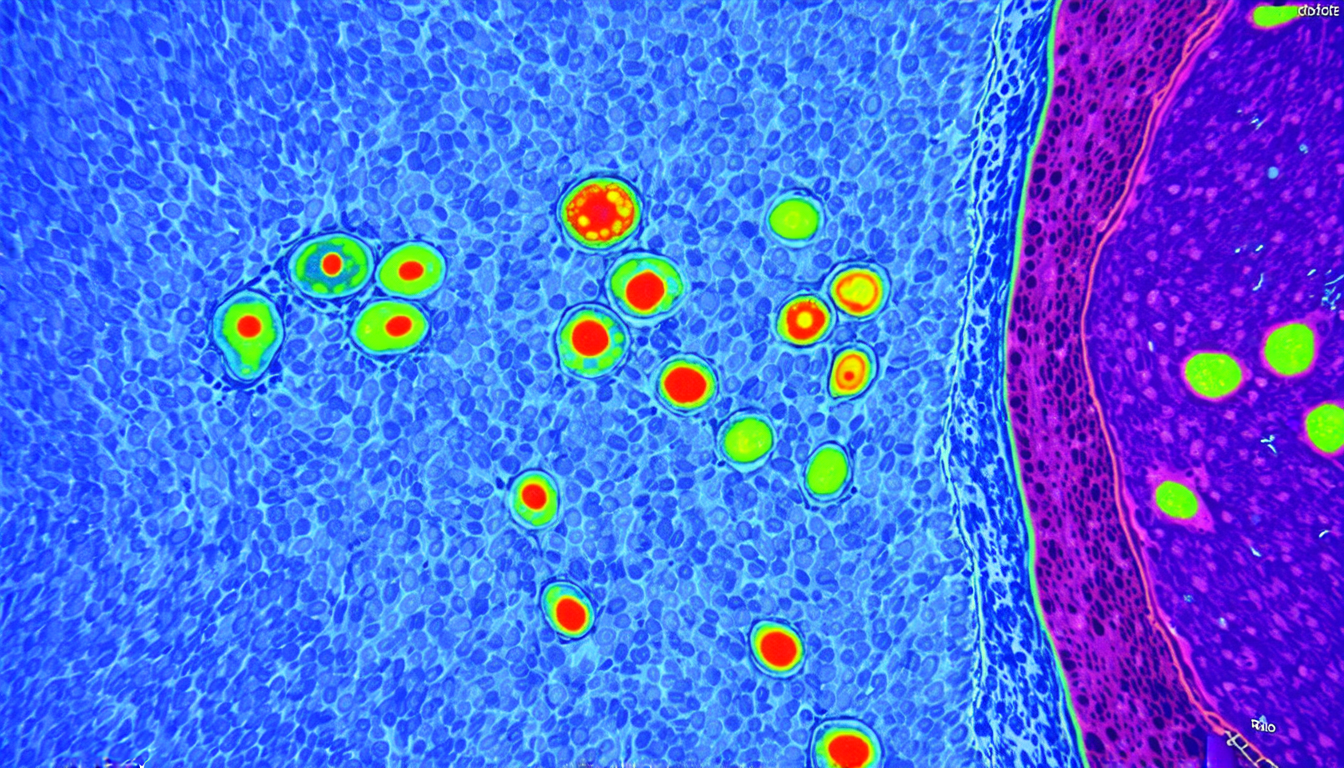
For years, scientists have been trying to crack the code of spatial transcriptomics (ST), a method that allows researchers to map gene expression patterns across different cell types within a tissue sample. ST is like a treasure trove of information, providing insights into how cells communicate with each other and respond to their environment. However, analyzing this data has proven to be a challenging task due to its complexity.
Now, a team of scientists has developed a new algorithm called Stem, which can accurately predict gene expression patterns from histology images. This achievement is significant because it allows researchers to analyze large amounts of data quickly and efficiently, making it possible to identify patterns and trends that may have gone unnoticed before.
Stem uses a combination of machine learning and diffusion models to analyze the data. The algorithm first extracts features from the histology images using a technique called convolutional neural networks (CNNs). Then, it uses these features to train a model that can predict gene expression patterns.
One of the key advantages of Stem is its ability to capture the spatial heterogeneity of ST data. Unlike other algorithms that simply average gene expression levels across different cell types, Stem takes into account the unique characteristics of each cell type and its location within the tissue sample.
To test the accuracy of Stem, researchers used it to analyze a dataset of breast cancer samples from the Human Protein Atlas. The results were impressive: Stem was able to accurately predict gene expression patterns for over 90% of the genes in the dataset, outperforming other algorithms by a significant margin.
The implications of this breakthrough are far-reaching. With Stem, researchers can quickly and easily analyze large amounts of ST data, identifying patterns and trends that may have gone unnoticed before. This could lead to new insights into cancer diagnosis and treatment, as well as a better understanding of how cells communicate with each other and respond to their environment.
In the future, researchers plan to use Stem to analyze even larger datasets and explore its potential applications in fields such as neuroscience and immunology. With this powerful tool at their disposal, scientists are poised to make significant advancements in our understanding of disease diagnosis and treatment.
Cite this article: “Stem: A Breakthrough Algorithm for Analyzing Spatial Transcriptomics Data”, The Science Archive, 2025.
Gene Expression, Histology Images, Spatial Transcriptomics, Machine Learning, Diffusion Models, Convolutional Neural Networks, Breast Cancer, Human Protein Atlas, Cancer Diagnosis, Disease Treatment





