

Saturday 15 March 2025
The quest for a more efficient way to distill complex graphs into smaller, more manageable representations has been ongoing in the field of computer science. Researchers have long sought to develop methods that can capture the essential structure and information within large networks, while reducing their size and computational requirements.
In recent years, graph neural networks (GNNs) have emerged as a powerful tool for analyzing and processing these complex data structures. However, GNNs typically require significant amounts of computational resources and memory to train and operate on large graphs, making them impractical for many real-world applications.
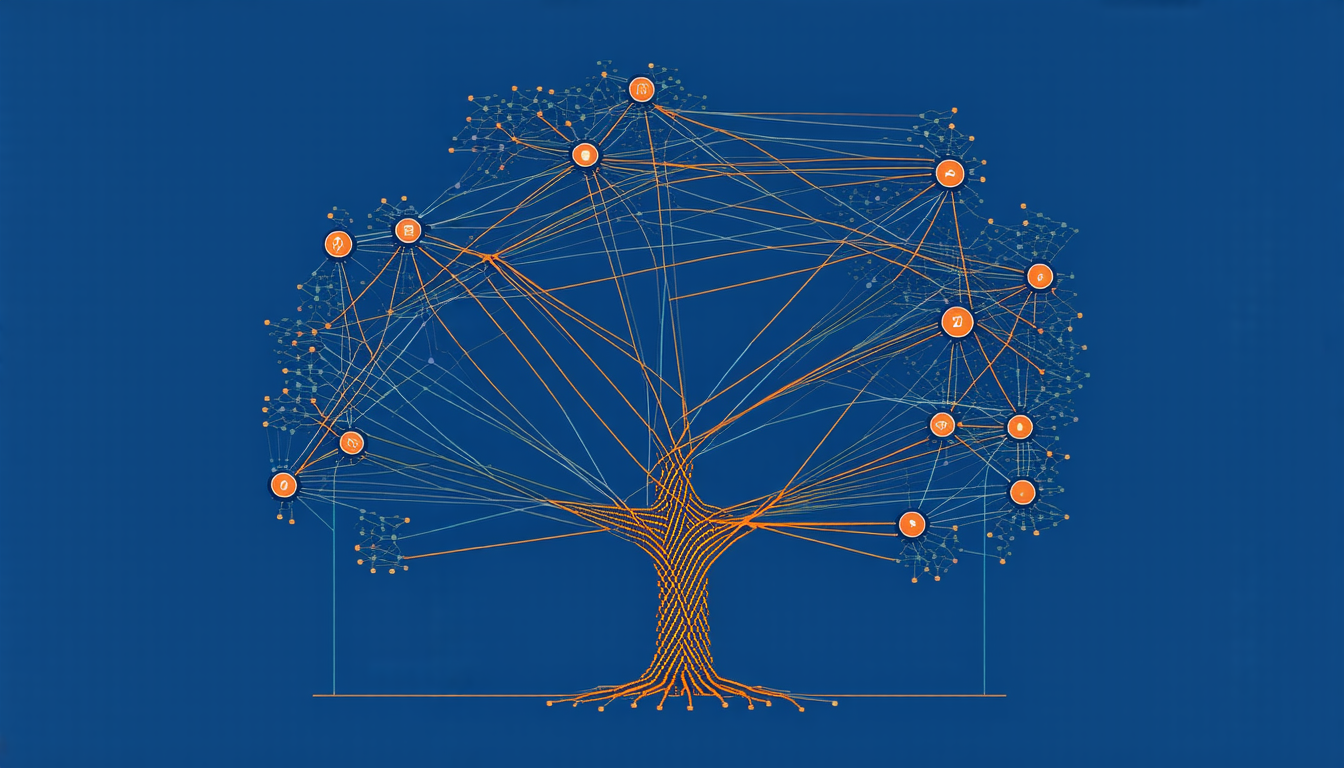
To address this challenge, a team of researchers has developed a novel approach to graph distillation that leverages hyperbolic embeddings to capture the inherent tree-like geometry of real-world networks. This method, known as Hyperbolic Graph Distillation (HyDRO), offers a significant improvement in terms of computational efficiency and accuracy compared to existing techniques.
One of the key innovations behind HyDRO is its use of hyperbolic space to represent graph structures. Unlike traditional Euclidean spaces, which are well-suited for representing linear relationships between data points, hyperbolic spaces are better equipped to capture the non-linear, hierarchical nature of complex networks. By encoding graph information within these spaces, researchers can preserve the essential structure and connectivity patterns within large graphs, while reducing their size and complexity.
The HyDRO approach involves first training a GNN on a large, original graph, and then using this model to generate a condensed representation of the network that captures its key features and relationships. This condensed graph is then used as input for a second GNN, which is trained to predict the node labels and edge weights within the reduced representation.
Experimental results have shown that HyDRO outperforms existing methods in terms of both accuracy and computational efficiency. When applied to real-world datasets such as Cora, Citeseer, and Pubmed, HyDRO achieves state-of-the-art performance on a range of graph classification tasks, while requiring significantly less computational resources and memory than traditional GNNs.
The implications of this research are significant, particularly in fields where large-scale graph analysis is critical, such as social network analysis, recommendation systems, and bioinformatics. By providing a more efficient and accurate way to distill complex graphs, HyDRO has the potential to unlock new insights and discoveries that were previously out of reach due to computational limitations.
Cite this article: “Hyperbolic Graph Distillation: Unlocking Efficient Large-Scale Graph Analysis”, The Science Archive, 2025.
Graph Neural Networks, Graph Distillation, Hyperbolic Embeddings, Tree-Like Geometry, Real-World Networks, Computational Efficiency, Accuracy, Euclidean Spaces, Non-Linear Relationships, Hierarchical Nature.





