

Saturday 15 March 2025
Scientists have long been fascinated by the intricate patterns and structures that emerge in complex systems, from the swirling shapes of galaxies to the branching networks of river deltas. A new study sheds light on the underlying rules that govern these phenomena, offering a fresh perspective on the behavior of cluster complexes.
Cluster complexes are abstract mathematical objects that arise from the interactions between different components of a system. They can be found in everything from the arrangement of atoms in molecules to the distribution of galaxies across the universe. In recent years, mathematicians and physicists have made significant progress in understanding the properties of cluster complexes, but many questions remain unanswered.
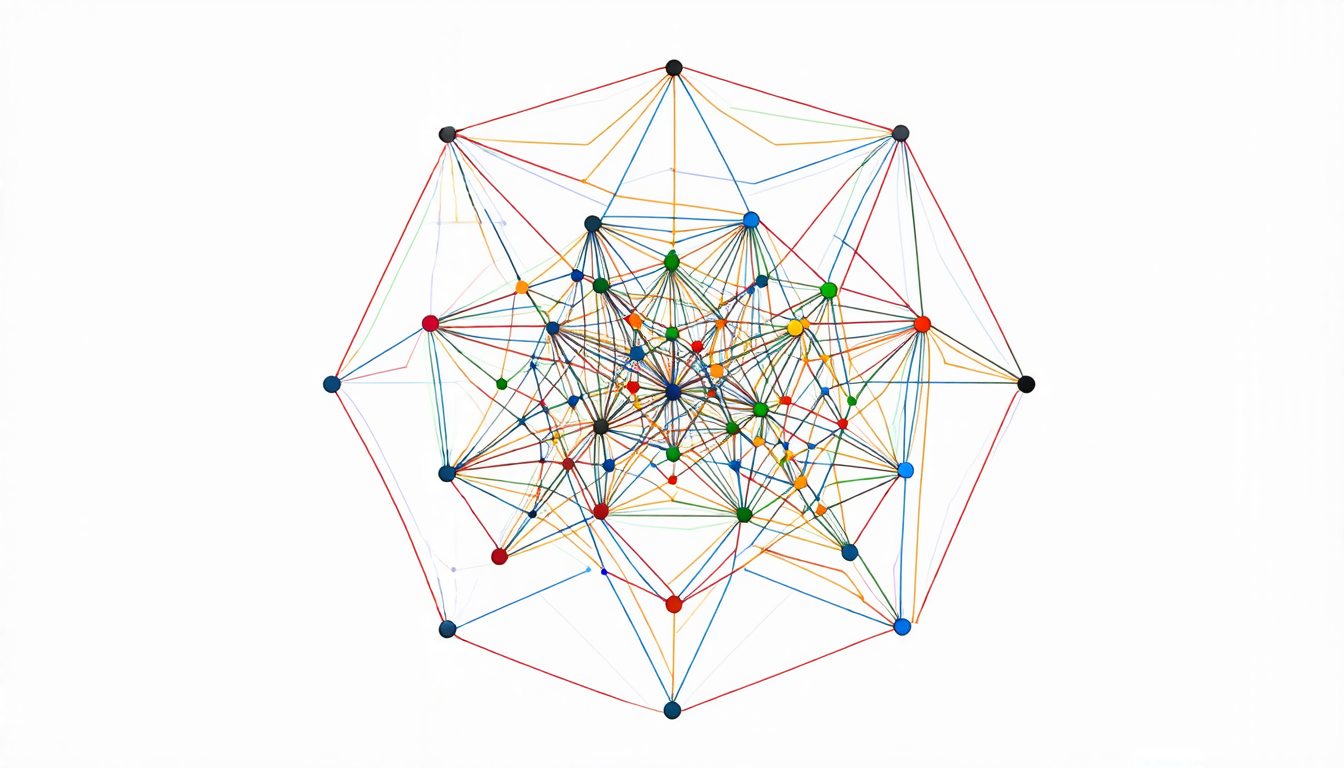
The study in question focuses on a particular type of cluster complex known as an X-evolution flow. This flow is characterized by a series of connected nodes, each representing a distinct phase or state within the system. The researchers were able to identify a set of rules that govern the behavior of these nodes, allowing them to predict the patterns and structures that emerge at different scales.
One of the key findings is that X-evolution flows can exhibit a property known as self-similarity. This means that the same patterns and structures are repeated at different scales, creating an intricate web-like network. The researchers were able to demonstrate this phenomenon using computer simulations, which showed that the flow’s behavior was consistent across a wide range of initial conditions.
The study also explored the relationship between X-evolution flows and another important concept in mathematics: triangulations. Triangulations are geometric structures composed of triangles, which can be used to describe the properties of complex systems. The researchers found that the nodes of an X-evolution flow correspond to specific types of triangles, allowing them to map the flow’s behavior onto a triangulation.
This connection between X-evolution flows and triangulations has important implications for our understanding of complex systems. It suggests that these systems may be governed by a set of underlying rules or patterns, which can be used to predict their behavior at different scales. This could have significant applications in fields such as physics, biology, and economics.
The researchers also discovered that X-evolution flows exhibit a property known as stability, meaning that they remain consistent over time despite changes in the initial conditions. This is an important finding, as it suggests that complex systems may be more predictable than previously thought.
Overall, this study offers a fresh perspective on the behavior of cluster complexes and their role in describing complex systems.
Cite this article: “Unraveling the Rules of Complex Systems: A Study on X-Evolution Flows”, The Science Archive, 2025.
Cluster Complexes, X-Evolution Flows, Self-Similarity, Triangulations, Complex Systems, Mathematics, Physics, Biology, Economics, Stability, Patterns





