

Saturday 15 March 2025
Scientists have made a significant breakthrough in developing a more precise and efficient control system for quadrotor drones, which could have major implications for their use in various industries.
The problem with controlling these drones is that they are inherently unstable and require complex calculations to stay aloft. Current systems rely on linearized models of the drone’s behavior, which can lead to inaccuracies and instability. To overcome this issue, researchers have developed an error-state Linear Quadratic Regulator (LQR) approach.
The key innovation is the use of exponential coordinates to represent orientation errors. This allows for a more compact and singularity-free representation of orientation errors, making it easier to control the drone’s movements. The LQR controller uses these coordinates to minimize deviations from a nominal trajectory, ensuring that the drone stays on course.
The new system was tested on a lemniscate trajectory, which involves following a curved path while keeping a constant yaw angle. The results showed that the error-state LQR controller outperformed traditional methods in terms of tracking performance and stability.
One of the major advantages of this approach is its ability to handle complex maneuvers with ease. Traditional control systems often struggle to keep up with rapid changes in direction or altitude, which can lead to instability and loss of control. The error-state LQR controller, however, is able to adapt quickly and smoothly to changing conditions, making it ideal for applications such as search and rescue, surveillance, and package delivery.
Another significant benefit is its ability to integrate seamlessly with existing systems. The bodyrate controller, which regulates the drone’s angular velocity, can be easily cascaded with the LQR controller to produce a stable and efficient control system.
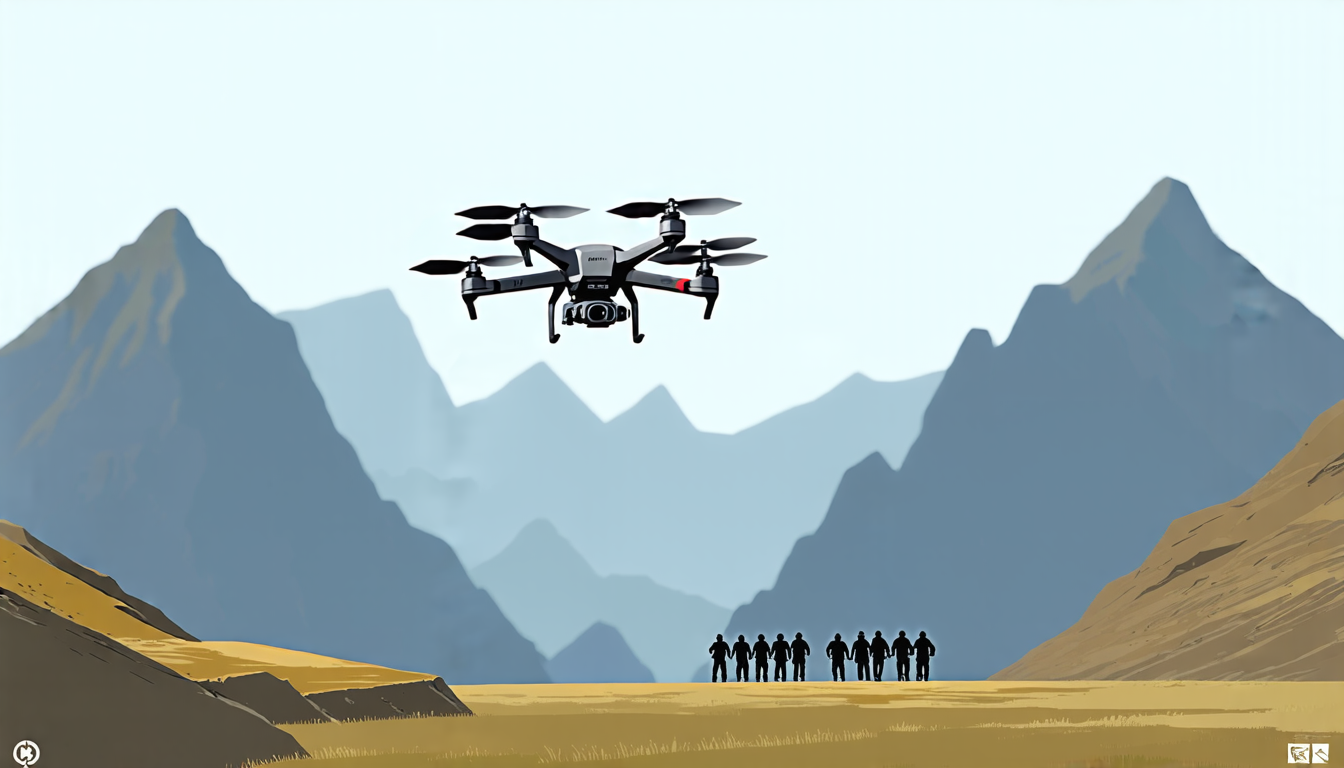
The development of this technology has far-reaching implications for various industries that rely on drones for their operations. For example, search and rescue teams could use these more precise control systems to navigate through complex terrain and locate missing persons or survivors more quickly and efficiently. Similarly, package delivery companies could benefit from the improved stability and maneuverability of these drones, allowing them to transport goods over longer distances with greater precision.
In addition to its practical applications, this research also pushes the boundaries of our understanding of drone control systems. The use of exponential coordinates and error-state LQR controllers opens up new avenues for research into more complex and dynamic control problems, which could have far-reaching implications for fields such as robotics and artificial intelligence.
Cite this article: “Precision Control Breakthrough in Quadrotor Drones”, The Science Archive, 2025.
Quadrotor Drones, Control Systems, Linearized Models, Lqr Controllers, Exponential Coordinates, Orientation Errors, Trajectory Tracking, Stability, Search And Rescue, Package Delivery
Reference: Micah Reich, “Error-State LQR Formulation for Quadrotor UAV Trajectory Tracking” (2025).





