

Saturday 15 March 2025
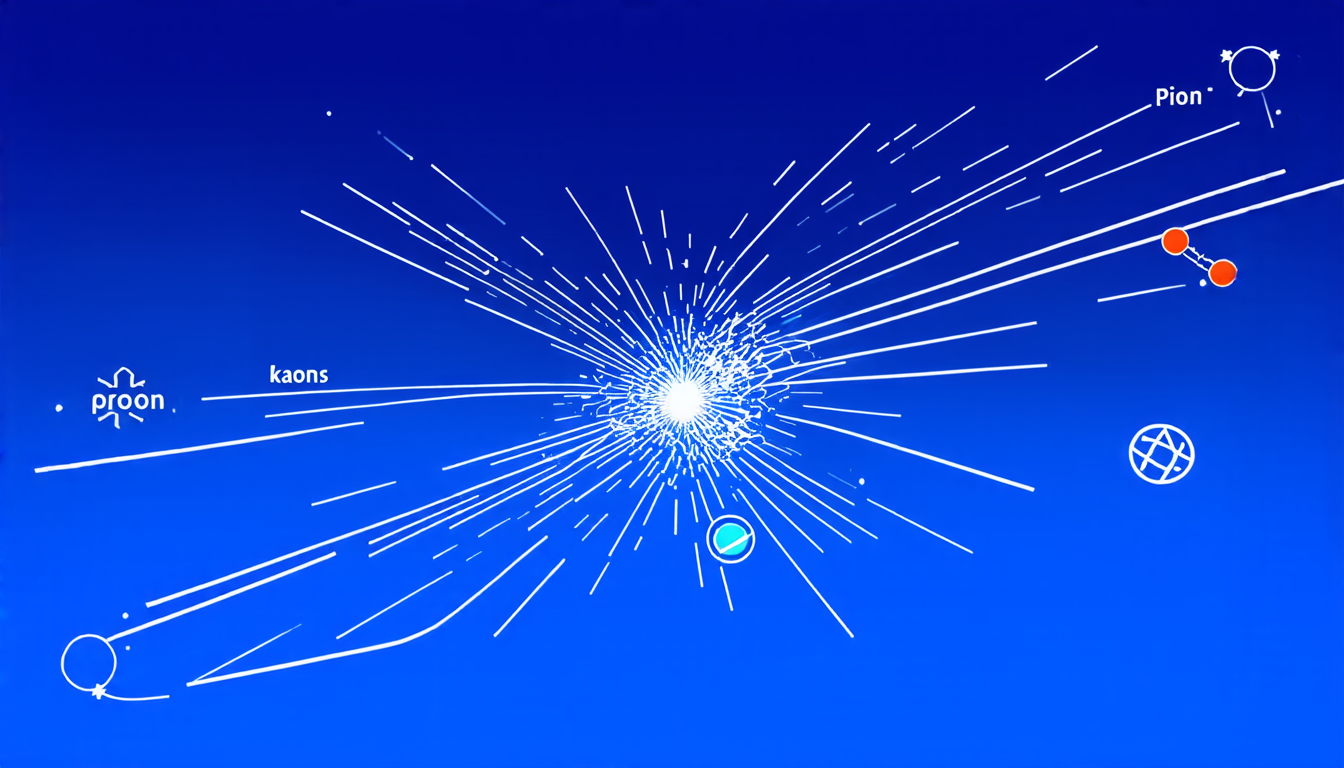
Scientists have been studying the particles that are produced when high-energy collisions occur in particle accelerators, such as those used at the Large Hadron Collider. These collisions can create a vast array of subatomic particles, including pions, kaons, and protons. Researchers are interested in understanding how these particles interact with each other and what properties they possess.
One way scientists study these interactions is by analyzing the patterns of particle emissions that occur in the collisions. This is done using a technique called femtoscopy, which involves measuring the distance between pairs of particles as they emerge from the collision site. By studying these distances, researchers can learn about the properties of the particles and how they interact with each other.
Recently, scientists have been able to study the interactions between pions, kaons, and protons in high-energy collisions using a technique called multiphase transport modeling. This approach allows researchers to simulate the behavior of these particles as they move through a medium, such as a plasma or a gas.
The results of these studies are providing new insights into the properties of subatomic particles and how they interact with each other. For example, scientists have been able to study the way that pions and kaons behave in collisions at high energies. They have found that these particles tend to move together in groups, rather than separately, when they collide.
This behavior is thought to be caused by the strong force of attraction between the particles. The strong force is a fundamental force of nature that holds quarks together inside protons and neutrons. It also causes pions and kaons to interact with each other in certain ways.
The study of these interactions has important implications for our understanding of the universe. For example, scientists believe that the early universe was once a hot, dense plasma in which particles were constantly interacting with each other. By studying the behavior of subatomic particles at high energies, researchers can gain insights into what the early universe may have been like.
In addition to its importance for understanding the universe, this research also has practical applications. For example, it could help scientists develop new technologies for generating high-energy particle beams, which are used in a variety of applications, including medical treatments and materials testing.
Overall, the study of subatomic particles at high energies is providing new insights into the fundamental nature of matter and the universe. By studying these interactions, researchers can gain a deeper understanding of the properties of subatomic particles and how they interact with each other.
Cite this article: “Unlocking the Secrets of Subatomic Particles at High Energies”, The Science Archive, 2025.
Particles, Accelerators, Collisions, Pions, Kaons, Protons, Femtoscopy, Multiphase Transport Modeling, Strong Force, Quarks





