

Saturday 15 March 2025
The quest for efficient resource management in cloud-edge continuums has been an ongoing challenge, as the dynamic nature of these networks demands adaptive solutions that can keep pace with changing conditions. In a recent paper, researchers proposed a novel approach that leverages distributed local and global learning to optimize resource allocation.
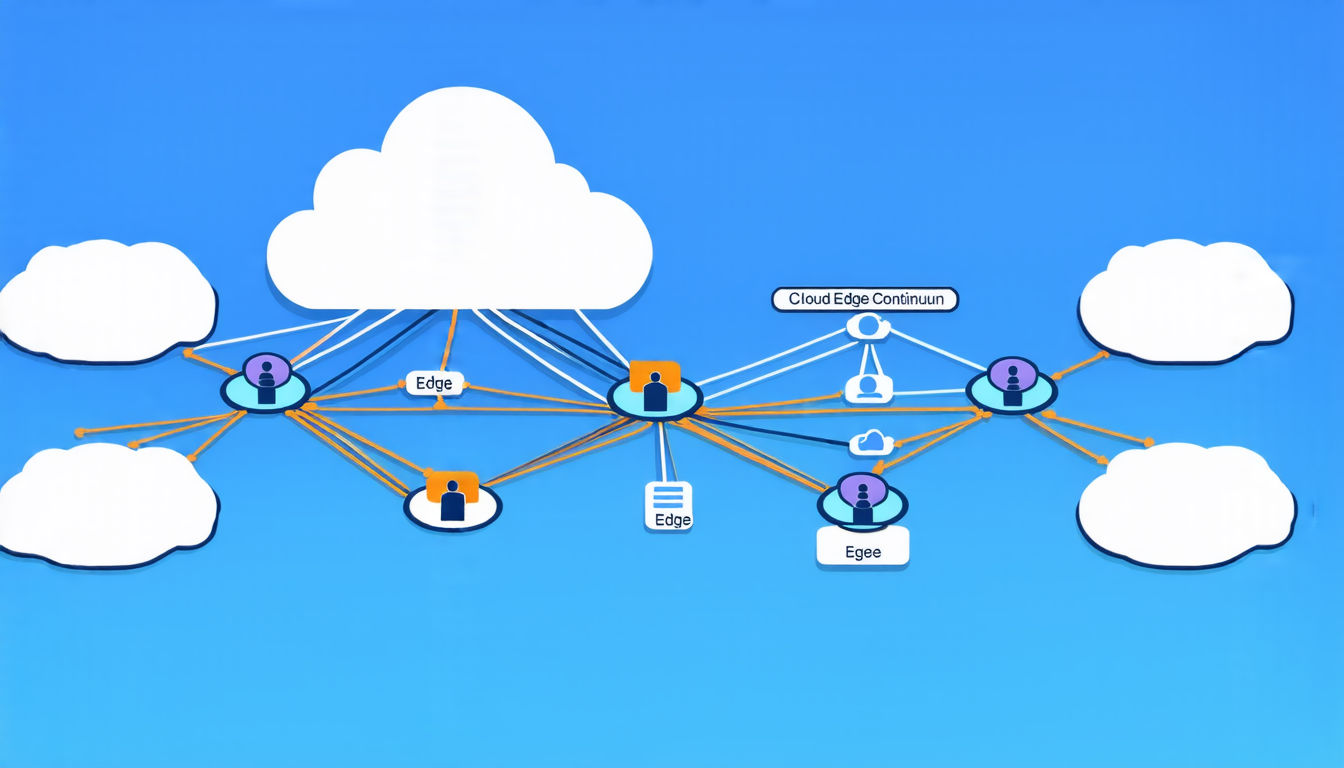
At its core, this method relies on a hierarchical system organization, where decentralized agents operate at both local and global levels. Local agents, responsible for managing resource nodes within their designated areas, are pre-trained using reinforcement learning (RL) techniques. These agents are then jointly trained with a global agent that aggregates information from all local agents to optimize application placement and resource allocation.
The benefits of this approach become apparent when considering the scalability and adaptability it offers. By decentralizing decision-making, the system can respond quickly to dynamic changes in network topology and resource availability, ensuring efficient use of resources. Moreover, the hierarchical structure allows for a balance between local optimization and global coordination, enabling the system to adapt to changing conditions while maintaining overall efficiency.
The researchers also explored various optimization techniques to enhance the performance of their approach. Graph Neural Networks (GNNs) were employed to encode the graph states of resource networks and application components, providing a compact representation that aids decision-making. Additionally, Multi-Agent Deep Reinforcement Learning was used to optimize resource allocation, leveraging the strengths of decentralized agents to adapt to changing conditions.
The authors also recognized the importance of evaluating their approach in realistic settings. To this end, they proposed using simulation frameworks to validate the practicality and robustness of their system. By testing their approach in a simulated environment, they can fine-tune parameters and assess its performance under various scenarios before deploying it in real-world applications.
The implications of this work are far-reaching, as it has the potential to revolutionize resource management in cloud-edge continuums. By providing a scalable and adaptive solution that can respond to changing conditions, this approach offers significant benefits for industries reliant on these networks, such as healthcare, finance, and telecommunications.
In summary, the researchers have proposed an innovative approach to optimizing resource allocation in cloud-edge continuums by leveraging distributed local and global learning. Their method, which combines reinforcement learning with graph neural networks and multi-agent deep reinforcement learning, has the potential to revolutionize the field of resource management. By providing a scalable and adaptive solution that can respond to changing conditions, this approach offers significant benefits for industries reliant on these networks.
Cite this article: “Optimizing Resource Allocation in Cloud-Edge Continuums through Distributed Learning”, The Science Archive, 2025.
Cloud-Edge Continuum, Resource Management, Reinforcement Learning, Graph Neural Networks, Multi-Agent Deep Reinforcement Learning, Distributed Learning, Hierarchical System Organization, Scalability, Adaptability, Optimization Techniques.





