

Sunday 16 March 2025
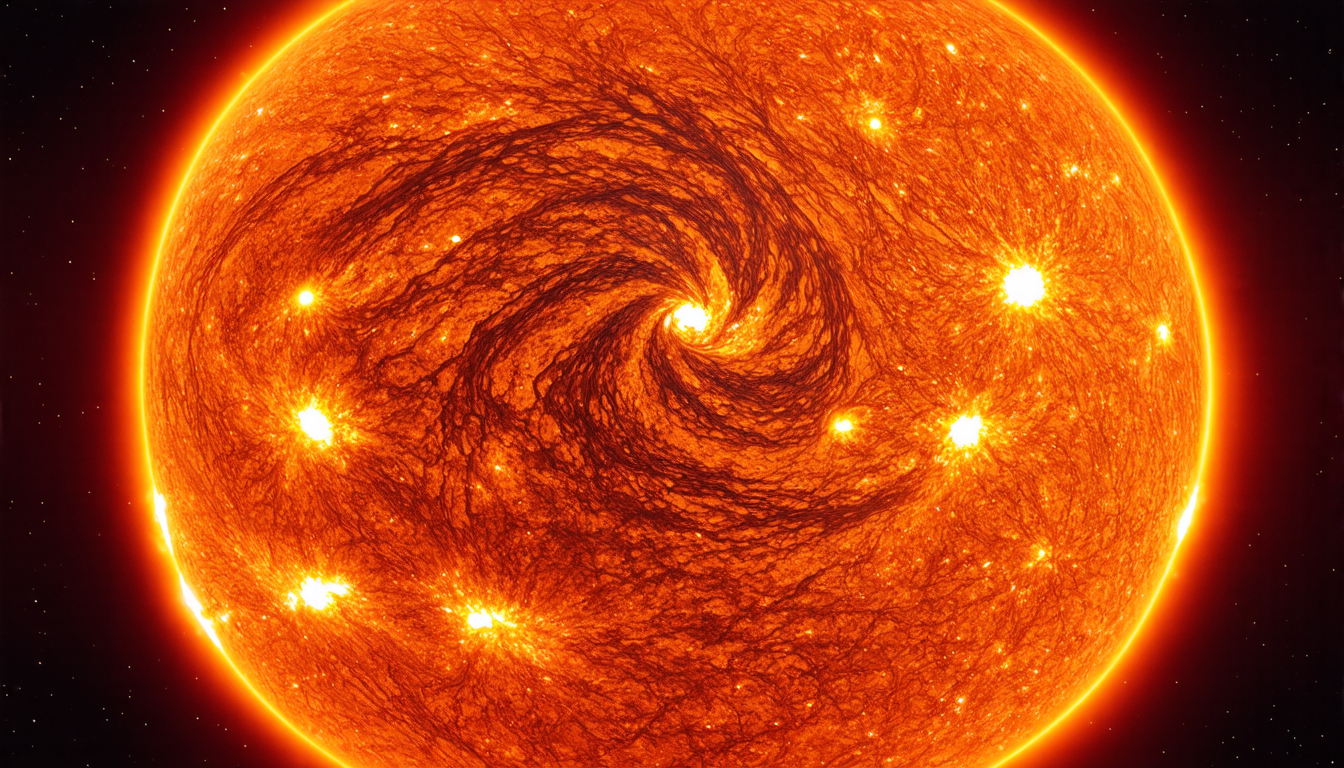
Scientists have long been fascinated by the Sun’s internal dynamics, and a new study sheds light on how solar inertial modes – slow, oscillating waves of hot plasma that circle the Sun – interact with its magnetic field.
Using complex computer simulations, researchers were able to model these modes in unprecedented detail, revealing a surprising connection between the Sun’s rotation rate and the behavior of these waves. The findings have significant implications for our understanding of the Sun’s internal workings and could even help improve forecasts of space weather events like solar flares and coronal mass ejections.
The study begins by explaining that the Sun’s magnetic field plays a crucial role in shaping its internal dynamics. The field is generated by the movement of molten iron at the Sun’s core, and it’s strong enough to influence the behavior of hot plasma that flows through the Sun’s interior. Inertial modes are one type of plasma oscillation that arises from this interaction.
The researchers used a powerful computer code called Dedalus to simulate the behavior of inertial modes in the Sun’s interior. They created three different models, each representing a simplification of the real solar dynamics: compressible, anelastic, and Boussinesq. The first two models accounted for the effects of density changes on the plasma’s motion, while the third model ignored these effects.
The team found that the anelastic model, which assumed that the plasma’s density remains constant, provided a remarkably good match to the behavior of inertial modes observed in the Sun. This suggests that density changes may not play as significant a role in shaping solar inertial modes as previously thought.
Another key finding was the connection between the Sun’s rotation rate and the frequency of inertial modes. The researchers discovered that slower-rotating regions of the Sun hosted more frequent oscillations, while faster-rotating areas had fewer. This correlation has important implications for understanding the Sun’s internal dynamics and could even help scientists predict when and where solar flares are likely to occur.
The study also highlights the importance of considering the magnetic field’s influence on inertial modes. The team found that neglecting this effect in their simulations led to significant errors in predicting the modes’ behavior.
The research has far-reaching implications for our understanding of the Sun’s internal workings and its impact on space weather. By refining our models of solar inertial modes, scientists can better predict when and where solar flares will occur, which is crucial for protecting both satellites and astronauts from these powerful events.
Cite this article: “Unraveling the Suns Internal Dynamics: New Study Reveals Surprising Connection Between Rotation Rate and Solar Inertial Modes”, The Science Archive, 2025.
Sun, Magnetic Field, Plasma Oscillation, Inertial Modes, Solar Dynamics, Space Weather, Computer Simulations, Dedalus, Boussinesq Model, Anelastic Model.





