

Sunday 16 March 2025
Scientists have made a major breakthrough in the field of polaritonics, a discipline that combines optics and condensed matter physics to create exotic states of matter. Researchers have successfully trapped and manipulated exciton-polaritons – quasiparticles that arise from the interaction between light and matter – using a unique perovskite material.
The achievement is significant because it allows for the creation of high-ordered angular harmonics, which are crucial for the development of reconfigurable and structured room temperature nonlinear lasing. The technique also opens up new possibilities for the study of quantum fluids and their properties.
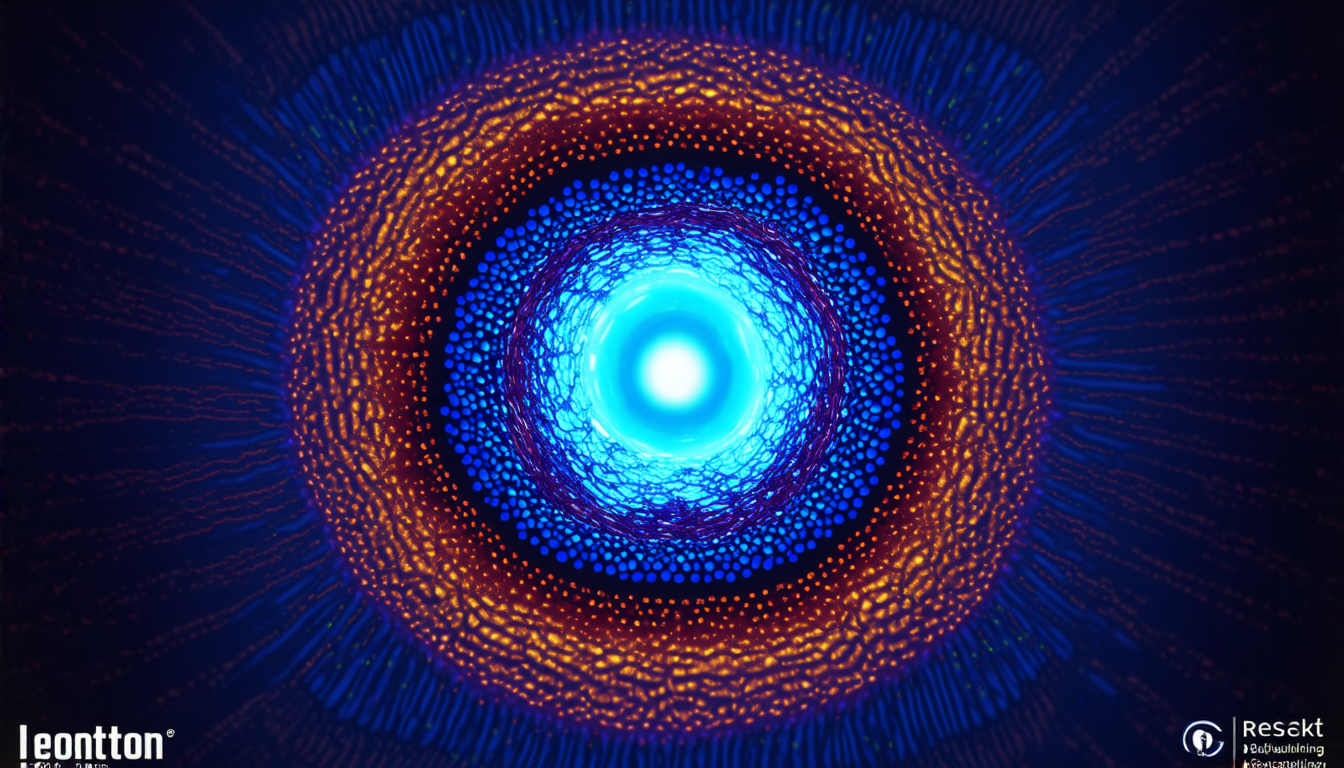
To achieve this milestone, scientists used a perovskite microcavity filled with a monocrystalline CsPbBr3 material. They employed an annular non-resonant excitation profile to focus light onto the perovskite, creating a polariton potential barrier at the maxima of the focused field.
The resulting optical trap allowed for the condensation of exciton-polaritons into high-ordered modes, which were then studied using advanced microscopy techniques. The researchers observed power-driven switching between different transverse modes of the optically induced trap, demonstrating the ability to control and manipulate the polariton fluid.
The implications of this research are far-reaching. Polaritons have been shown to possess strong optical nonlinearities due to their exciton constituent, making them ideal for applications in quantum information processing, neuromorphic computing, and optimization.
Moreover, the ability to trap and manipulate exciton-polaritons at room temperature using perovskite materials paves the way for the development of novel optoelectronic devices. These devices could potentially enable new forms of data storage and processing, as well as advanced sensing and imaging capabilities.
The study also sheds light on the fundamental properties of quantum fluids, which are critical for understanding many-body interactions and phase transitions in condensed matter systems. The discovery of high-ordered angular harmonics in exciton-polaritons may lead to a deeper understanding of these complex phenomena.
In summary, scientists have made significant progress in the field of polaritonics by trapping and manipulating exciton-polaritons using perovskite materials. This breakthrough has far-reaching implications for quantum information processing, neuromorphic computing, optimization, and our understanding of quantum fluids.
Cite this article: “Trapping and Manipulating Exciton-Polaritons: A Breakthrough in Polaritonics”, The Science Archive, 2025.
Polaritonics, Exciton-Polaritons, Perovskite Materials, Optics, Condensed Matter Physics, Quantum Fluids, Nonlinear Lasing, Room Temperature, Optoelectronics, Neuromorphic Computing





