

Sunday 16 March 2025
For centuries, humans have been fascinated by the mysteries of the universe. One of the most intriguing questions has always been how stars and planets form. Astronomers have long studied the process, but it’s only in recent years that they’ve made significant progress.
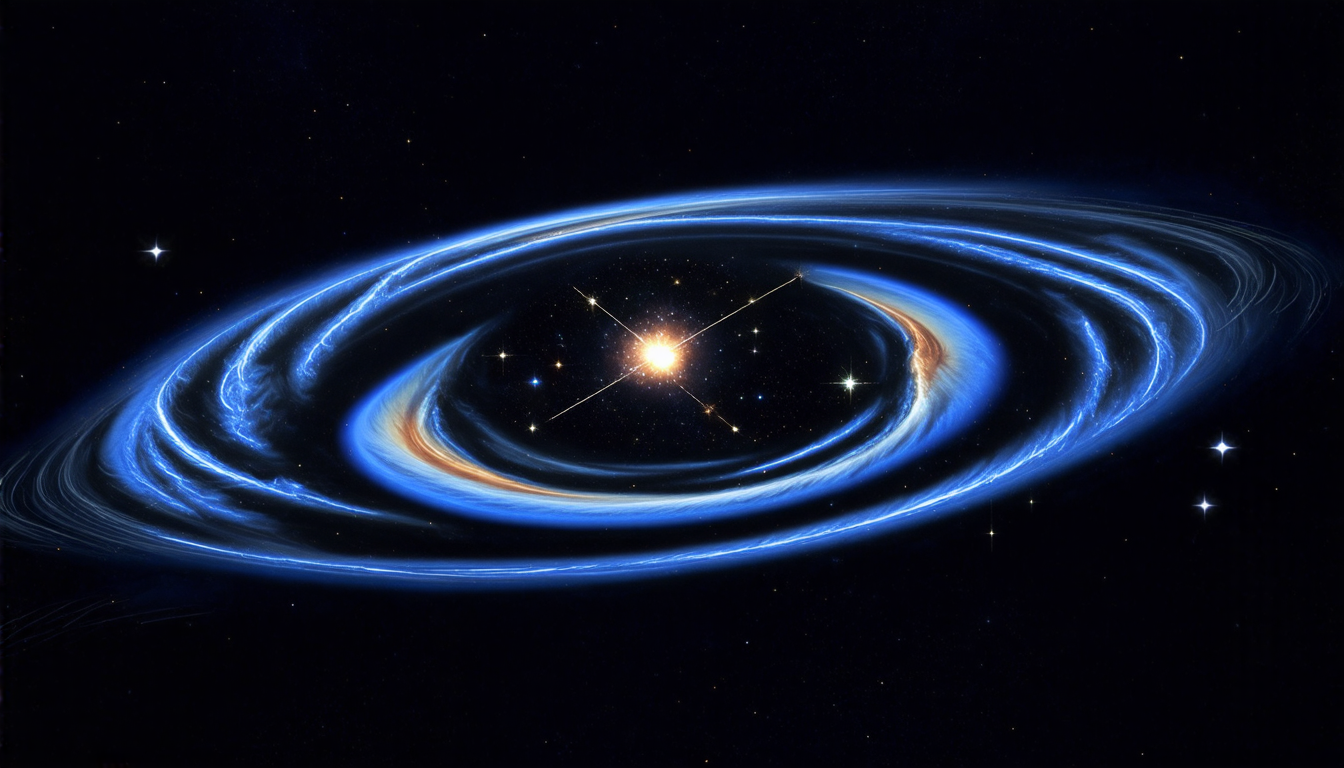
The latest breakthrough comes from a team of scientists who used a powerful telescope called SOFIA to study a young star called HL Tau. Located about 140 light-years away, HL Tau is surrounded by a swirling disk of gas and dust that could potentially give birth to new planets.
Using SOFIA’s HAWC+ instrument, the researchers observed HL Tau in different wavelengths of infrared light. They were able to detect the polarization of this light, which revealed the presence of magnetic fields in the star’s surroundings.
Polarization is a phenomenon where light waves vibrate in a specific direction as they travel through space. In this case, the scientists found that the polarization was oriented in a way that suggested the magnetic field was aligned with the disk’s rotation.
This discovery is significant because it provides evidence for a long-suspected theory: that magnetic fields play a crucial role in shaping the formation of stars and planets. The alignment of the magnetic field with the disk’s rotation suggests that the field is influencing the motion of gas and dust within the disk, which could ultimately determine where planets form.
The researchers also found that the polarization patterns changed as they observed HL Tau at different wavelengths of light. This change suggests that there are different types of particles present in the disk, including tiny dust grains and larger rocks. The scientists believe that these particles could be the building blocks of future planets.
One of the most striking aspects of this research is its ability to reveal the intricate details of the star’s surroundings. By studying the polarization patterns, the team was able to create detailed maps of the magnetic field and particle distribution within the disk.
These findings have important implications for our understanding of planetary formation. They suggest that magnetic fields could be a key factor in shaping the architecture of planetary systems, influencing where planets form and how they evolve over time.
As scientists continue to study HL Tau and other young stars, they hope to uncover even more secrets about the universe’s most fundamental processes. The discovery of magnetic fields in the star’s surroundings is just one piece of a much larger puzzle that will ultimately help us better understand how our solar system came to be.
Cite this article: “Magnetic Fields Shape the Formation of Stars and Planets”, The Science Archive, 2025.
Stars, Planets, Formation, Magnetic Fields, Polarization, Infrared Light, Sofia, Hl Tau, Young Star, Planetary Systems





