

Sunday 16 March 2025
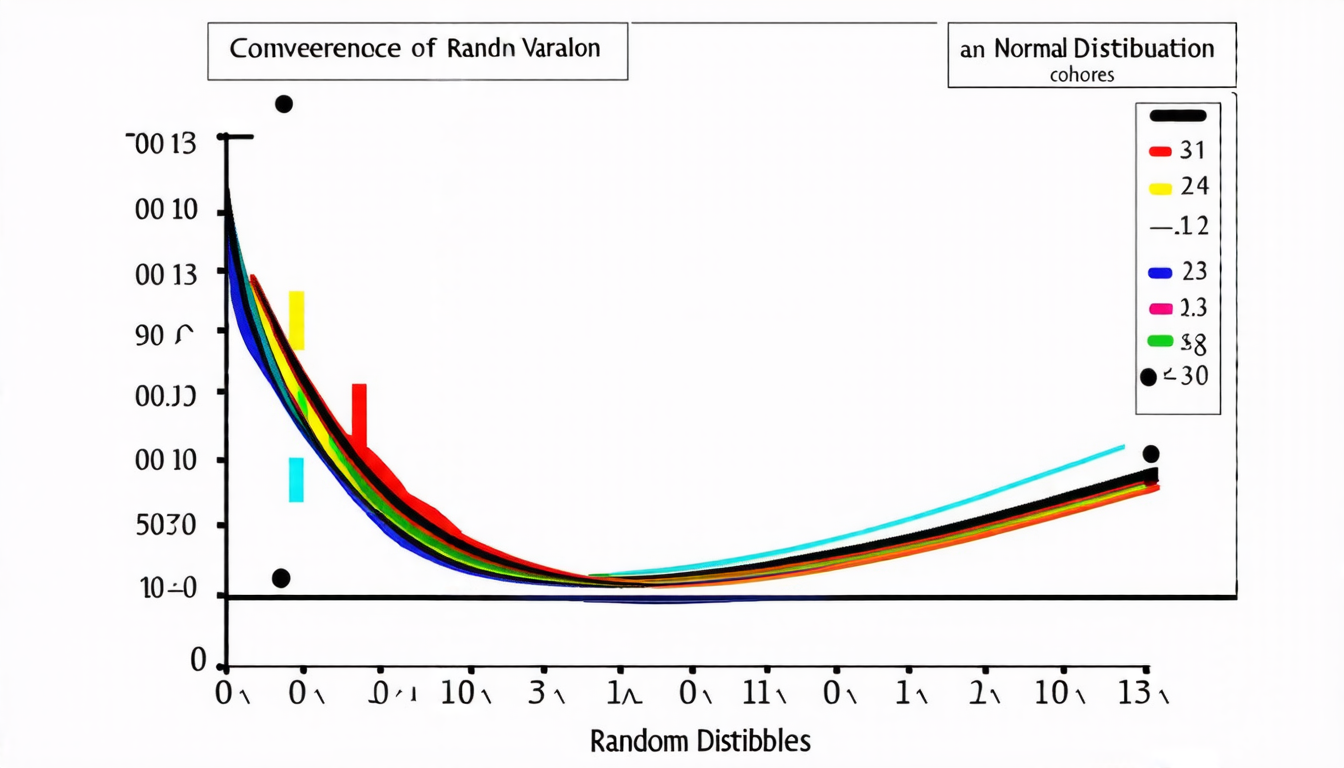
The central limit theorem, a cornerstone of probability theory, has been refined and re-examined by researchers seeking to better understand the behavior of random variables. This fundamental concept states that as the sum of many independent random variables grows, its distribution will converge to a normal distribution.
However, the conditions under which this convergence occurs have long been a subject of debate. A new study sheds light on this issue by introducing a novel formulation of the central limit theorem, one that is more intuitive and accessible than previous versions.
The key innovation lies in the introduction of a natural restriction, which allows for a transparent and straightforward formulation of the theorem. This restriction, based on the concept of uniform convergence, ensures that the sequence of random variables satisfies certain conditions necessary for the central limit theorem to hold.
In essence, the study shows that if a sequence of independent random variables with finite second moments converges uniformly, then the total variance must increase indefinitely for the central limit theorem to be valid. This result has far-reaching implications, as it provides a clear and concise framework for understanding when and how the central limit theorem applies.
The researchers’ approach begins by defining a sequence of functions that describe the distribution of each random variable. These functions, known as αn(s), are used to determine whether the sequence converges uniformly or not. If the sequence does converge uniformly, then the total variance must increase indefinitely for the central limit theorem to hold.
This result has significant implications for various fields, including statistics, finance, and engineering. In these domains, the central limit theorem is often employed as a tool for modeling complex systems and making predictions about their behavior. By refining our understanding of this theorem, researchers can develop more accurate models and make more informed decisions.
The study’s findings also highlight the importance of considering the total variance when applying the central limit theorem. In many cases, the assumption that the total variance is constant or finite may be unrealistic, and neglecting to account for its growth can lead to inaccurate results.
In addition to its theoretical significance, this research has practical applications in fields such as finance, where it can help portfolio managers make more informed investment decisions by taking into account the uncertainty associated with different assets. Similarly, in engineering, understanding the behavior of random variables is crucial for designing and optimizing complex systems.
The study’s authors hope that their work will inspire further research into the central limit theorem and its applications.
Cite this article: “Refining the Central Limit Theorem: New Insights and Implications”, The Science Archive, 2025.
Central Limit Theorem, Probability Theory, Random Variables, Normal Distribution, Uniform Convergence, Total Variance, Statistics, Finance, Engineering, Uncertainty.
Reference: Alexander Shmyrov, Vasily Shmyrov, “On a formulation of the central limit theorem” (2025).





