

Wednesday 19 March 2025
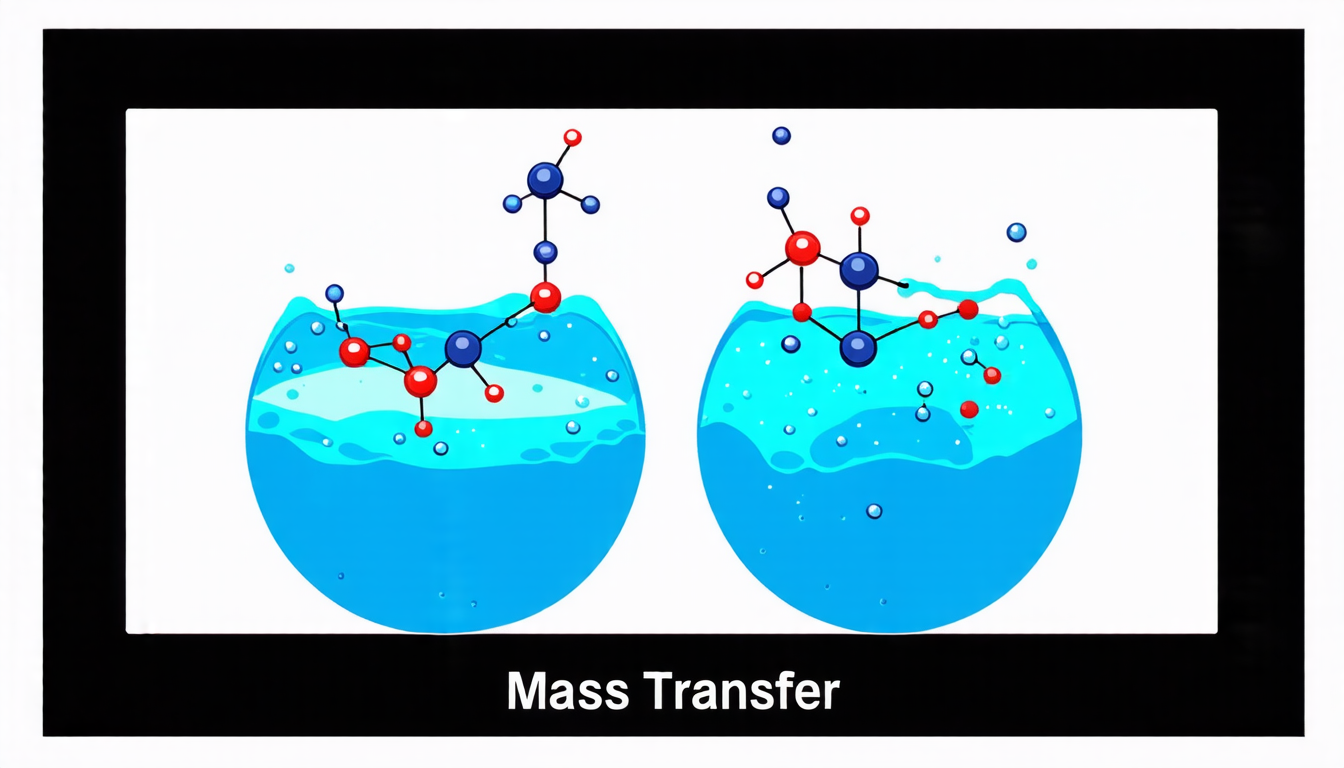
Scientists have long struggled to understand how molecules move across the boundary between two liquids, a process known as mass transfer. This phenomenon is crucial in many natural and industrial systems, from ocean currents to chemical reactions. Now, researchers have made a significant breakthrough in understanding this complex process.
The key challenge lies in modeling the behavior of molecules at the interface between two fluids. Unlike the smooth flow of molecules within each liquid, the interface is a chaotic region where molecules are constantly jumping back and forth between the two liquids. To make matters worse, the properties of the interface, such as its thickness and composition, can vary greatly depending on factors like temperature, pressure, and the presence of surfactants.
To tackle this problem, researchers developed a new mathematical framework that combines insights from thermodynamics, statistical mechanics, and fluid dynamics. The approach is based on the concept of sharp interfaces, where the transition between the two liquids occurs over an extremely thin layer, essentially zero thickness. This allows scientists to focus on the behavior of molecules at the interface rather than trying to model the entire system.
The new framework has been tested against experimental data and simulations, showing remarkable agreement. It has also enabled researchers to make accurate predictions about mass transfer rates in various systems, from simple liquids to complex chemical reactions.
One of the key implications of this research is its potential to improve our understanding of natural phenomena like ocean currents and atmospheric circulation patterns. By better grasping how molecules move across interfaces, scientists may be able to refine their models of these complex systems, leading to more accurate predictions about climate change and other environmental issues.
The breakthrough also has significant industrial applications. In chemical processing plants, for example, mass transfer plays a critical role in the production of pharmaceuticals, fertilizers, and other chemicals. By optimizing the design of reactors and interfaces, manufacturers may be able to improve efficiency and reduce costs.
In addition to its practical implications, this research highlights the importance of interdisciplinary collaboration in scientific inquiry. By combining insights from multiple fields, researchers have been able to develop a more complete understanding of mass transfer and its role in complex systems. As science continues to evolve, it is likely that similar collaborations will lead to further breakthroughs and innovations.
Ultimately, this research demonstrates the power of rigorous mathematical modeling in uncovering the hidden patterns and mechanisms that govern our world. By developing new tools and frameworks for analyzing complex phenomena, scientists can gain a deeper understanding of the natural world and unlock new possibilities for innovation and discovery.
Cite this article: “Unraveling Mass Transfer: A Breakthrough in Understanding Molecule Movement Across Liquids”, The Science Archive, 2025.
Mass Transfer, Molecular Movement, Interface, Liquids, Thermodynamics, Statistical Mechanics, Fluid Dynamics, Sharp Interfaces, Chemical Reactions, Climate Change.





