

Wednesday 19 March 2025
Scientists have been working tirelessly to crack the code of identifying unique geochemical fingerprints for geological formations, a crucial step in understanding the ancient history of our planet. Recently, a team has made significant progress in this area, using a combination of advanced statistics and rock analysis.
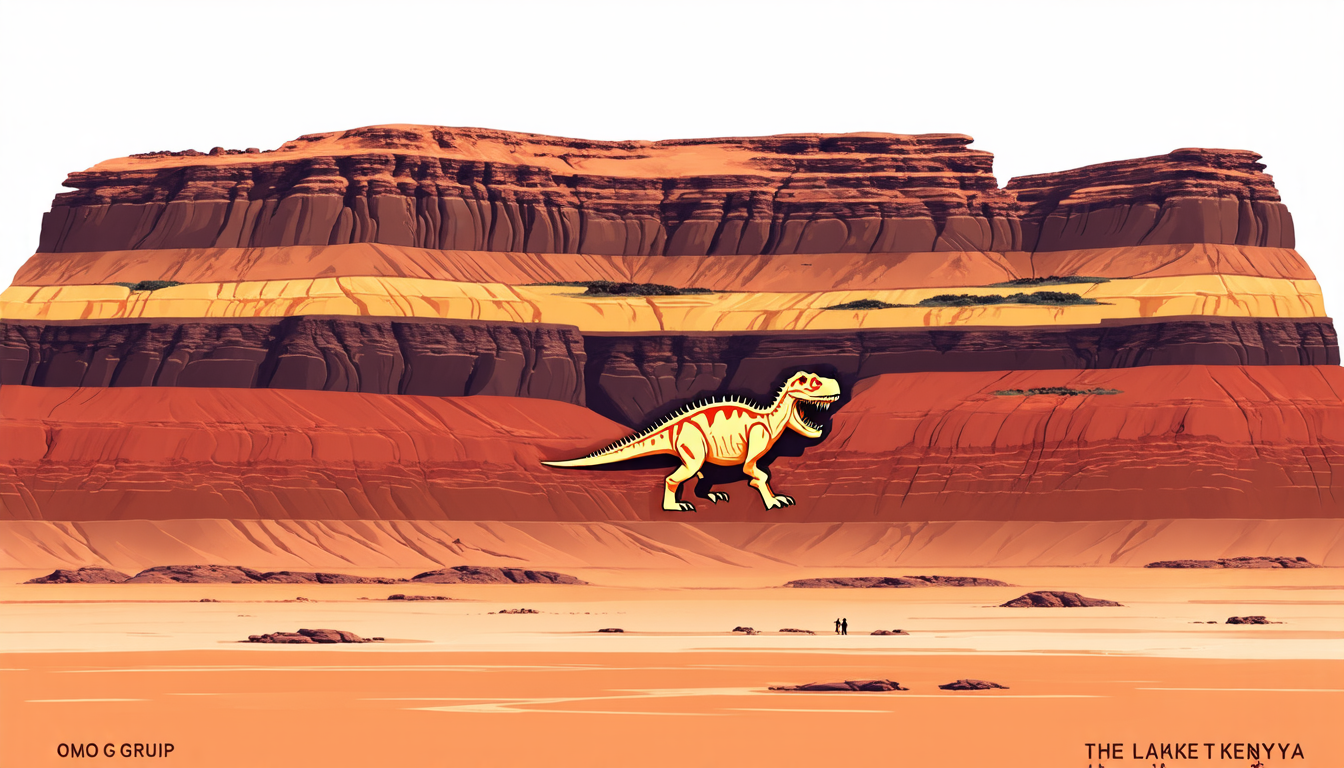
The study focused on the Omo Group of Lake Turkana in Kenya, an area rich in fossil findings that date back millions of years. The researchers collected geochemical data from 300 rock samples and used it to identify unique combinations of chemical compounds that could serve as a fingerprint for each formation.
One of the key challenges in this field is distinguishing between formations with similar chemical signatures. To overcome this, the team employed Gaussian Discriminant Analysis (GDA), a statistical technique that fits each geochemical point cloud to its own Gaussian distribution. This allowed them to identify triplets of coordinates where the Gaussians don’t overlap, effectively creating a unique fingerprint for each formation.
The results were impressive: after testing every possible combination of coordinates, the researchers identified eight sets of coordinates where the Gaussian ellipsoids did not overlap with a probability threshold of 0.01. This means that if a new rock sample is analyzed and plotted in one or more of these coordinate systems, it can be confidently assigned to its corresponding formation.
This breakthrough has significant implications for paleontology and geology. By identifying unique geochemical fingerprints, scientists can better understand the geological history of an area, including the timing and sequence of events that shaped our planet over millions of years. This information can also help researchers pinpoint the origin of fossils found in a particular region.
The study’s findings are not limited to this specific location; the GDA technique can be applied to almost any geological problem where high-dimensional data is available. In fact, the team suggests that multidimensional geophysical measurements and rock physics data could be used to identify separable coordinate systems for other geological problems.
While there may still be challenges in applying this method to all geological formations, the researchers’ achievement marks a significant step forward in understanding our planet’s ancient history. By unlocking the secrets of geochemical fingerprints, scientists can gain a deeper appreciation for the complex and fascinating story of Earth’s evolution.
Cite this article: “Unlocking Geochemical Fingerprints to Reveal Earths Ancient History”, The Science Archive, 2025.
Geochemistry, Geology, Paleontology, Statistics, Rock Analysis, Gaussian Discriminant Analysis, Omo Group, Lake Turkana, Kenya, Fingerprinting





