

Wednesday 19 March 2025
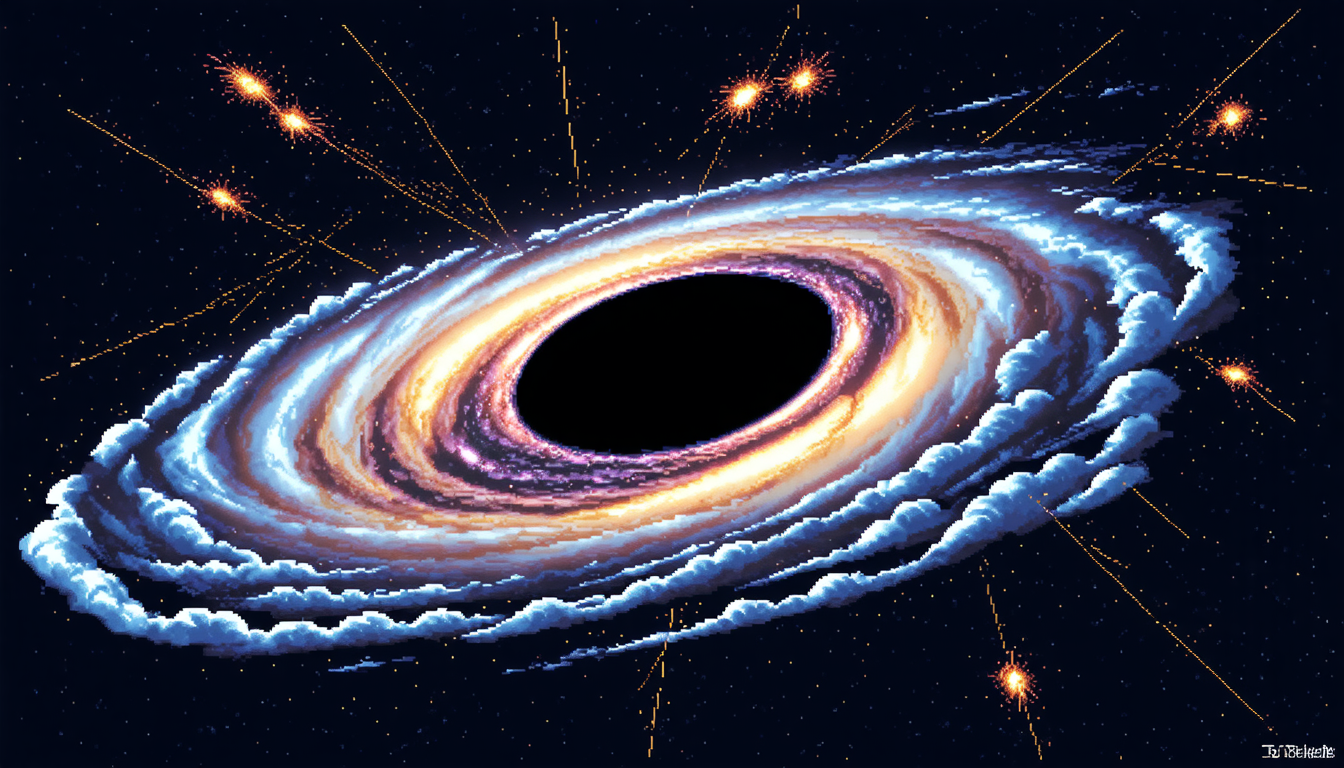
A team of astronomers has made a significant breakthrough in understanding how supermassive black holes at the centers of galaxies affect their surroundings. These behemoths, which can have masses millions or even billions of times that of our sun, are known to play a crucial role in shaping the evolution of galaxies.
The researchers used computer simulations to study how cosmic rays – high-energy particles accelerated by powerful explosions and shocks – interact with the hot gas surrounding black holes. They found that when these cosmic rays are injected into the gas at large scales, they can efficiently suppress cooling flows and quench star formation.
Cooling flows occur when gas in a galaxy’s halo cools down to the point where it becomes dense enough to collapse under its own gravity. This process is thought to trigger the formation of stars, but it can also lead to the growth of supermassive black holes as they feed on the cooled gas. However, the new research suggests that cosmic rays could provide an additional mechanism for regulating this process.
The simulations showed that when cosmic rays are injected into the hot gas at large scales, they create a complex network of magnetic fields and turbulent flows that can scatter and absorb the radiation emitted by the gas. This reduces the cooling rate of the gas, making it less likely to collapse and form stars.
The researchers also found that the injection site of the cosmic rays plays a crucial role in determining their impact on the surrounding gas. When they are injected near the black hole, they tend to be absorbed quickly, whereas those injected at larger scales can propagate more efficiently and have a greater impact on the cooling flow.
The study’s findings could have important implications for our understanding of galaxy evolution. Supermassive black holes are thought to play a key role in regulating the growth of galaxies over cosmic time, and the interaction between these black holes and their surroundings is still not fully understood.
The researchers used a combination of numerical simulations and analytical models to study the effects of cosmic rays on cooling flows. They found that the injection of cosmic rays can reduce the star formation rate in galaxies by up to 50%, making it an important mechanism for regulating galaxy evolution.
In addition, the study’s findings could also provide insight into the observed properties of galaxies. For example, some galaxies are known to have low levels of star formation activity, despite having abundant gas available for star formation. The suppression of cooling flows through cosmic rays could provide a mechanism for explaining this phenomenon.
Cite this article: “Cosmic Rays Regulate Galaxy Evolution by Suppressing Cooling Flows”, The Science Archive, 2025.
Supermassive Black Holes, Galaxies, Cosmic Rays, Cooling Flows, Star Formation, Galaxy Evolution, Magnetic Fields, Turbulent Flows, Radiation, Simulations





