

Wednesday 19 March 2025
The quest for optimal cell deployment and antenna configuration has long been a challenge in wireless network design. Researchers have been working to develop more efficient methods for determining the best placement of base stations and their antennas, but it’s only recently that significant progress has been made.
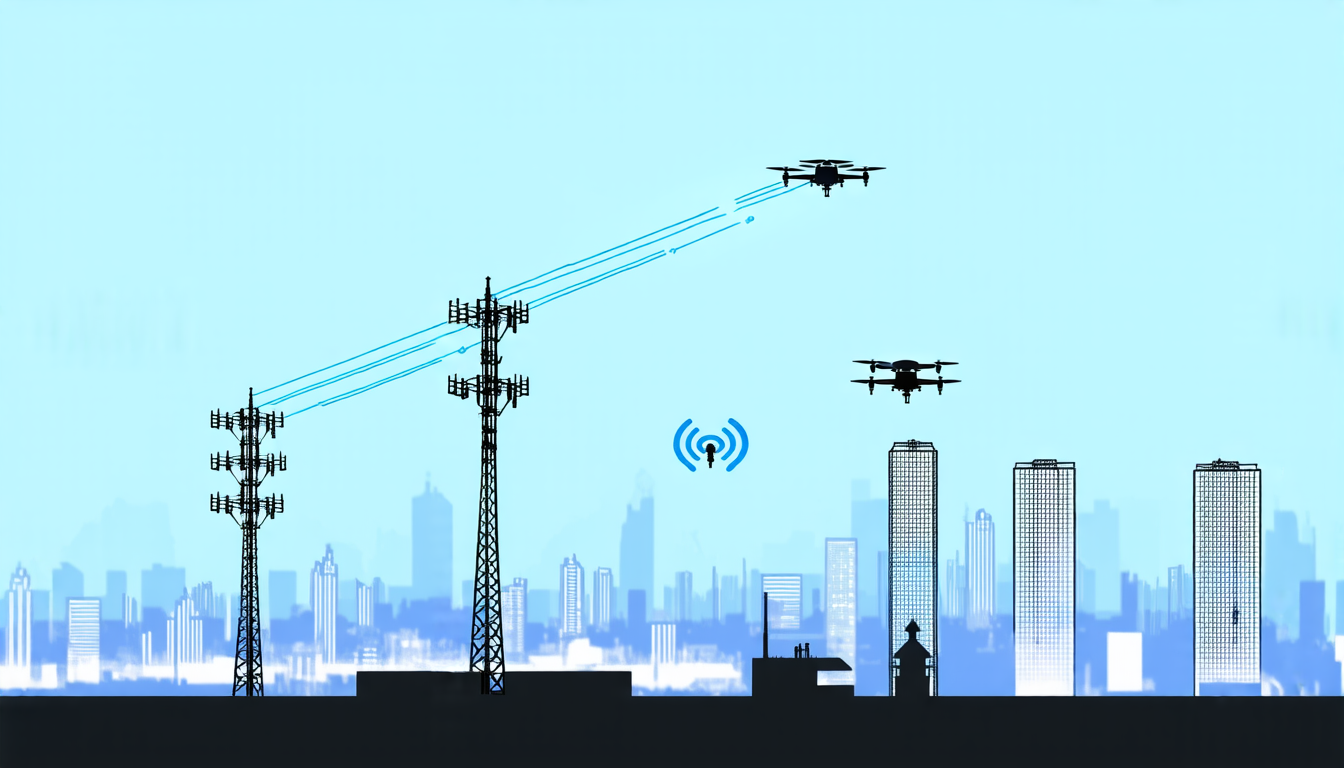
A new paper from Saeed Karimi-Bidhendi, Giovanni Geraci, and Hamid Jafarkhani presents a mathematical framework for optimizing cell deployment and antenna configuration in wireless networks. The framework is based on quantization theory and takes into account the complexities of heterogeneous 3D user populations comprising both ground users and uncrewed aerial vehicles (UAVs) along aerial corridors.
The authors’ approach involves modeling the network as a complex system, where each node represents a base station or UAV. By applying quantization theory to this model, they are able to optimize the placement of base stations and their antennas to achieve maximum coverage and capacity. This is done by iteratively updating the cell partitioning and antenna settings until an optimal solution is reached.
One of the key benefits of this approach is its ability to handle complex interference patterns between neighboring cells. The authors show that their method outperforms traditional methods in simulations, achieving better coverage and capacity while also reducing interference.
The implications of this work are significant, as it could lead to more efficient use of wireless network resources and improved service quality for users. For example, the optimized placement of base stations could reduce the number of cells needed to achieve a certain level of coverage, resulting in cost savings for network operators.
In addition, the authors’ framework could be applied to other areas where complex systems need to be optimized, such as sensor networks or IoT devices.
The paper’s findings are based on simulations and theoretical analysis, but the authors acknowledge that further research is needed to validate their results in real-world scenarios. Nevertheless, this work represents an important step forward in our understanding of how to optimize wireless network design for complex user populations.
Cite this article: “Optimizing Wireless Network Design for Heterogeneous User Populations”, The Science Archive, 2025.
Wireless Networks, Cell Deployment, Antenna Configuration, Quantization Theory, Heterogeneous 3D User Populations, Uavs, Complex Systems, Interference Patterns, Network Optimization, Iot Devices





