

Wednesday 19 March 2025
The pursuit of efficient algorithms has long been a cornerstone of computer science, driving innovation in fields like data storage, network optimization, and more. Recently, researchers have made significant progress in this area, discovering new connections between seemingly disparate concepts and uncovering fresh insights into the nature of graph theory.
At its core, graph theory is concerned with the study of relationships between objects, represented as nodes connected by edges. This abstract framework has far-reaching implications, influencing fields like computer networks, social network analysis, and even biology. However, the complexity of real-world graphs can be overwhelming, making it challenging to develop efficient algorithms for tasks like finding shortest paths or clustering nodes.
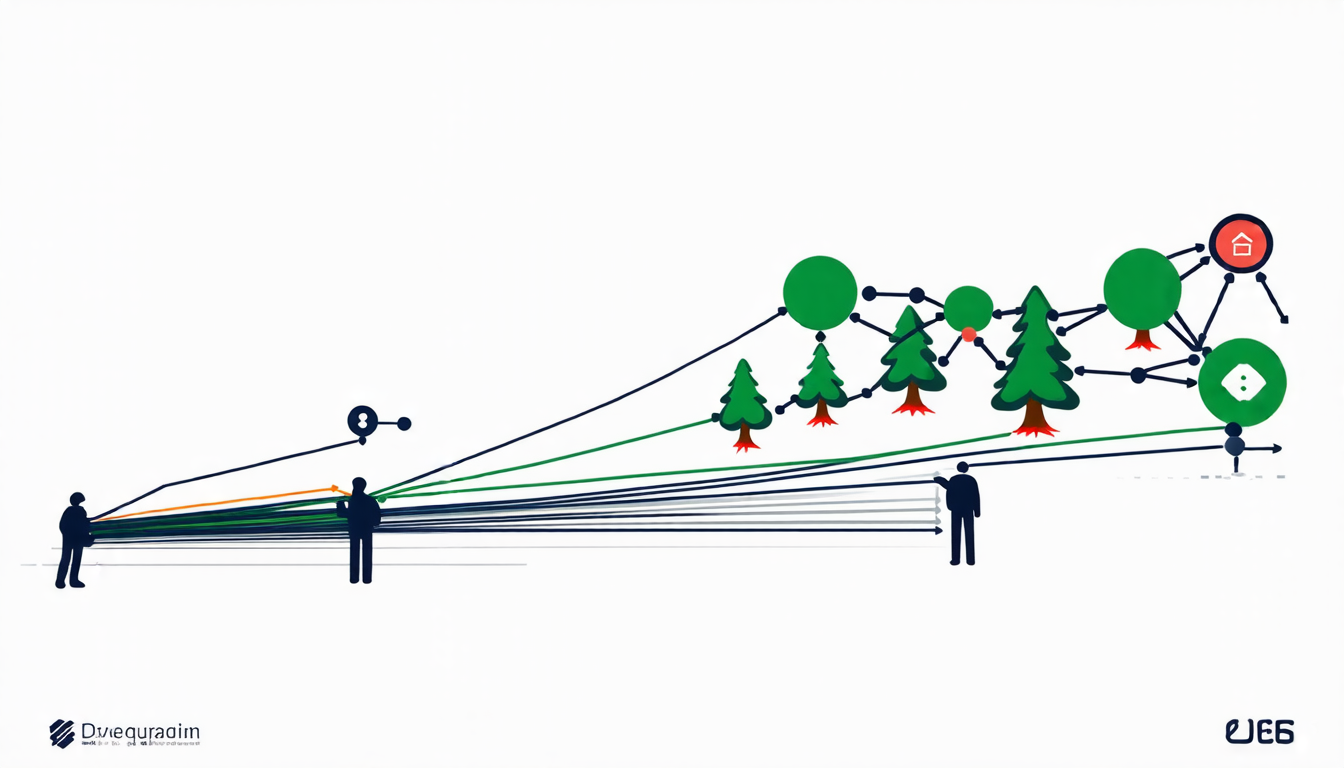
In a remarkable breakthrough, researchers have demonstrated that several graph parameters are coarsely equivalent, meaning they share a common underlying structure despite their seemingly disparate nature. This insight has far-reaching implications, as it allows developers to design more effective algorithms by exploiting these connections.
One key parameter is the tree- length of a graph, which measures the minimum number of edges required to connect all nodes in a tree-like structure. Another important concept is the tree-breadth, which captures the maximum distance between any two nodes in the graph. Traditionally, these parameters were considered distinct and difficult to relate.
The researchers’ findings reveal that not only are tree-length and tree-breadth closely linked but also share commonalities with other graph parameters like cluster-diameter, minimum fill-in, and more. This newfound understanding has significant implications for algorithm design, as it allows developers to leverage these connections to create more efficient solutions.
For instance, the researchers show that the minimum fill-in of a graph is tightly bounded by its tree-length, providing a new perspective on this long-standing problem. Similarly, they demonstrate that the cluster-diameter of a graph can be used to estimate its tree-breadth, offering a novel approach for clustering nodes in large datasets.
These findings also have practical implications for real-world applications. For example, network optimization problems like finding shortest paths or minimizing latency become more tractable when viewed through the lens of these connected parameters. Moreover, the researchers’ work paves the way for new algorithmic techniques and data structures that can better handle the complexities of large-scale graph processing.
The study’s authors have made their results available in a comprehensive paper, detailing the mathematical foundations and practical applications of their discoveries.
Cite this article: “New Connections Uncovered: Graph Theory Breakthroughs Enable More Efficient Algorithm Design”, The Science Archive, 2025.
Graph Theory, Algorithms, Data Storage, Network Optimization, Computer Science, Tree-Length, Tree-Breadth, Cluster-Diameter, Minimum Fill-In, Graph Parameters
Reference: Feodor F. Dragan, “Graph parameters that are coarsely equivalent to tree-length” (2025).





