

Wednesday 19 March 2025
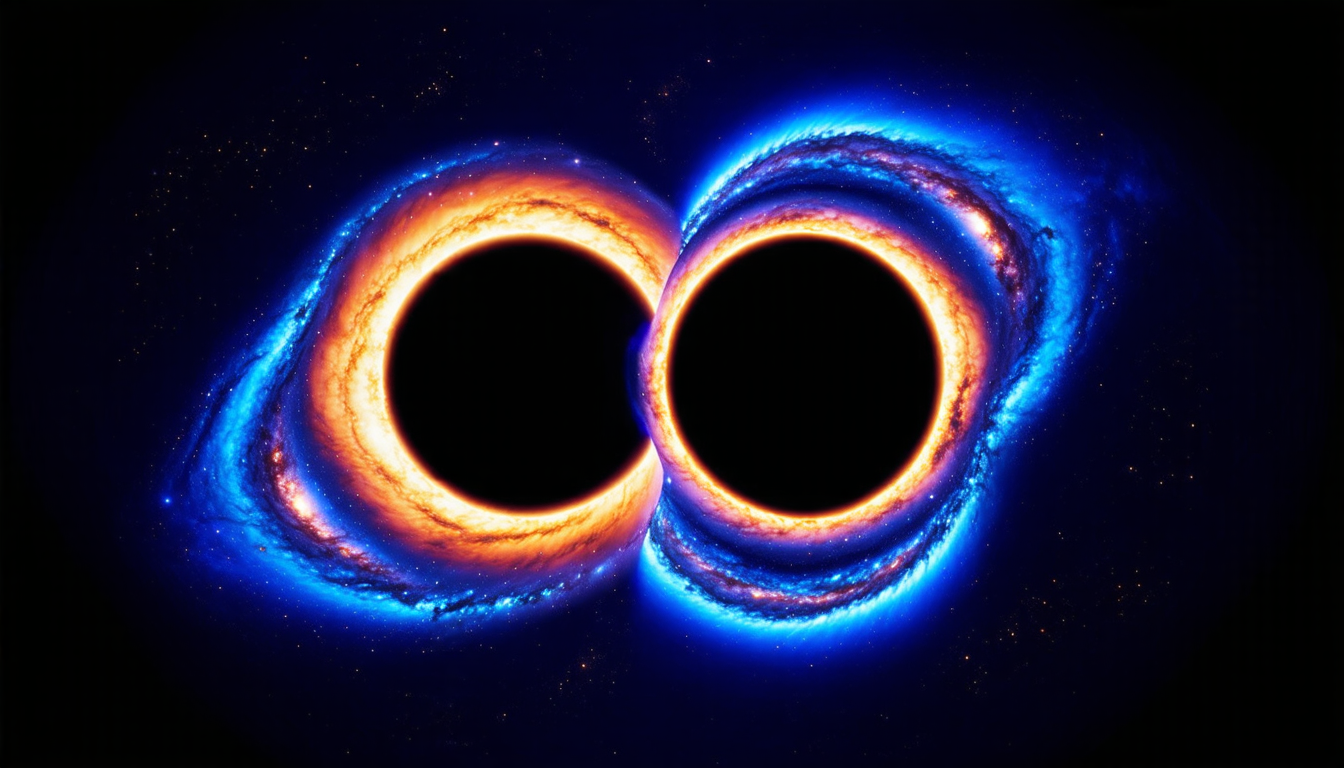
A team of researchers has made a significant breakthrough in understanding the gravitational wave background (GWB) produced by massive black holes (MBHs). The study, published in a recent issue of a prestigious scientific journal, provides new insights into the formation and evolution of these cosmic monsters.
The GWB is a faint hum of energy that fills the universe, generated by the merger of MBHs. These mergers are thought to occur when galaxies collide and their central black holes combine. The resulting gravitational waves can be detected on Earth using advanced laser interferometers like LIGO and VIRGO.
The researchers used a state-of-the-art computer simulation called ASTRID to model the formation and evolution of MBHs in galaxy mergers. The simulation follows the growth of these massive objects over billions of years, taking into account various physical processes such as gas accretion, star formation, and gravitational radiation.
One of the key findings is that the GWB from MBH mergers is significantly larger than previously thought. The study suggests that a large fraction of the observed GWB can be attributed to these cosmic events. This has important implications for our understanding of galaxy evolution and the role played by MBHs in shaping the universe.
The researchers also investigated how the GWB changes with frequency. They found that the signal is strongest at low frequencies, which corresponds to longer wavelengths of gravitational radiation. This is consistent with previous observations and provides further evidence for the validity of the ASTRID simulation.
Another significant result is the identification of a new population of MBHs that are responsible for a large portion of the observed GWB. These objects are thought to be the remnants of earlier galaxy mergers, which have been stripped of their host galaxies through interactions with other galaxies or the intergalactic medium.
The study’s findings have significant implications for our understanding of the universe and its evolution. The detection of gravitational waves by LIGO and VIRGO has opened up a new window into the universe, allowing us to study cosmic events in ways that were previously impossible.
In addition to providing insights into galaxy evolution and MBH formation, the study also highlights the importance of continued research into the properties of gravitational radiation. As detectors like LIGO and VIRGO continue to improve in sensitivity, they will be able to detect even more distant and fainter sources of gravitational waves, allowing us to explore the universe in unprecedented detail.
Cite this article: “Unlocking the Secrets of Massive Black Holes and Gravitational Waves”, The Science Archive, 2025.
Gravitational Wave Background, Massive Black Holes, Galaxy Mergers, Ligo, Virgo, Gravitational Radiation, Computer Simulation, Astrid, Galaxy Evolution, Cosmic Events





