

Wednesday 19 March 2025
The intricate dance of numbers and shapes has long fascinated mathematicians, leading them down a rabbit hole of discovery and innovation. In recent years, researchers have been delving deeper into the realm of combinatorics, exploring the vast expanse of possibilities within the modular group.
At its core, combinatorics is concerned with counting and arranging objects in various ways, often with surprising results. The modular group, a fundamental concept in mathematics, is particularly well-suited to such explorations. This group, denoted by SL(2, Z), is comprised of 2×2 matrices with integer entries and determinant equal to one.
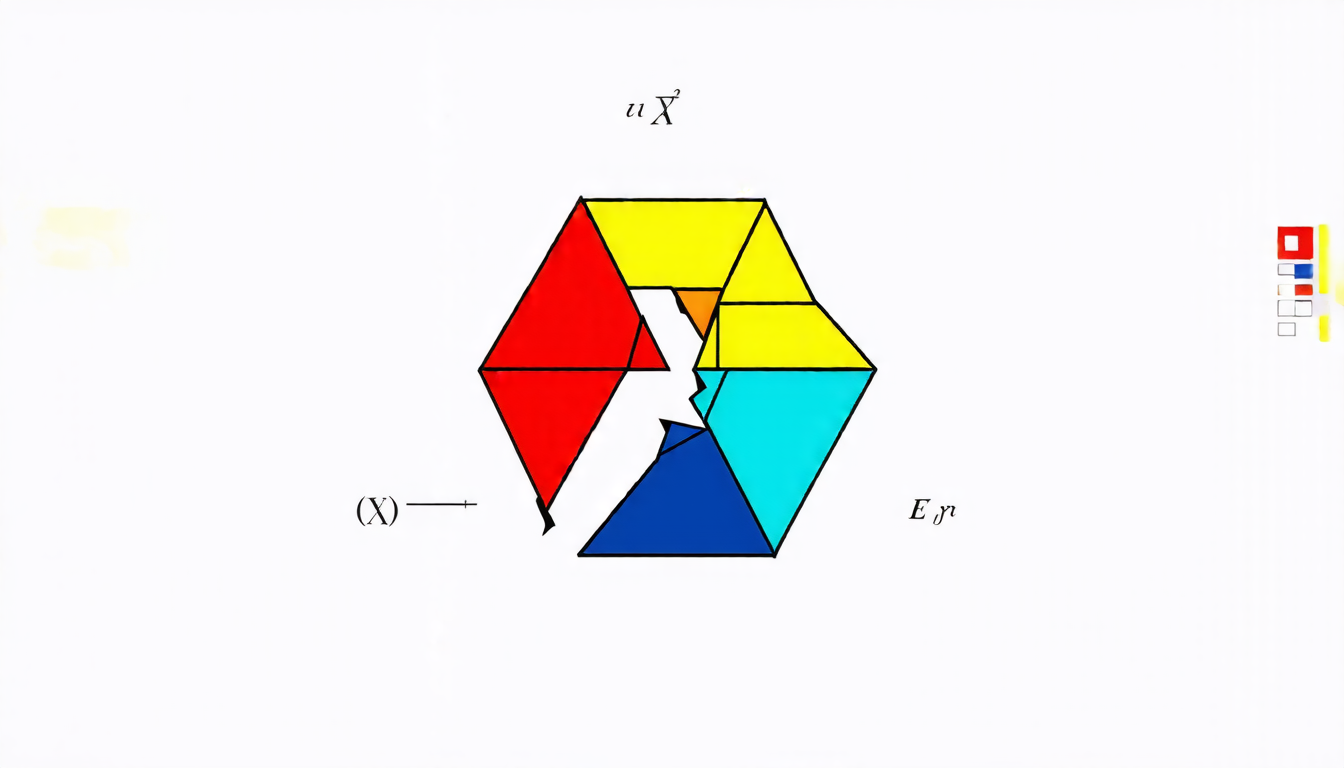
One fascinating aspect of the modular group is its relationship with polygon dissections. These dissections involve breaking down a polygon into smaller triangles or quadrilaterals, often in a specific pattern. Researchers have long sought to understand the properties of these dissections, particularly their connection to continued fractions and the modular group.
Recently, mathematicians have made significant strides in this area, shedding light on the intricate dance between numbers and shapes. By exploring the combinatorics of the modular group, they have uncovered novel ways to count and arrange polygon dissections.
One key discovery is the concept of λ- quiddities, which can be thought of as a way to describe the arrangement of triangles in a polygon dissection. These quiddities are precisely defined mathematical objects that capture the essence of the dissection’s structure.
The study of λ-quiddities has led researchers to develop novel algorithms for counting and arranging polygon dissections. These algorithms, in turn, have far-reaching implications for fields such as computer science and cryptography.
Furthermore, the research has also uncovered connections between the modular group and other areas of mathematics, including number theory and algebraic geometry. This interplay between disciplines is a hallmark of modern mathematics, where concepts from disparate fields are woven together to reveal new insights and understanding.
The study of combinatorics within the modular group is not only intellectually stimulating but also has practical applications. For instance, it can be used to develop more efficient algorithms for solving problems in computer science and cryptography.
As researchers continue to explore this fascinating realm, they are likely to uncover even more surprising connections and insights. The dance between numbers and shapes remains a powerful catalyst for innovation and discovery, driving us ever closer to the frontiers of human knowledge.
Cite this article: “Combinatorial Connections: Unraveling the Modular Groups Secrets”, The Science Archive, 2025.
Combinatorics, Modular Group, Polygon Dissections, Continued Fractions, Mathematics, Computer Science, Cryptography, Number Theory, Algebraic Geometry, Lambda Quiddities





