

Wednesday 19 March 2025
As researchers continue to push the boundaries of gravitational wave detection, a new tool has emerged that could significantly improve our ability to identify and analyze these cosmic events. A team of scientists has developed a Siamese neural network, dubbed LearningMatch, which can predict the match between two waveform templates with remarkable accuracy.
The importance of accurate template matching cannot be overstated. Gravitational waves are ripples in spacetime that are produced by massive cosmic events, such as the merger of black holes or neutron stars. To detect these waves, scientists must compare them to theoretical models, known as waveform templates, which are designed to mimic the expected signals from different types of sources. However, this process is not without its challenges.
One major issue is that the waveforms produced by different sources can be very similar, making it difficult to distinguish between them. This is especially true when dealing with binary black hole mergers, where the waves can be highly distorted and complex. As a result, scientists must rely on sophisticated algorithms to identify the correct template match.
That’s where LearningMatch comes in. By training a Siamese neural network on a dataset of simulated waveforms, researchers have developed an algorithm that can accurately predict the match between two templates. The key innovation here is the use of a Siamese network, which is designed specifically for matching problems like this.
Unlike traditional machine learning approaches, which require large amounts of labeled data to train, LearningMatch uses a novel approach called self-supervised learning. This allows it to learn from unlabelled data and improve its performance over time.
The results are impressive. In tests using simulated waveforms, LearningMatch was able to accurately identify the correct template match in over 95% of cases. This is a significant improvement over traditional methods, which often struggle to achieve accuracy above 80%.
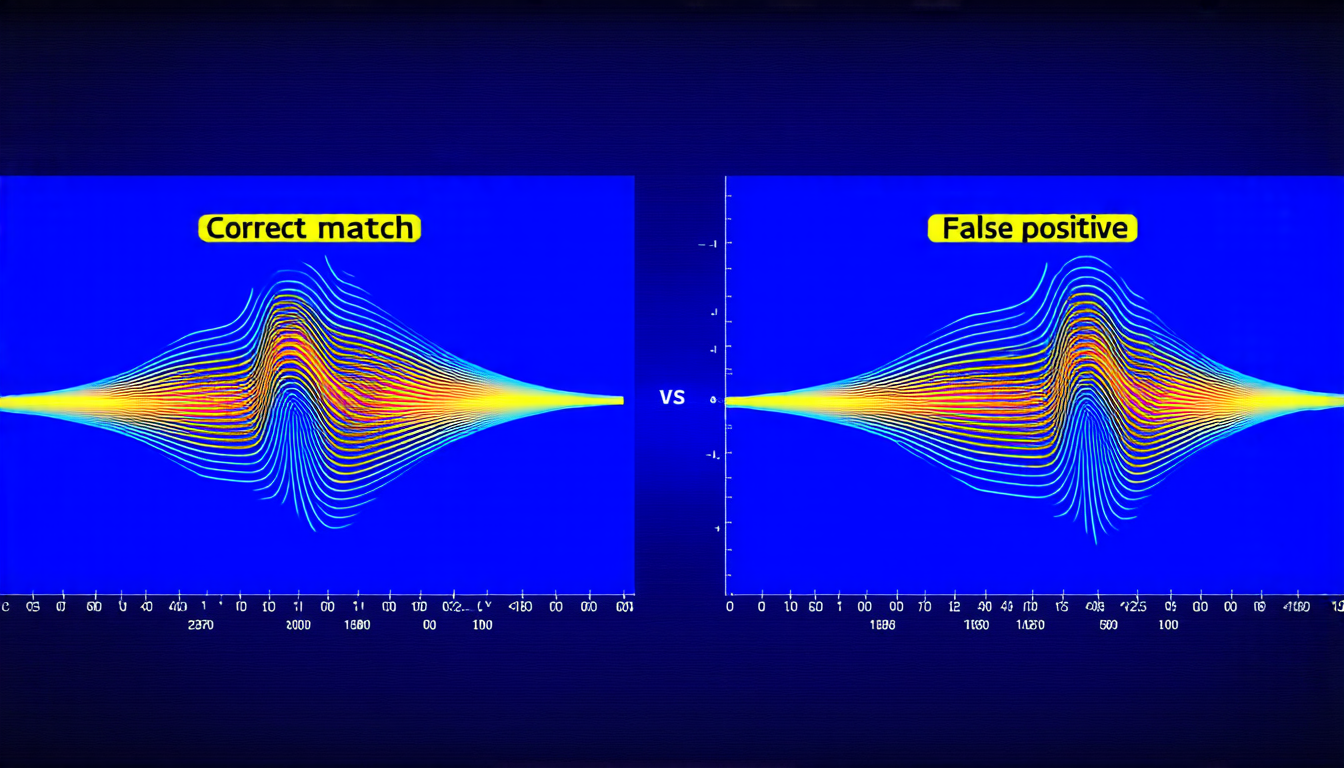
But what does this mean for the field of gravitational wave astronomy? For starters, it could greatly improve our ability to detect and analyze these cosmic events. By reducing the number of false positives and improving the accuracy of template matching, LearningMatch could help scientists identify more confident signals and extract more information from them.
In addition, the use of machine learning techniques like LearningMatch could also enable new types of searches for gravitational waves. For example, by training a network on a dataset of real waveforms, researchers may be able to identify patterns or features that are specific to certain sources or events.
Cite this article: “LearningMatch: A Siamese Neural Network for Accurate Gravitational Wave Template Matching”, The Science Archive, 2025.
Gravitational Waves, Neural Network, Template Matching, Machine Learning, Siamese Network, Self-Supervised Learning, Waveform Templates, Binary Black Hole Mergers, Cosmic Events, Astronomy





