

Wednesday 19 March 2025
The world of probability theory and stochastic processes is often shrouded in mystery, even for those with a background in mathematics. But researchers have been working tirelessly to demystify these concepts, making them more accessible and applicable to real-world problems.
A recent paper has taken a significant step forward in this endeavor by introducing new models of counting processes, which are used to describe the behavior of random events over time. These models are crucial in fields such as epidemiology, finance, and biology, where understanding the dynamics of complex systems is essential for making accurate predictions and informed decisions.
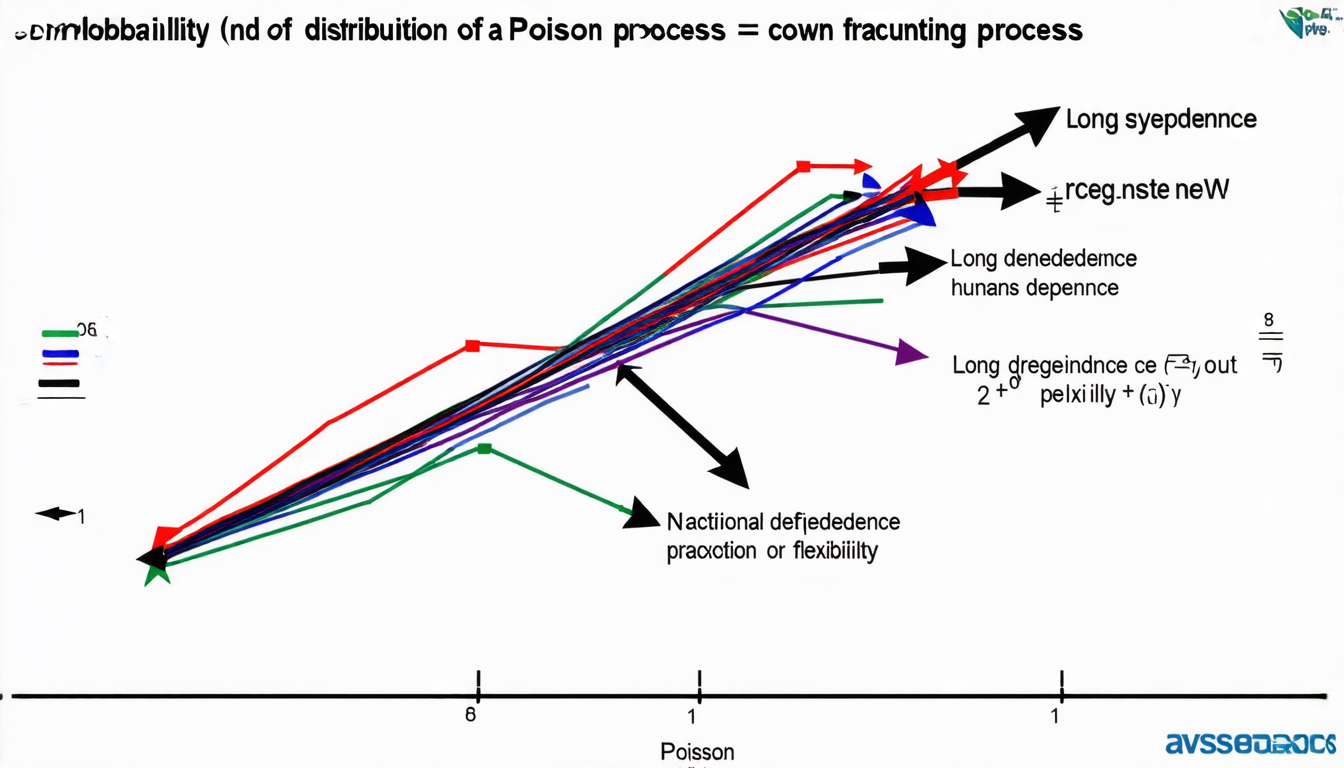
The authors of the paper have developed a new class of fractional counting processes, which can be thought of as a generalization of traditional Poisson processes. In a Poisson process, events occur at random times, with the probability of an event occurring in a given time interval being proportional to the length of that interval. Fractional counting processes, on the other hand, allow for more flexibility in modeling the behavior of events over time.
One of the key advantages of these new models is their ability to capture long-range dependence, which is a phenomenon where events that occur at distant times can still have an impact on each other. This is particularly important in fields such as finance, where understanding the relationships between seemingly unrelated events is crucial for predicting market fluctuations.
The authors have also developed methods for analyzing these new models, including formulas for calculating their probability distributions and moments. These formulas will be useful for researchers who want to apply these models to real-world problems, but don’t necessarily need to understand the underlying mathematical theory.
The potential applications of these new models are vast, from modeling the spread of diseases to understanding the behavior of financial markets. They could also be used to study complex biological systems, such as populations of animals or cells within an organism.
In addition to their practical applications, these models have also shed new light on some fundamental concepts in probability theory and stochastic processes. For example, they provide a new perspective on the relationship between time and probability, which is a topic that has puzzled researchers for centuries.
Overall, this paper represents a significant advance in our understanding of counting processes and their applications to real-world problems. It will likely have a lasting impact on fields such as finance, epidemiology, and biology, and will provide new tools and techniques for researchers who want to model complex systems.
Cite this article: “Advances in Counting Processes: New Models for Complex Systems”, The Science Archive, 2025.
Probability Theory, Stochastic Processes, Counting Processes, Poisson Process, Fractional Counting Processes, Long-Range Dependence, Financial Markets, Epidemiology, Biology, Probability Distributions





