

Wednesday 19 March 2025
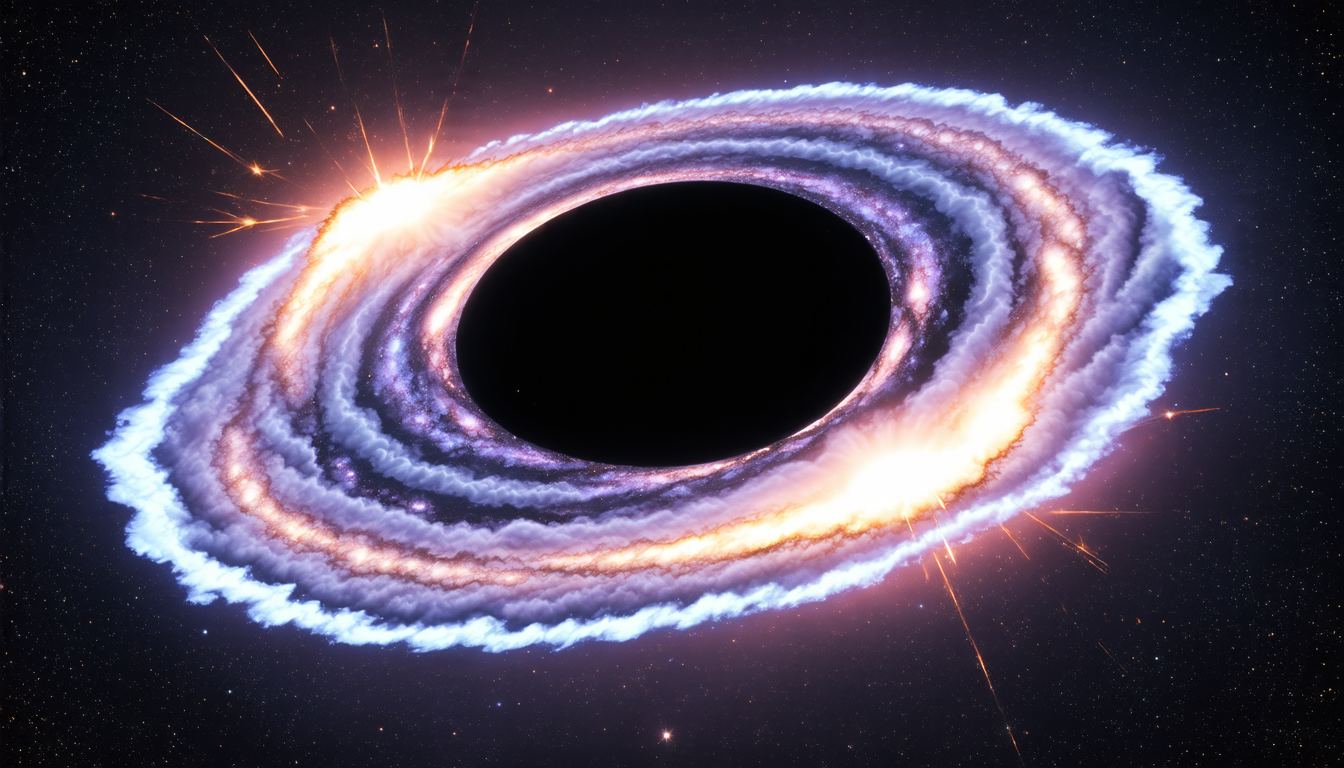
For nearly two decades, astronomers have been studying M31*, a supermassive black hole at the center of the Andromeda galaxy. Recently, researchers have made significant strides in understanding this enigmatic object’s behavior, shedding light on its unusual X-ray activity.
The observations began in 2009 using NASA’s Chandra X-ray Observatory. Initially, scientists thought M31* was exhibiting typical activity for a supermassive black hole of its size, with periods of high energy emission followed by quiescence. However, as more data became available, it became apparent that something was amiss.
In 2011, astronomers discovered that M31*’s X-ray output had increased significantly since the early observations. This surge in activity was unexpected, as supermassive black holes typically follow predictable patterns of behavior. The team proposed that this unusual behavior might be linked to a series of flares, which are intense bursts of energy emission.
Fast forward to 2024, and researchers have continued to monitor M31*’s X-ray activity using Chandra. Their latest findings suggest that the supermassive black hole has remained in an elevated state since the initial surge in 2011. This prolonged period of high energy emission is unprecedented for a black hole of this type.
One particularly interesting observation was made in 2013, when M31* exhibited a moderate flare, with its X-ray output increasing by a factor of five compared to typical quiescent periods. During this event, the other nuclear sources in the Andromeda galaxy’s nucleus were in low flux states, allowing researchers to isolate the emission from M31*. By analyzing the spectrum of this flare, scientists were able to rule out non-thermal processes and instead attribute it to amplifications of typical X-ray emission mechanisms.
The implications of these findings are significant. They suggest that M31*’s unusual behavior may be linked to its mass, which is approximately one-tenth that of the supermassive black hole at the center of our own galaxy, Sagittarius A*. This disparity could be influencing the way energy is released from M31*, leading to the observed fluctuations in X-ray activity.
Further study is needed to fully understand the mechanisms driving M31*’s behavior. However, these latest findings have already provided valuable insights into the complex dynamics of supermassive black holes.
Cite this article: “Unraveling the Enigma of M31: A Supermassive Black Holes Unusual Behavior”, The Science Archive, 2025.
Here Are The Relevant Keywords: Supermassive Black Hole, Andromeda Galaxy, M31*, X-Ray Activity, Nasa’S Chandra X-Ray Observatory, Flares, Energy Emission, Quiescence, Sagittarius A*, Galactic Nucleus





