

Wednesday 19 March 2025
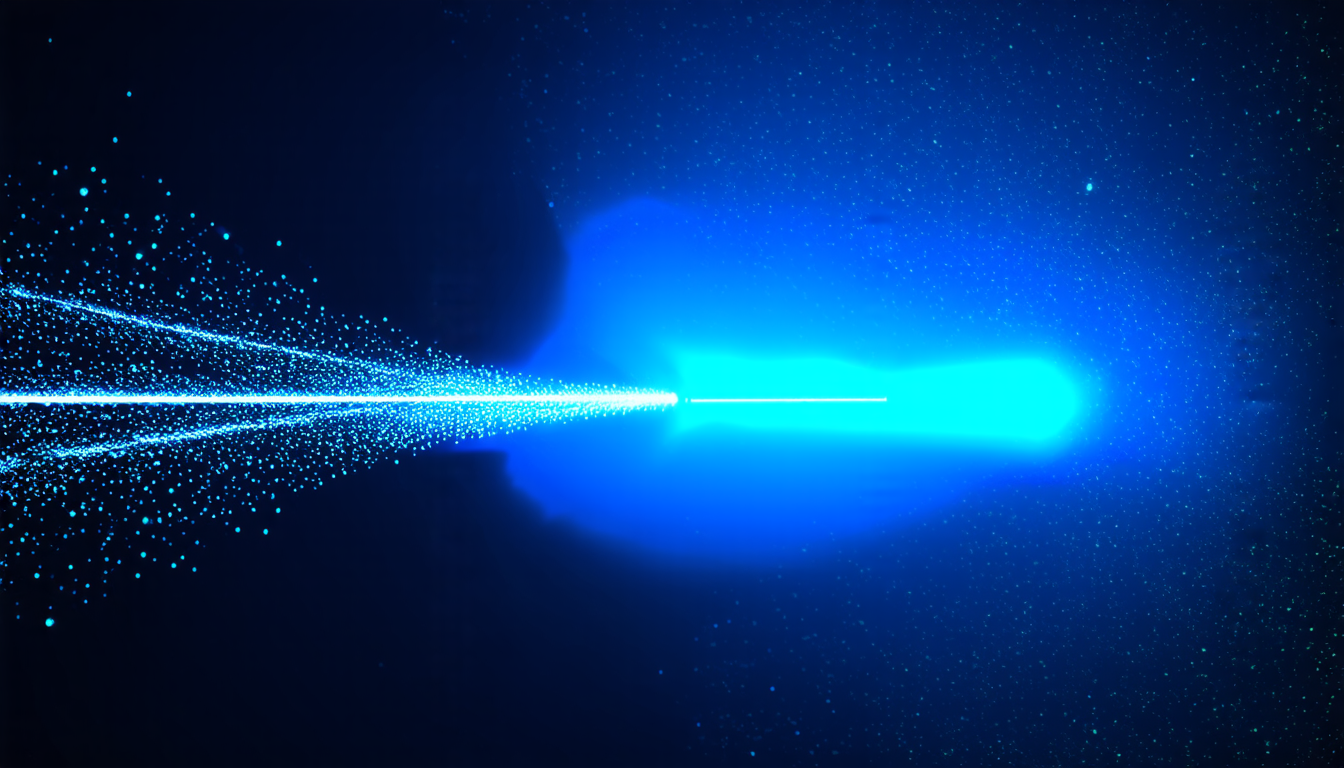
Scientists have long been fascinated by the phenomenon of air lasing, where a high-powered laser beam can create a glowing filament in the air that can emit coherent light. Now, researchers have made a significant breakthrough in understanding how this process works.
For years, scientists have debated whether the filament’s emission is seeded by a self-generated spectral component, such as the second harmonic of the driving field. The prevailing view was that the second harmonic generated by the charge gradient in the laser plasma filament seeds the lasing process. However, new research has shed light on this long-standing mystery.
Using advanced techniques to generate radially and azimuthally polarized beams, scientists have been able to study the properties of the filament’s emission in unprecedented detail. By analyzing the spatial phase distribution of the emitted light, researchers found that the phase of the lasing is synchronized with the driving field, ruling out self-seeding by the second harmonic.
This discovery has significant implications for our understanding of air lasing and its potential applications. The ability to remotely generate ultraviolet light fields with customized profiles could have a major impact on various fields, from remote sensing to medicine.
The research also highlights the importance of structured light in driving the lasing process. By generating beams with specific polarization patterns, scientists can control the properties of the emitted light and tailor it to specific applications.
In addition to advancing our understanding of air lasing, this breakthrough could also have practical implications for a range of fields. For example, the ability to generate ultraviolet light fields with customized profiles could be used in medical treatments, such as skin rejuvenation or cancer therapy.
The study’s findings also underscore the importance of interdisciplinary research, bringing together experts from physics, optics, and materials science to tackle complex problems. The collaboration has yielded a deeper understanding of air lasing and its potential applications, opening up new avenues for research and innovation.
Cite this article: “Unlocking the Secrets of Air Lasing: A Breakthrough in Understanding the Process”, The Science Archive, 2025.
Laser, Air Lasing, Filament, Emission, Coherent Light, Second Harmonic, Polarized Beams, Spatial Phase Distribution, Ultraviolet Light, Interdisciplinary Research





