
Wednesday 19 March 2025
A new way of understanding four-dimensional space has been discovered by mathematicians, who have found a connection between three different methods for representing these complex structures.
Four-dimensional space is difficult to visualize and understand because it is beyond our everyday experience of three dimensions. However, scientists use mathematical models to represent these spaces and study their properties. In this case, the researchers used three distinct approaches: Kirby diagrams, trisections, and gems.
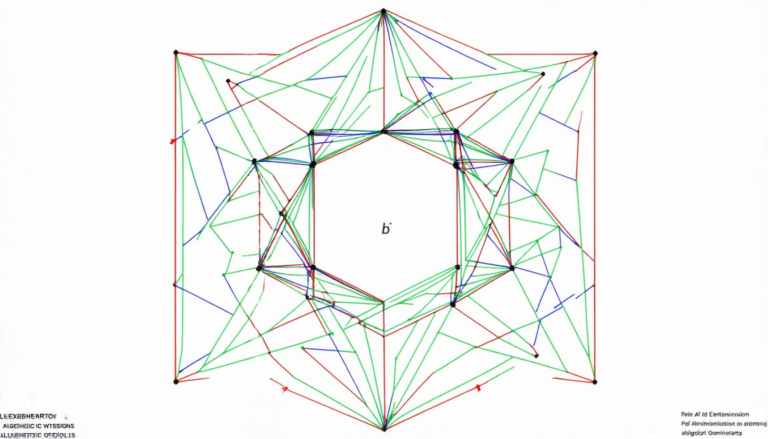
Kirby diagrams are a way of representing four-dimensional manifolds as a collection of handles that can be added or removed. Trisections, on the other hand, involve dividing a four-dimensional space into three simpler parts, which can then be combined to form the original structure. Gems, meanwhile, are a type of graph that represents a four-dimensional manifold using colored edges and vertices.
The researchers found that these three approaches are not only distinct but also interconnected. They showed that Kirby diagrams can be used to create trisections, and that trisections can be used to construct gems. This connection allows mathematicians to move seamlessly between the different methods, gaining new insights into the properties of four-dimensional spaces.
One of the key findings is that the number of handles in a Kirby diagram, known as its genus, is related to the number of cycles in a gem’s colored graph. This means that by studying gems and their cycles, mathematicians can gain information about the handle structure of a four-dimensional manifold.
The connection between these approaches has far-reaching implications for our understanding of four-dimensional space. For example, it could help scientists develop new methods for classifying four-dimensional manifolds, which is crucial for applications in fields such as physics and engineering.
Moreover, the study highlights the power of interdisciplinary collaboration between mathematicians and computer scientists. The researchers used computational tools to analyze large datasets of gems and trisections, providing valuable insights into their properties.
The discovery also has potential implications for our understanding of the fundamental laws of physics. In theoretical physics, four-dimensional space is thought to play a crucial role in describing phenomena such as gravity and electromagnetism. By better understanding these complex structures, scientists may be able to develop new theories that unify different forces of nature.
As researchers continue to explore the connections between Kirby diagrams, trisections, and gems, they are likely to uncover even more surprising relationships and insights into four-dimensional space.
Cite this article: “Unraveling the Fabric of Four-Dimensional Space”, The Science Archive, 2025.
Four-Dimensional Space, Kirby Diagrams, Trisections, Gems, Manifolds, Handles, Genus, Cycles, Graph Theory, Computational Geometry