

Wednesday 19 March 2025
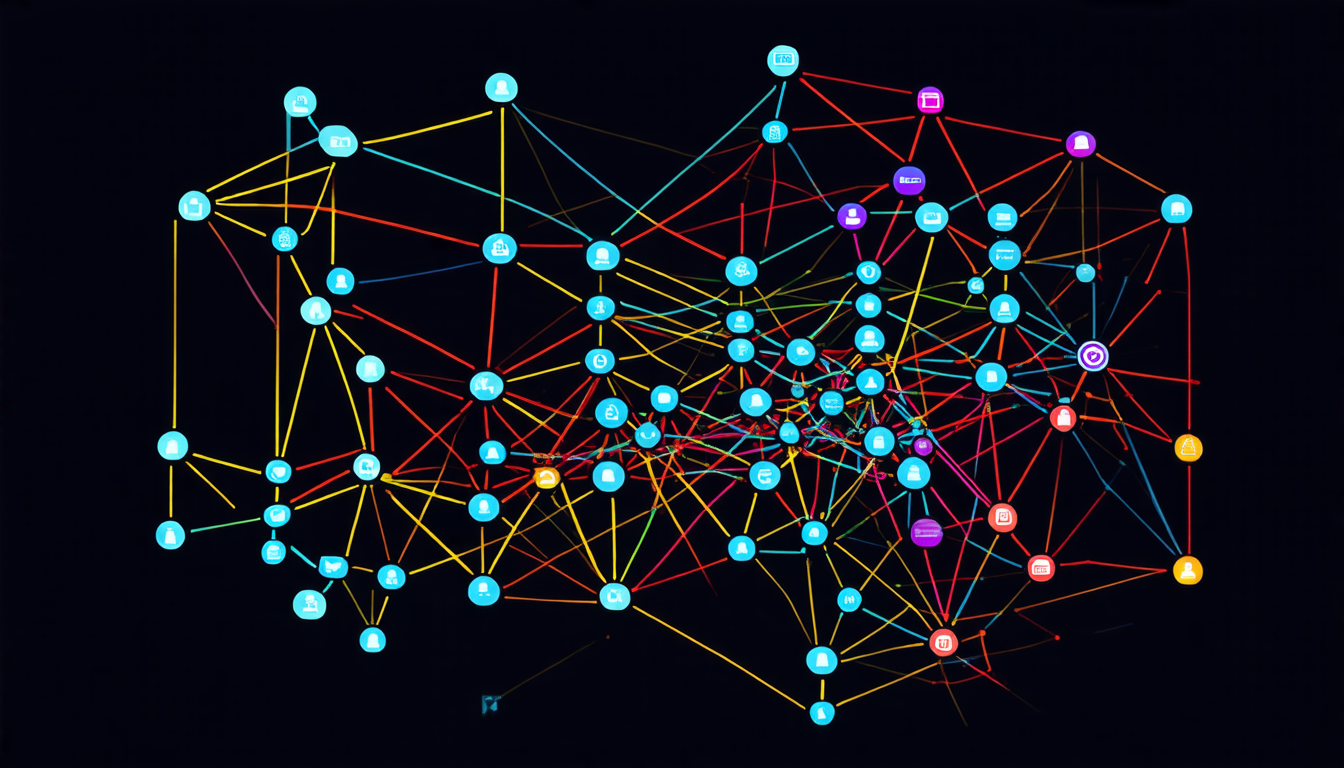
Scientists have made a significant breakthrough in understanding how computers can better analyze complex networks, like social media or biological systems. A team of researchers has developed a new approach that uses reinforcement learning to help machines identify important patterns and relationships within these networks.
Reinforcement learning is a type of artificial intelligence that involves trial and error. In this case, the AI is trained to navigate through the network, making decisions about what substructures (small groups of nodes) are most relevant and worth exploring further. The goal is to identify the most informative patterns, which can then be used to improve our understanding of the system as a whole.
The approach is called the Reinforcement Walk Exploration Subgraph Neural Network, or RWE-SGNN for short. It’s an innovative solution that combines two existing techniques: graph neural networks and reinforcement learning. Graph neural networks are designed to analyze complex networks by identifying patterns and relationships between nodes (individual units within the network). Reinforcement learning is used to train the AI to make decisions about which substructures to explore.
The RWE-SGNN works by generating a random walk through the network, starting from an initial node. At each step, the AI evaluates the substructure it has encountered and decides whether to continue exploring or move on to a new path. The goal is to identify the most informative patterns, which can then be used to improve our understanding of the system as a whole.
The researchers tested their approach on several real-world datasets, including social media networks and biological systems. They found that RWE-SGNN outperformed existing methods in identifying important patterns and relationships within these networks. The results have significant implications for fields such as social network analysis, biology, and finance.
One of the key benefits of RWE-SGNN is its ability to explain complex phenomena by identifying the most relevant substructures. This can help us better understand how systems work and make more informed decisions. For example, in biology, RWE-SGNN could be used to identify important protein-protein interactions that are linked to disease.
The researchers believe that their approach has the potential to revolutionize our understanding of complex networks and lead to significant breakthroughs in various fields. By combining reinforcement learning with graph neural networks, they have created a powerful tool for analyzing and understanding complex systems.
In the future, the RWE-SGNN could be used to analyze even more complex networks, such as those found in finance or transportation systems.
Cite this article: “Unlocking Complex Networks with Reinforcement Learning”, The Science Archive, 2025.
Artificial Intelligence, Reinforcement Learning, Graph Neural Networks, Complex Networks, Social Media, Biology, Finance, Protein-Protein Interactions, Disease, Network Analysis





