

Thursday 20 March 2025
The scientists have made a significant breakthrough in understanding the dynamics of moving fronts in three-dimensional spaces. The phenomenon is observed in various natural processes, including oil production, fire spread, and acoustic waves. Researchers have been studying this topic for years, but the complexity of the problem has hindered progress.
Recently, a team of mathematicians has developed an innovative approach to tackle this issue. They used asymptotic expansions to decompose the original equation into two sub-problems, which enabled them to identify the outer functions. This technique allowed them to establish the location of the transition layer and describe the solution across the full domain of the problem.
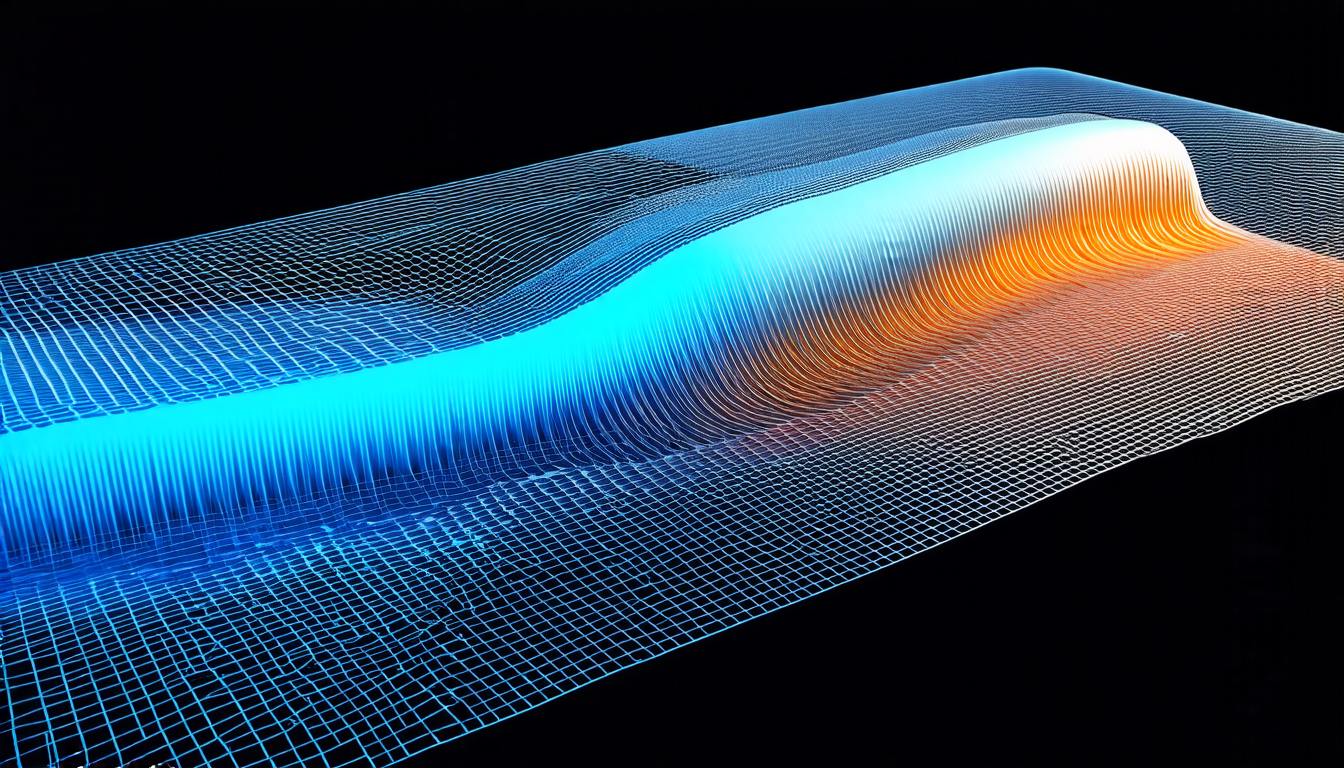
The researchers tested their method by analyzing a three-dimensional reaction-diffusion-advection differential equation. They found that the asymptotic solution accurately predicted the behavior of the moving front, which was confirmed through numerical simulations. The results showed that the method can be effectively used to solve problems involving complex dynamics in three-dimensional spaces.
One of the key advantages of this approach is its ability to handle singular perturbations, which are common in physical systems. Singular perturbations occur when a small parameter in an equation has a significant impact on the solution. In the past, solving such problems was challenging due to the lack of effective methods.
The researchers’ technique involves using local coordinates to focus on the transition layer, where the solution undergoes rapid changes. They were able to establish all coefficients of the representations of the upper and lower functions up to a desired level of accuracy. This approach allowed them to accurately predict the behavior of the moving front and describe the solution across the full domain of the problem.
The scientists also validated their method by comparing it with numerical simulations at two specific instances, t1 = 0.2 and t2 = 0.6. The relative error was calculated for both cases, and the results showed that the asymptotic solution accurately predicted the behavior of the moving front. This validation demonstrates the effectiveness of the researchers’ approach in solving complex problems involving three-dimensional dynamics.
The findings of this study have significant implications for various fields, including physics, chemistry, and engineering. The method developed by the researchers can be applied to a wide range of problems that involve singular perturbations and complex dynamics in three-dimensional spaces. This breakthrough has the potential to advance our understanding of natural phenomena and lead to new discoveries.
The research team’s innovative approach has opened up new avenues for studying complex systems.
Cite this article: “Unveiling Complex Dynamics in Three-Dimensional Spaces: A Breakthrough Approach to Solving Singular Perturbation Problems”, The Science Archive, 2025.
Mathematics, Three-Dimensional Spaces, Asymptotic Expansions, Reaction-Diffusion-Advection, Differential Equations, Singular Perturbations, Transition Layer, Numerical Simulations, Physics, Chemistry, Engineering.





