

Thursday 20 March 2025
Neutron stars are some of the most extreme objects in the universe, with densities that are millions of times greater than those found on Earth. These cosmic wonders are formed when a massive star runs out of fuel and collapses under its own gravity, causing a massive explosion that can be seen from millions of light-years away.
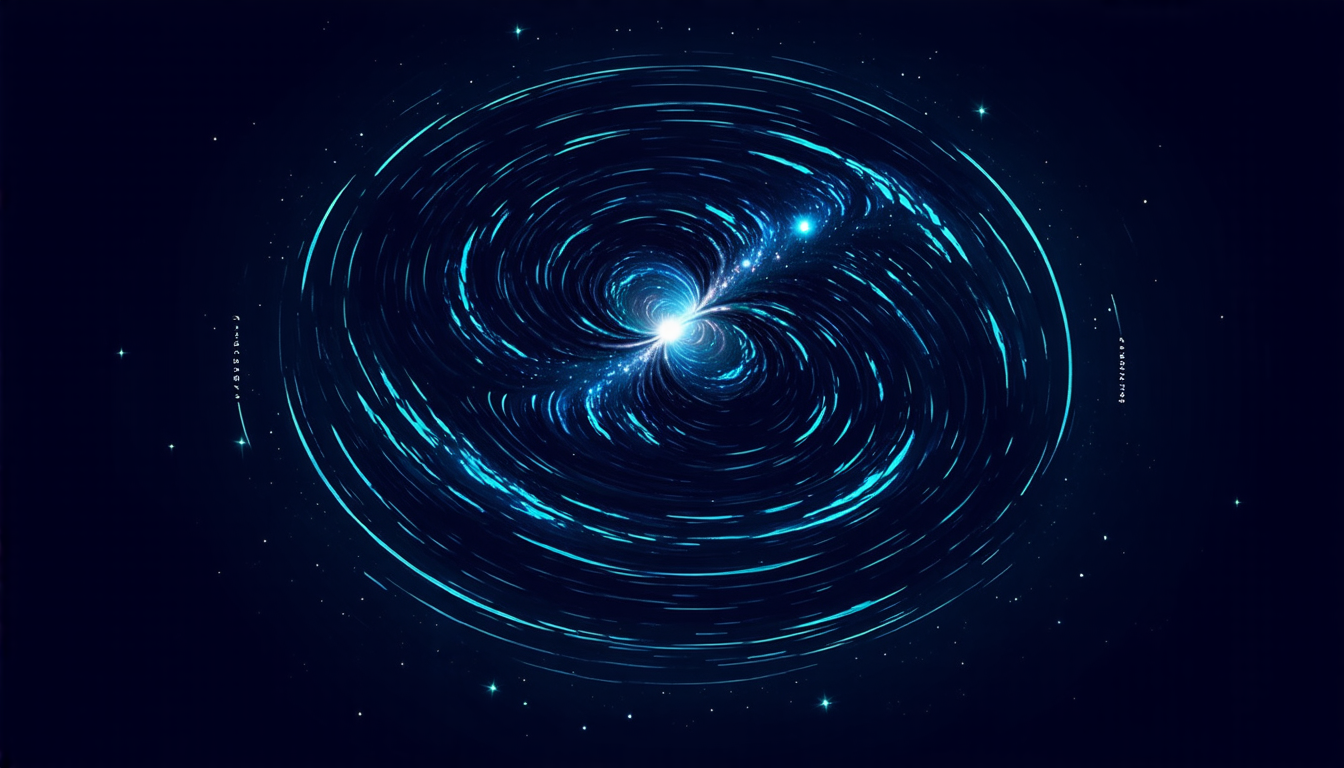
Despite their incredible density, neutron stars are surprisingly complex and dynamic objects. They have strong magnetic fields and rotate rapidly, which causes them to emit intense beams of radiation that sweep through space like lighthouses. These beams can interact with nearby matter, causing it to heat up and glow brightly in a process known as pulsar emission.
Recently, scientists have discovered a new way to study these extraordinary objects using gravitational waves, ripples in the fabric of spacetime that were predicted by Einstein’s theory of general relativity. Gravitational waves are produced when massive objects collide or merge, such as when two black holes or neutron stars come together.
The detection of these waves has opened up a new window into the universe, allowing scientists to study cosmic events in ways that were previously impossible. One of the most exciting applications of gravitational wave astronomy is the ability to study the properties of neutron stars themselves.
Neutron stars are incredibly dense objects, with some having masses similar to those of small cities. They are thought to be composed primarily of neutrons, which are the building blocks of atomic nuclei. However, their interiors can also contain other exotic particles, such as quarks and muons.
Scientists have long been interested in studying these particles, as they could provide valuable insights into the fundamental laws of physics that govern the universe. However, until now, it has been difficult to study these objects directly, as they are located far from Earth and are surrounded by intense radiation that makes it hard for telescopes to observe them.
The detection of gravitational waves from neutron star collisions has changed all this. By studying the ripples in spacetime produced when these stars collide, scientists can learn more about their properties and composition. This information can then be used to improve our understanding of the fundamental laws of physics that govern the universe.
One of the most exciting aspects of this research is the potential to study the properties of neutron star matter itself. This matter is thought to be incredibly dense and exotic, with properties that are far removed from those found on Earth. By studying the gravitational waves produced when two neutron stars collide, scientists can learn more about the composition and properties of this mysterious material.
Cite this article: “Unveiling the Secrets of Neutron Stars through Gravitational Waves”, The Science Archive, 2025.
Neutron Stars, Gravitational Waves, General Relativity, Einstein, Astronomy, Cosmic Events, Spacetime, Radiation, Quarks, Muons





