

Thursday 20 March 2025
Deep learning models have revolutionized our ability to analyze complex data sets, but they often struggle when faced with irregularly shaped and noisy data, such as those found in particle physics experiments. In recent years, researchers have turned to masked autoencoders (MAEs) to improve the performance of these models, but even MAEs have limitations when dealing with the unique challenges posed by particle trajectory data.
Now, a team of scientists has developed a new approach that leverages the strengths of both MAEs and point cloud processing techniques to create a more robust and effective method for analyzing particle trajectories. The key innovation is the use of a novel grouping strategy called Centrality-based Non-Maximum Suppression (C- NMS), which adaptively selects group centers based on their centrality in the data.
The researchers’ approach, dubbed PoLAr-MAE, uses C-NMS to create groups of points that are more likely to represent coherent particle trajectories. This is achieved by iteratively selecting group centers and suppressing overlapping candidates, resulting in a set of well-defined and isolated groups that can be used as input for the MAE.
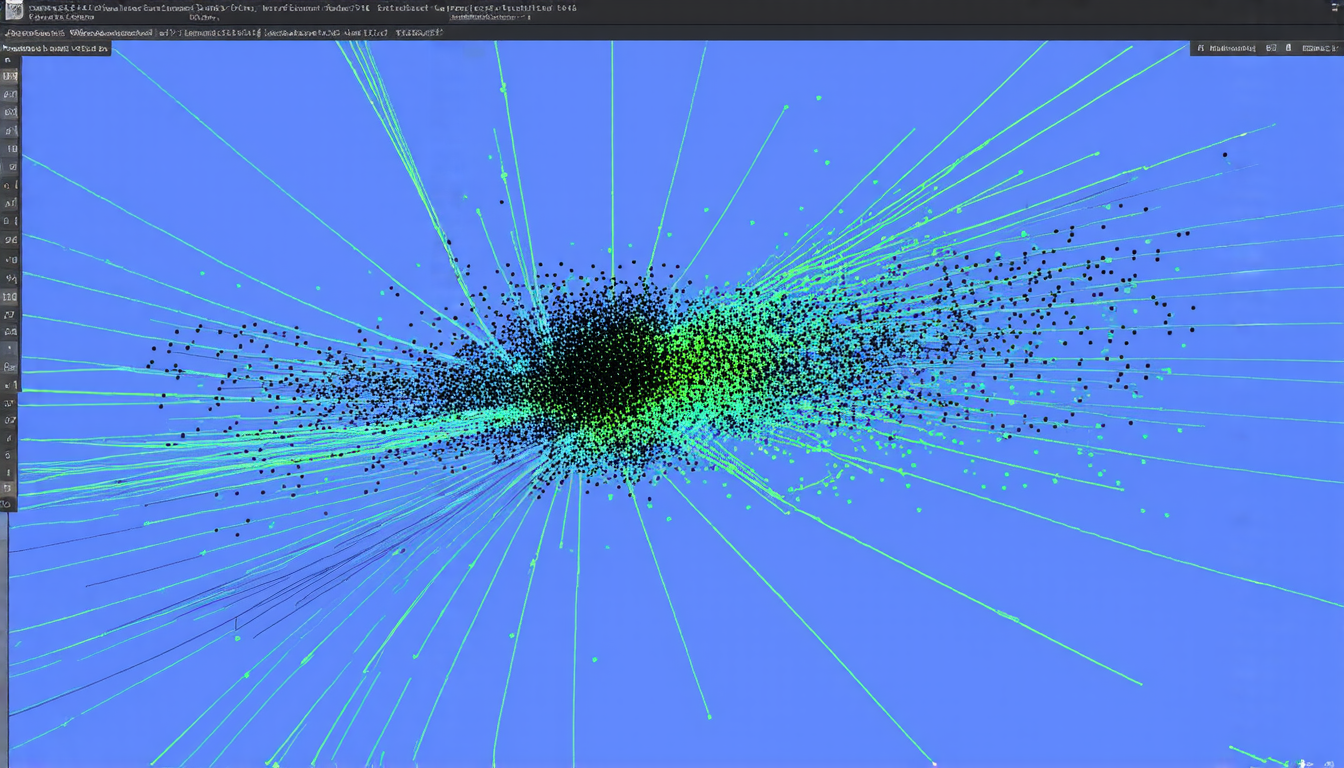
The team evaluated their approach using a large dataset of particle trajectory data from LArTPC experiments. They found that PoLAr-MAE outperformed traditional MAEs by achieving better semantic segmentation results and lower rates of missed points and duplicated points. The improved performance was also accompanied by more accurate predictions for particle types, such as tracks, showers, and delta rays.
One of the key advantages of PoLAr-MAE is its ability to handle the complex and irregular structure of particle trajectories. By using C-NMS to group points based on their centrality, the model can effectively capture the underlying patterns and relationships in the data, even when faced with noisy or incomplete information.
The researchers also explored alternative approaches to improving the performance of MAEs on particle trajectory data. These included energy normalization and embedding, handling stochasticity in LArTPC events, and enforcing sub-token semantics. However, these efforts ultimately proved unsuccessful, highlighting the importance of the C-NMS grouping strategy in achieving better results.
Overall, the development of PoLAr-MAE represents a significant step forward in the application of deep learning techniques to particle physics experiments. By leveraging the strengths of both MAEs and point cloud processing, this approach has the potential to improve our understanding of complex physical phenomena and accelerate the discovery of new particles and forces.
Cite this article: “Robust Particle Trajectory Analysis with Centrality-Based Non-Maximum Suppression”, The Science Archive, 2025.
Particle Physics, Deep Learning, Masked Autoencoders, Particle Trajectories, Lartpc Experiments, Polar-Mae, Centrality-Based Non-Maximum Suppression, Point Cloud Processing, Semantic Segmentation, Machine Learning.





