

Thursday 20 March 2025
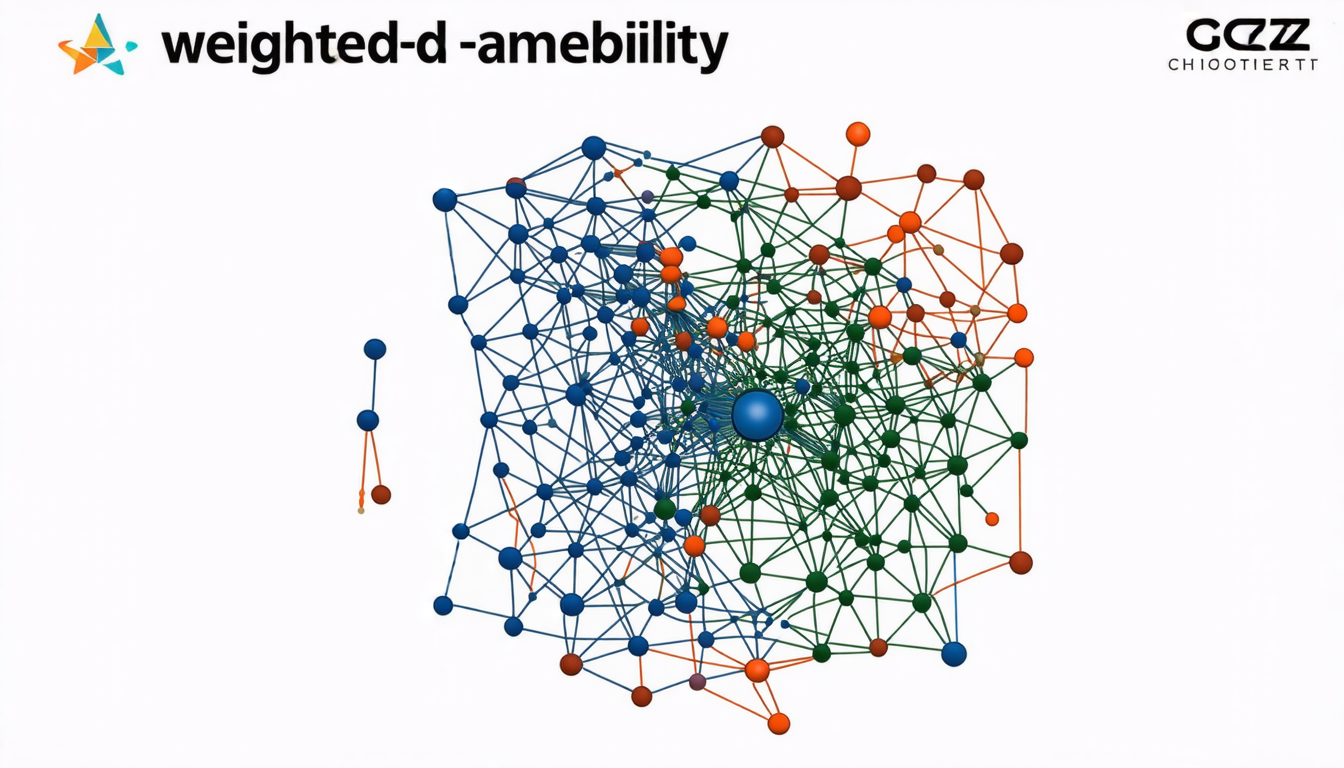
The intricate dance of probability and geometry has long fascinated mathematicians, particularly when it comes to understanding percolation theory. Percolation is a fundamental concept in statistical physics that describes the behavior of random connections between particles or sites on a lattice. Think of it like a game where you randomly connect dots on a piece of paper, and then ask if there’s a path from one end to the other.
Recently, researchers have made significant progress in understanding percolation on complex networks, such as those found in social media, biological systems, or even computer networks. The key challenge lies in finding patterns and structures within these networks that can help predict behavior under different conditions. In this article, we’ll delve into a recent study that sheds new light on the connection between percolation theory and weighted-amenable graphs.
Amenable graphs are a type of graph where the probability of traversing from one node to another is proportional to the weight assigned to each edge. Weighted-amenable graphs take it a step further by incorporating weights into the structure of the graph itself, allowing for more nuanced exploration of percolation behavior. The study in question focuses on the critical percolation threshold, where the probability of finding an infinite cluster (a connected path from one end to the other) is precisely 1.
The researchers used a combination of mathematical techniques, including group theory and probability theory, to analyze the behavior of weighted-amenable graphs under different conditions. They found that the critical percolation threshold is closely tied to the spectral radius of the graph, which describes how fast information spreads through the network. This connection has significant implications for understanding percolation on complex networks.
One of the most intriguing results from this study is that the critical percolation threshold can be significantly affected by the weights assigned to edges in the graph. This means that even small changes to the weight distribution can have a profound impact on the behavior of the network under different conditions. This finding has important implications for applications such as traffic flow, social network analysis, or even epidemiology.
The study also highlights the importance of considering non-unimodular graphs, which are networks where the probability of traversing from one node to another is not uniform. These types of graphs can exhibit unique behavior that’s different from traditional unimodular graphs, and this study provides valuable insights into understanding these differences.
Overall, this research has significant implications for our understanding of percolation theory on complex networks.
Cite this article: “Uncovering the Secrets of Percolation Theory in Weighted-Amenable Graphs”, The Science Archive, 2025.
Percolation, Weighted-Amenable Graphs, Graph Theory, Probability Theory, Critical Percolation Threshold, Spectral Radius, Network Analysis, Traffic Flow, Social Networks, Epidemiology
Reference: Grigory Terlov, Ádám Timár, “Weighted-amenability and percolation” (2025).





