

Thursday 20 March 2025
Researchers have made a significant breakthrough in understanding the behavior of random quantum systems, shedding light on the mysteries of quantum diffusion and localization. The discovery, published recently in a scientific paper, has far-reaching implications for our comprehension of the fundamental principles governing quantum mechanics.
The researchers’ work focuses on the study of quantum systems, where particles interact with each other in complex ways. In these systems, the behavior of individual particles is influenced by the interactions with their surroundings, leading to fascinating phenomena such as quantum diffusion and localization.
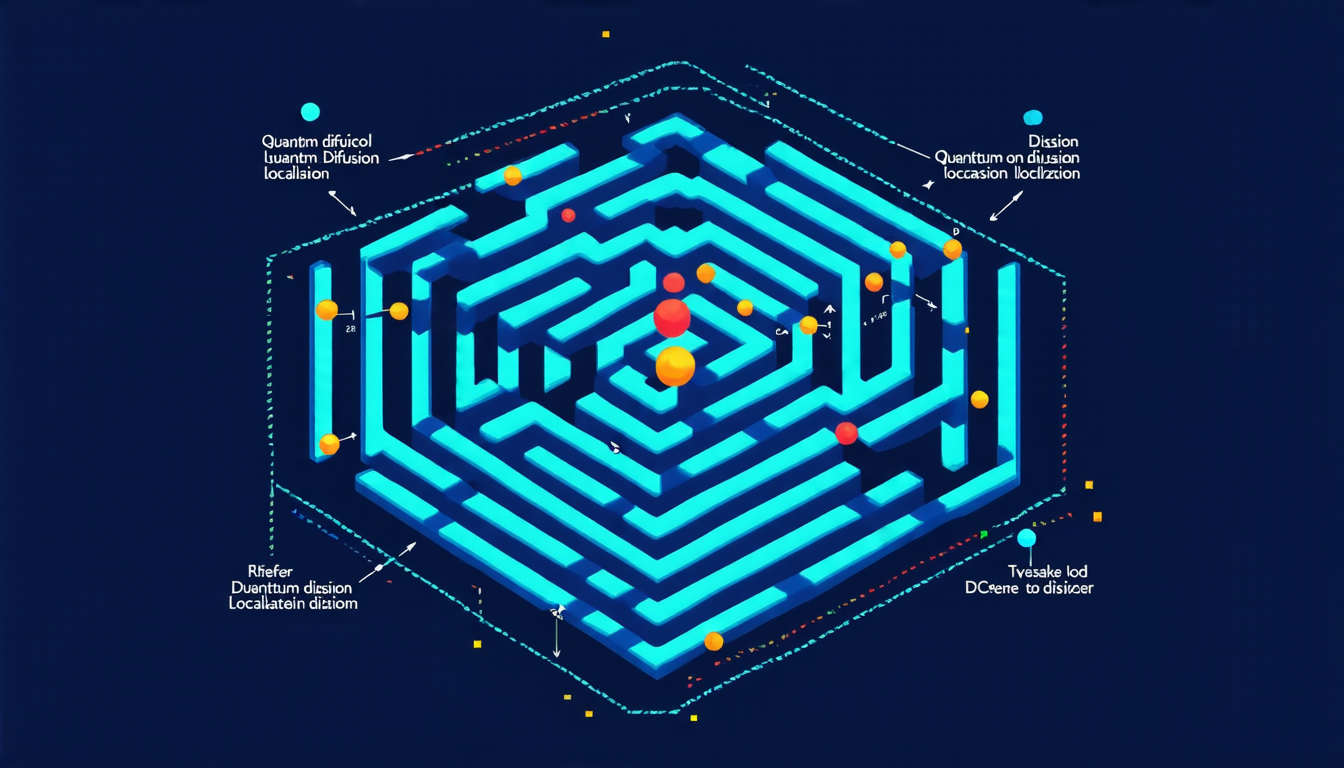
Quantum diffusion refers to the way in which particles move through a quantum system, spreading out over time due to the interactions with their environment. This process is crucial for understanding many physical phenomena, from superconductivity to superfluidity. On the other hand, localization occurs when particles become trapped in specific regions of the system, unable to move freely.
The researchers’ approach involves analyzing the behavior of these quantum systems using a combination of mathematical techniques and numerical simulations. By studying the properties of these systems, they were able to uncover new insights into the underlying mechanisms driving quantum diffusion and localization.
One of the key findings is that quantum diffusion can be understood as a result of the interplay between two competing processes: the spreading out of particles due to their interactions with the environment, and the localization of particles in specific regions. This interplay leads to the formation of complex patterns and structures, which are characteristic of many quantum systems.
The researchers also found that the transition from diffusion to localization can be understood as a phase transition, similar to those observed in classical systems. This has important implications for our understanding of quantum critical phenomena, where small changes in the system’s parameters can lead to dramatic changes in its behavior.
The study has significant potential applications in various fields, including materials science and condensed matter physics. By better understanding the underlying mechanisms driving quantum diffusion and localization, researchers may be able to design new materials with unique properties, such as superconductors or superfluids.
Furthermore, the discovery can shed light on the mysteries of quantum gravity, where the principles of general relativity meet those of quantum mechanics. The study’s findings could provide valuable insights into the behavior of particles in extreme environments, such as those found near black holes or during the early universe’s Big Bang.
The researchers’ work represents a significant step forward in our understanding of quantum systems, offering new perspectives on the complex phenomena governing their behavior.
Cite this article: “Unlocking the Secrets of Quantum Diffusion and Localization”, The Science Archive, 2025.
Random Quantum Systems, Quantum Diffusion, Localization, Quantum Mechanics, Phase Transition, Critical Phenomena, Materials Science, Condensed Matter Physics, Superconductors, Superfluids





